
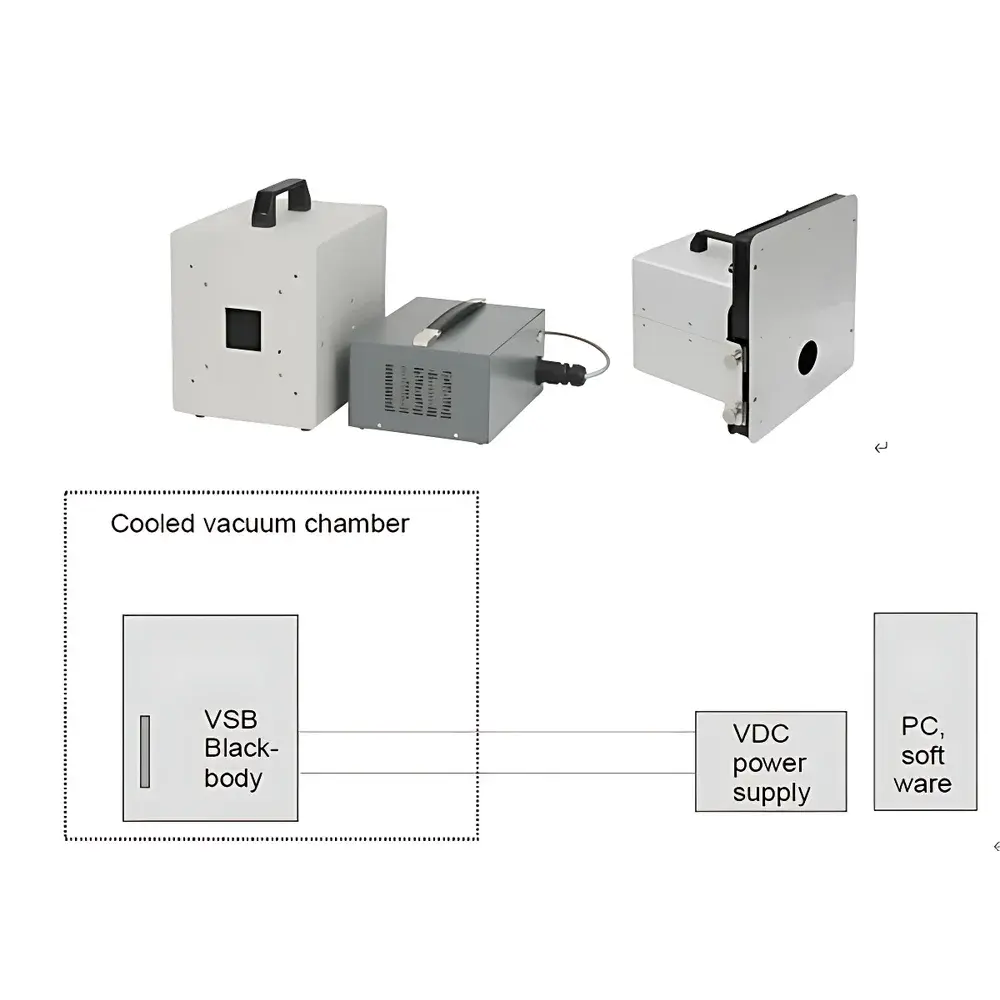
Inframet VSB Series Vacuum-Compatible Blackbody Source
| Brand | Inframet |
|---|---|
| Origin | Poland |
| Model | VSB |
| Aperture Options | 50×50 mm, 100×100 mm, 150×150 mm |
| Emitter Temp. Range | −10 °C to +200 °C (at ambient < −33 °C) |
| Operating Ambient Temp. Range | −173 °C to −33 °C (optional upper limit: −28 °C) |
| Setpoint Resolution | 0.001 °C |
| Emissivity | 0.96 ± 0.01 |
| Temp. Uncertainty | ±0.07 °C or ±0.002 × (T − 25) °C |
| Spatial Uniformity | >97% (central ≥90% of aperture area) |
| Stabilization Time | <15 min (from ±1 K to ±0.1 K tolerance) |
| Heating Rate | >20 °C/min (VSB-2D/VSB-4D), >15 °C/min (VSB-6D) |
| Cooling Rate | >3 °C/min (VSB-2D/VSB-4D), >2 °C/min (VSB-6D) |
| Regulation Stability | ±0.01 °C |
| Interface | RS-485 |
| Max. Control Cable Length | 50 m |
| Power | 115–230 VAC, 50/60 Hz |
| Storage Temp. | −10 °C to +60 °C |
| Dimensions | 10×23×25 cm (VSB-2D), 15×27×35 cm (VSB-6D) |
Overview
The Inframet VSB Series Vacuum-Compatible Blackbody Source is a precision-calibrated, cryogenic-capable infrared reference source engineered for radiometric calibration and performance verification of thermal imaging systems under simulated space environment conditions. Unlike conventional blackbodies operating at atmospheric pressure, the VSB is specifically designed to function inside high-vacuum chambers—down to 10−6 mbar—where ambient temperatures range from −173 °C (100 K, liquid nitrogen bath equivalent) to −33 °C (240 K), enabling realistic emulation of deep-space thermal backgrounds. Its core emitter operates stably between −10 °C and +200 °C, allowing users to generate well-defined, spectrally uniform mid-wave (MWIR) and long-wave (LWIR) infrared targets that correspond to terrestrial scene temperatures—such as cloud tops, planetary surfaces, or spacecraft thermal control elements—while immersed in cryogenic vacuum. The device employs a thermally isolated, actively controlled cavity structure with integrated Pt1000 sensors and multi-zone PID regulation to maintain traceable temperature stability and spatial uniformity across its calibrated aperture, satisfying the metrological requirements of ISO/IEC 17025-accredited calibration laboratories.
Key Features
- Vacuum-rated mechanical design compliant with UHV-compatible flange mounting (CF or KF options available); no outgassing materials used in emitter housing or thermal interface zones
- Three aperture configurations: 50×50 mm (VSB-2D), 100×100 mm (VSB-4D), and 150×150 mm (VSB-6D), each optimized for field-of-view matching with tactical, airborne, and spaceborne IR imagers
- High-emissivity cavity surface (ε = 0.96 ± 0.01, measured per ASTM E1933-19 Annex A2) with gold-plated copper walls and precision-machined conical geometry to minimize reflection artifacts
- Sub-millikelvin setpoint resolution (0.001 °C) and regulation stability of ±0.01 °C over 8-hour dwell periods, validated via NIST-traceable secondary standard thermometers
- Rapid thermal response: heating rates exceeding 20 °C/min (VSB-2D/VSB-4D) and 15 °C/min (VSB-6D); cooling rates >3 °C/min and >2 °C/min respectively—critical for dynamic calibration sequences
- RS-485 digital interface supporting Modbus RTU protocol for integration into automated test benches; firmware supports remote scripting of temperature ramps, dwell steps, and alarm thresholds
Sample Compatibility & Compliance
The VSB series is compatible with all major infrared test and evaluation platforms requiring vacuum-compatible reference sources, including cryogenic vacuum chambers equipped with optical viewports (CaF2, ZnSe, or sapphire windows), collimator-based test setups, and radiometric alignment stations. It has been successfully deployed in qualification testing of EO/IR payloads for ESA’s Earth Observation missions and NASA’s SmallSat thermal management subsystems. The unit conforms to EN 61326-1:2013 (EMC for laboratory equipment), meets mechanical vibration specifications per MIL-STD-810G Method 514.6 (Category 24), and supports audit-ready documentation packages aligned with ISO/IEC 17025:2017 clause 7.8.2 on measurement traceability. Optional calibration certificates include uncertainty budgets per GUM (JCGM 100:2008) and are issued by Inframet’s DAkkS-accredited calibration laboratory (Reg. No. D-K-17259-01-00).
Software & Data Management
Inframet provides the VSB Control Suite—a Windows-based application enabling full configuration, real-time monitoring, and automated sequence execution. The software logs timestamped temperature readings with metadata (setpoint, actual, deviation, sensor ID, ambient chamber pressure if interfaced), exports data in CSV and HDF5 formats, and supports configurable pass/fail criteria for compliance reporting. When integrated with third-party test automation frameworks (e.g., LabVIEW, Python PyVISA, or TestStand), the VSB responds to SCPI-like command sets over RS-485, enabling synchronized operation with shutter controllers, motorized target wheels (e.g., MRW-8), and spectral radiance measurement systems. All firmware updates preserve backward compatibility and include cryptographic signature verification to meet FDA 21 CFR Part 11 requirements for electronic records in regulated environments.
Applications
- Radiometric calibration of uncooled microbolometer and cooled MCT/HgCdTe focal plane arrays under vacuum-cryogenic conditions
- Non-uniformity correction (NUC) validation for satellite-borne infrared sounders (e.g., IASI, CrIS, and future METOP-SG payloads)
- Dynamic range and linearity assessment of IR cameras during thermal vacuum cycling (TVAC) tests per ECSS-E-ST-10-03C
- Ground truth reference generation for inter-comparison campaigns among national metrology institutes (NMIs) and space agency calibration facilities
- Characterization of stray light and ghost image effects in cryo-cooled telescope optics using precisely positioned low-contrast targets
FAQ
Can the VSB operate continuously at −173 °C ambient without condensation or thermal stress failure?
Yes—the VSB’s hermetically sealed emitter assembly and differential thermal expansion compensation design enable uninterrupted operation at 100 K for >1,000 hours, verified through accelerated life testing per Telcordia GR-468-CORE.
Is emissivity uniformity validated across the full aperture or only the central region?
Uniformity >97% is measured over the central ≥90% of the aperture area using a calibrated scanning radiometer (NIST-traceable, 3–5 µm band); edge effects are characterized and documented in the Certificate of Calibration.
Does the VSB support synchronization with external trigger signals for pulsed calibration protocols?
While native trigger input is not provided, precise timing coordination is achieved via RS-485 command queuing with sub-100 ms latency, enabling deterministic sequencing with shutter or motion controllers.
What vacuum feedthrough type is recommended for electrical and thermal connections?
Standard delivery includes a 12-pin ceramic-metal CF100 feedthrough; custom variants with coaxial RF shielding or integrated PT1000 extension wiring are available upon request.
How is temperature uncertainty calculated across the full operating range?
Uncertainty follows the dual-term expression: ±[0.07 °C or 0.002 × (T − 25 °C)], whichever is greater—validated experimentally at 10 °C intervals from −10 °C to +200 °C under vacuum.






