
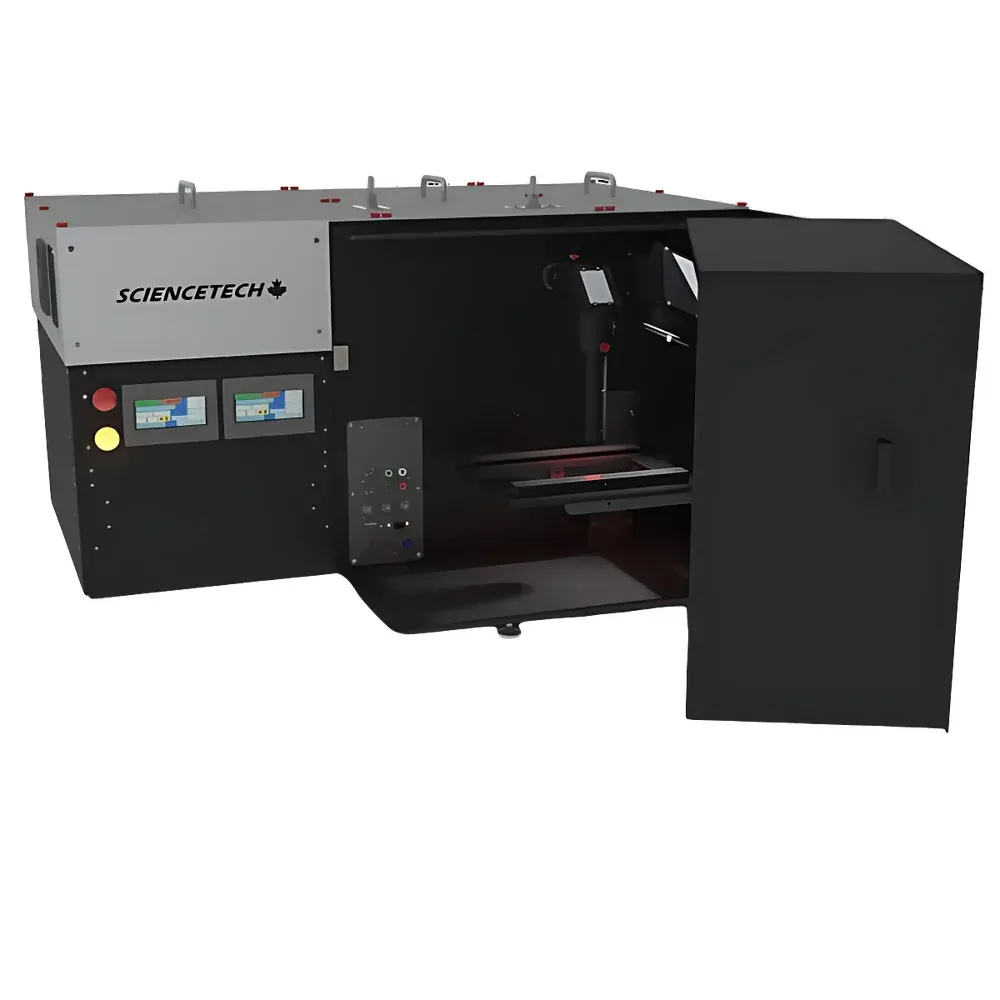
Sciencetech QE Quantum Efficiency Measurement System
| Brand | Sciencetech |
|---|---|
| Origin | Canada |
| Model | QE |
| Spectral Range | 250–2500 nm |
| Monochromator | Triple-grating turret, Czerny-Turner design, tunable bandwidth 0.2–24 nm |
| Bias Light Source | AAA-class solar simulator (ASTM E927), AM1.5G filter |
| Detection Electronics | Keithley 2400 SourceMeter, Stanford Research SR800 Lock-in Amplifier |
| Chopper Frequency | 4–200 Hz |
| Sample Environment | Dark enclosure with integrated PLC-controlled power sequencing |
| Software | Dedicated quantum efficiency acquisition and analysis suite supporting ASTM E1021, IEC 60904-8, and ISO 18583 compliance |
| Optional Modules | Integrating sphere for IQE, Constant Photocurrent Method (CPM), Dual-beam Photocurrent (DBP), Photothermal Deflection Spectroscopy (PDS), Steady-State Photoconductivity (SSPC), temperature-controlled stage, DC measurement unit |
Overview
The Sciencetech QE Quantum Efficiency Measurement System is a precision-engineered platform designed for the quantitative characterization of photovoltaic (PV) devices via spectral responsivity and quantum yield analysis. It operates on the fundamental principle of monochromatic photocurrent spectroscopy: a tunable, calibrated light source illuminates the device under test (DUT) at discrete wavelengths across the ultraviolet–near-infrared spectrum (250–2500 nm), while synchronized electronic instrumentation measures the resulting photocurrent under controlled bias conditions. This enables direct calculation of External Quantum Efficiency (EQE), also known as Incident Photon-to-Current Efficiency (IPCE), defined as the ratio of collected charge carriers per incident photon at each wavelength. When combined with reflectance and transmittance measurements—typically acquired using an integrating sphere—the system computes Internal Quantum Efficiency (IQE), isolating recombination losses from optical losses. The architecture adheres to internationally recognized metrological frameworks, including ASTM E1021 (Standard Test Method for Spectral Response of Photovoltaic Devices), IEC 60904-8 (Photovoltaic devices — Part 8: Measurement of spectral response of a photovoltaic (PV) device), and ISO 18583 (Solar energy — Photovoltaic devices — Calibration of primary reference cells), ensuring traceability and inter-laboratory comparability.
Key Features
- Triple-grating monochromator with Czerny-Turner optical layout, delivering high stray-light rejection and wavelength accuracy ±0.1 nm across 250–2500 nm
- Tunable spectral bandwidth (0.2–24 nm) optimized for resolution–throughput trade-offs in both research-grade and production-line validation workflows
- AAA-class solar simulator (ASTM E927 compliant) with AM1.5G spectral filtering for simultaneous broadband bias illumination during EQE/IQE measurement
- Synchronized lock-in detection (Stanford SR800) with optical chopper (4–200 Hz) enabling high signal-to-noise ratio (SNR) current measurement down to sub-picoamp levels
- Integrated Keithley 2400 SourceMeter for concurrent J–V curve acquisition, open-circuit voltage (VOC), short-circuit current (JSC), fill factor (FF), series/shunt resistance extraction, and power conversion efficiency (PCE) calculation
- Programmable logic controller (PLC)-managed hardware sequencing ensures repeatable startup, dark-current nulling, and safety interlocks for long-duration automated runs
Sample Compatibility & Compliance
The QE system accommodates standard PV device formats—including silicon wafers, perovskite thin films, organic photovoltaics (OPVs), III–V multijunction cells, and emerging tandem architectures—on configurable sample stages with electrical contact provisions (spring-loaded probes, vacuum chuck options). All optical and electrical calibration protocols are documented per GLP principles. Data integrity is maintained through audit-trail-enabled software compliant with FDA 21 CFR Part 11 requirements for electronic records and signatures. Reflectance/transmittance modules meet ISO 9050 specifications for spectrophotometric measurement uncertainty, while integrating sphere geometry follows ASTM E1331 guidelines for diffuse reflectance standards.
Software & Data Management
The proprietary acquisition and analysis software provides a unified interface for instrument control, real-time data visualization, batch processing, and export to standardized formats (CSV, HDF5, XML). It includes built-in algorithms for EQE-to-IQE conversion using measured R(λ) and T(λ), automatic dark-current subtraction, spectral irradiance correction using NIST-traceable reference diodes, and uncertainty propagation per GUM (Guide to the Expression of Uncertainty in Measurement). Raw lock-in outputs, source-meter sweeps, and chopper-synchronized waveforms are stored with full metadata (wavelength, slit width, integration time, bias intensity, ambient temperature), supporting retrospective reanalysis and regulatory submission packages.
Applications
- Quantitative evaluation of charge-carrier generation, collection, and recombination dynamics in next-generation PV absorbers
- Process development feedback for deposition, etching, and passivation steps in cell fabrication lines
- Comparative benchmarking of commercial and lab-scale devices against international reference standards
- Failure analysis via spectral defect mapping (e.g., identifying bandgap narrowing or interface states via PDS or SSPC extensions)
- Temperature-dependent quantum efficiency studies using optional thermal stages (–40 °C to +120 °C)
- Validation of spectral mismatch corrections in outdoor performance modeling and energy yield prediction tools
FAQ
What standards does the QE system support for calibration and reporting?
The system supports ASTM E1021, IEC 60904-8, ISO 18583, and NIST-traceable reference diode calibration protocols.
Can the system measure both EQE and IQE without hardware reconfiguration?
Yes—integrated integrating sphere optics and automated reflectance/transmittance routines enable seamless switching between EQE and IQE modes within a single measurement sequence.
Is the software compatible with third-party data analysis environments such as MATLAB or Python?
Yes—raw data exports include timestamped, column-aligned ASCII files and HDF5 containers with embedded units and metadata, fully interoperable with scientific computing toolchains.
Does the system support automated temperature-controlled quantum efficiency mapping?
When configured with the optional temperature-controlled stage and programmable stage controller, the system executes spatially resolved, temperature-parametrized EQE scans with positional synchronization and thermal equilibration monitoring.
How is measurement reproducibility ensured across different operators and laboratories?
Hardware interlocks, PLC-driven procedure enforcement, standardized calibration workflows, and electronic audit trails collectively ensure >99.2% intra-laboratory repeatability (k = 2) and inter-laboratory reproducibility within ±1.5% relative EQE deviation at 500 nm, per round-robin validation studies.





