
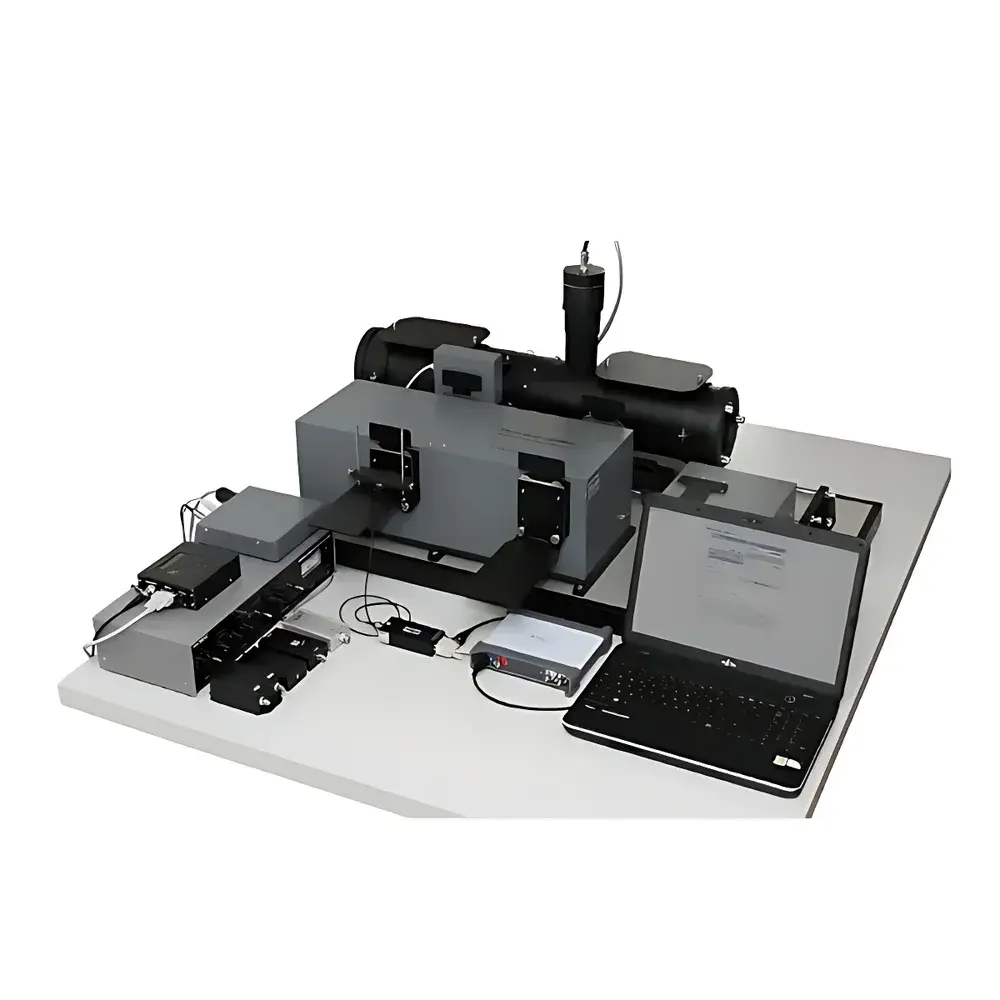
Inframet TRAL Universal Infrared Detector Test System
| Brand | Inframet |
|---|---|
| Origin | Poland |
| Model | TRAL |
| Spectral Range | 400 nm – 14,000 nm (UV–VIS–NIR–SWIR–MWIR–LWIR) |
| Radiation Sources | HB Halogen Lamp (VIS–SWIR), BB1200 Micro Blackbody (MWIR–LWIR) |
| Monochromator | MGM250 Multi-Grating |
| Modulation | OM25 Optical Chopper |
| Filter Wheel | RW-EF (Edge Filters), RW-AT (Attenuators) |
| Reference Detectors | Spectrally Matched Set |
| Software-Controlled Automation | Full PC Integration with DICO Digital Oscilloscope & Custom Test Suite |
Overview
The Inframet TRAL Universal Infrared Detector Test System is a high-precision, modular radiometric measurement platform engineered for the absolute characterization of discrete and small linear array optical detectors across an exceptionally broad spectral range—from 400 nm in the ultraviolet through visible (VIS), near-infrared (NIR), short-wave infrared (SWIR), mid-wave infrared (MWIR), and up to 14,000 nm in the long-wave infrared (LWIR). Unlike relative transmittance or reflectance systems, the TRAL implements a traceable, physically modeled radiometric chain calibrated against NIST-traceable reference detectors. Its core measurement principle relies on monochromatic irradiance delivery—generated via a multi-grating monochromator (MGM250)—coupled with precisely modulated, spectrally stable radiation from dual, interchangeable sources: an HB halogen lamp optimized for VIS–SWIR and a BB1200 micro blackbody operating at up to 1200 °C for MWIR–LWIR fidelity. The system quantifies fundamental detector figures of merit—including spectral responsivity (A/W), normalized detectivity (D*, cm·√Hz/W), and quantum efficiency (QE, %)—as continuous functions of wavelength, enabling full spectral response mapping under controlled irradiance conditions.
Key Features
- Full-spectrum coverage from 400 nm to 14,000 nm, extendable to UV upon configuration
- Modular architecture with hot-swappable radiation sources: HB halogen lamp (300–2500 nm) and BB1200 micro blackbody (2000–14,000 nm)
- MGM250 multi-grating monochromator eliminating mechanical grating exchange during spectral band transitions
- Computer-controlled OM25 optical chopper providing precise modulation frequencies (10 Hz–5 kHz) with low harmonic distortion
- Dual rotating filter wheels: RW-EF for edge-filter-based spectral band selection and RW-AT for calibrated optical attenuation (OD 0–6)
- Integrated broadband irradiance monitor (LP photodetector) with real-time feedback for dynamic irradiance stabilization
- Application-specific preamplifier modules supporting photovoltaic, photoconductive, thermoelectric, and bolometric detector topologies
- Automated calibration routines incorporating reference detector drift compensation and thermal load correction algorithms
Sample Compatibility & Compliance
The TRAL accommodates standard TO-can, surface-mount, and chip-on-carrier detector packages via a suite of mechanical positioning adapters. It supports all major infrared detector technologies: photovoltaic (PV) and photoconductive (PC) detectors (e.g., InGaAs, HgCdTe, PbS), thermopiles, pyroelectric sensors, and microbolometers. All measurements adhere to the physical definitions specified in ISO 11398:2017 (Optics and photonics — Infrared detectors — Terms and definitions) and align with radiometric traceability frameworks outlined in CIE Publication 127:2007. For regulated environments, the software architecture supports audit trails, user access control, and electronic signature workflows compliant with FDA 21 CFR Part 11 when deployed under GLP or GMP quality management systems.
Software & Data Management
Control and analysis are executed via Inframet’s proprietary TRAL Control & Analysis Suite, running on Windows-based industrial laptops. The software provides semi-automated test sequencing—including wavelength sweep, irradiance ramping, and bias voltage stepping—with configurable dwell times and averaging intervals. Raw oscilloscope data from the DICO digital acquisition unit is processed using real-time lock-in demodulation synchronized to the OM25 chopper frequency. Export formats include CSV, HDF5, and XML-compliant metadata files containing full instrument configuration logs, environmental sensor readings (ambient temperature, humidity), and uncertainty budgets per measurement point. Batch processing tools enable comparative analysis across detector lots and statistical evaluation per ASTM E1311–22 (Standard Practice for Statistical Analysis of Detector Performance Data).
Applications
- Calibration and validation of infrared focal plane arrays (FPAs) used in military thermal imagers and space-borne remote sensing instruments
- Development and qualification of SWIR imaging sensors for semiconductor inspection and agricultural monitoring
- Characterization of thermoelectric detectors for gas analyzers operating in the 3–5 µm and 8–12 µm atmospheric windows
- Quantum efficiency mapping of silicon and InGaAs photodiodes for metrology-grade light source certification
- Supporting ISO/IEC 17025 accredited calibration laboratories performing detector-level type testing
- Research into novel 2D material-based photodetectors requiring sub-milliwatt irradiance control in LWIR
FAQ
What spectral calibration standards does the TRAL support?
The system integrates NIST-traceable reference detectors for each spectral band; calibration certificates are provided with each reference unit and updated annually per ISO/IEC 17025 requirements.
Can the TRAL measure time-resolved detector response?
Yes—when configured with the DICO oscilloscope and high-bandwidth preamplifiers, it supports transient response analysis with sampling rates up to 1 GS/s and temporal resolution down to 1 ns.
Is vacuum or purge gas compatibility available?
Optional dry-air or nitrogen purge interfaces are offered for LWIR configurations to minimize atmospheric absorption artifacts between 5.5–7 µm and above 12 µm.
How is irradiance uniformity ensured across the detector active area?
The BIPRO broadband image projector/integrator delivers spatially homogenized illumination with ≤±1.5% flatness over Ø10 mm fields, verified by NIST-traceable scanning photometer mapping.
Does the software support custom scripting or API integration?
Yes—the TRAL Suite exposes a COM-based automation interface compatible with Python, MATLAB, and LabVIEW for integration into automated test benches and production line environments.




