
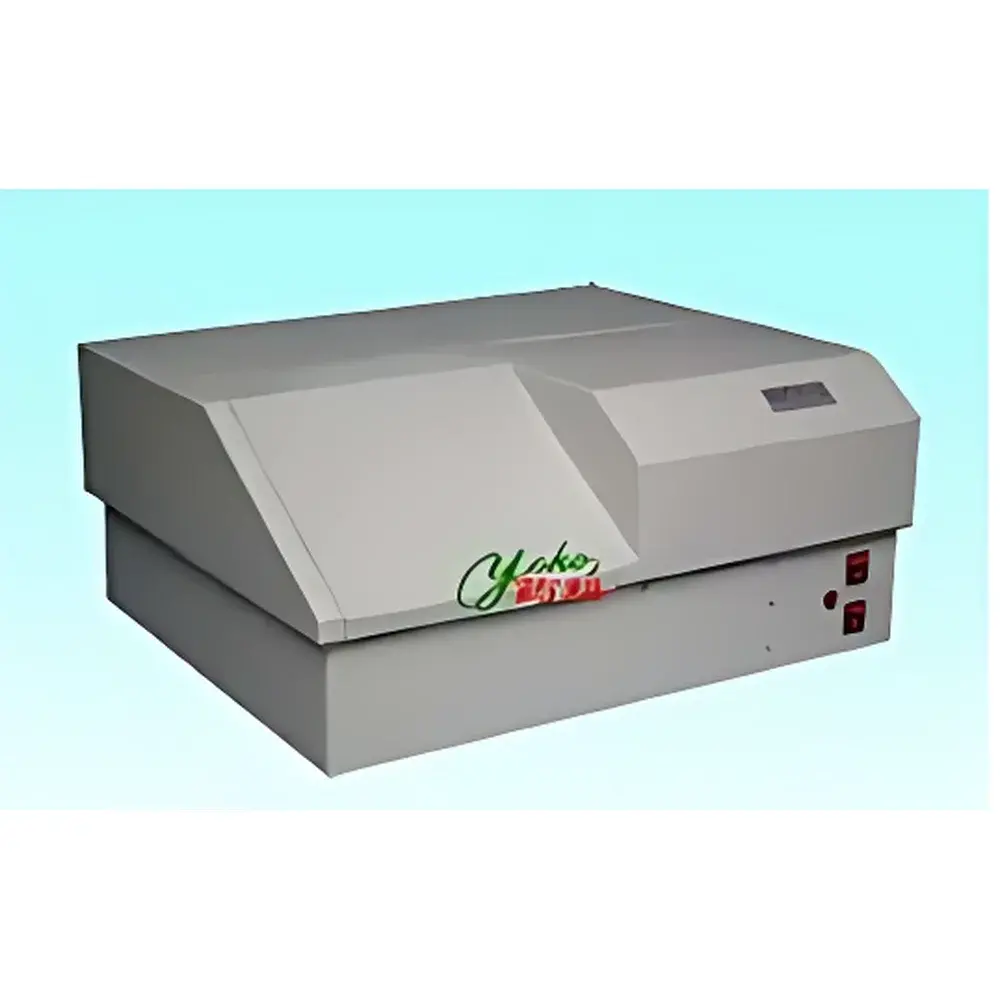
YOKO YOKO-3000 Thin-Layer Chromatography Scanner
| Brand | YOKO |
|---|---|
| Model | YOKO-3000 |
| Origin | Hubei, China |
| Instrument Type | TLC Scanner |
| Operation Mode | Automatic |
| Measurement Modes | Reflectance, Fluorescence, Absorption |
| Wavelength Range | 200–800 nm |
| Light Sources | Tungsten-Halogen Lamp & Deuterium Lamp (Auto-Switching) |
| Monochromator | Holographic Grating (1200 lines/mm) |
| Spectral Bandwidth | 5 nm |
| Wavelength Accuracy | ±0.5 nm |
| Minimum Spatial Resolution | 10 µm |
| Sample Stage Capacity | Up to 200 mm × 200 mm TLC Plates |
| Scan Speed | 50 mm/s |
| Baseline Flatness | ±1% |
| Interface | USB 2.0 |
| Power Supply | 220 V AC, 300 W |
| Operating System Compatibility | Windows 2000/XP |
Overview
The YOKO YOKO-3000 Thin-Layer Chromatography (TLC) Scanner is a fully automated, high-precision densitometric instrument engineered for quantitative and qualitative analysis of compounds separated on planar chromatographic media. It operates on the principle of reflectance densitometry—measuring light reflected from analyte bands on stationary-phase plates—and extends functionality to fluorescence detection (for native or derivatized fluorescent compounds) and transmission-mode absorption (when applicable with transparent supports). Designed in alignment with the methodological requirements of the Chinese Pharmacopoeia (2005 Edition) for TLC scanning, the system delivers reproducible, traceable, and compliant data suitable for regulated environments including pharmaceutical quality control, herbal medicine standardization, and academic research. Its dual-lamp optical architecture—integrating a deuterium lamp for deep-UV performance (200–350 nm) and a tungsten-halogen lamp for visible-range stability (350–800 nm)—ensures continuous spectral coverage across the full UV-Vis range without manual intervention.
Key Features
- Automated dual-source illumination with seamless, software-controlled switching between deuterium and tungsten-halogen lamps—enabling optimal signal-to-noise ratio across 200–800 nm.
- Holographic grating monochromator (1200 lines/mm) delivering high spectral purity and consistent 5 nm bandwidth, critical for selective band quantitation and spectral deconvolution.
- High-accuracy X-Y translation stage with 10 µm spatial resolution and programmable scan paths—including linear, zigzag, and dual-wavelength ratiometric modes—for flexible plate interrogation.
- Photomultiplier tube (PMT) detector with low dark-current design and real-time feedback compensation, minimizing drift caused by lamp intensity fluctuations over extended runs.
- USB 2.0 interface enabling rapid, high-fidelity data transfer directly to the dedicated TLC workstation software—eliminating serial bottlenecks and supporting large-scale batch processing.
- Robust mechanical platform accommodating standard and oversized TLC plates up to 200 mm × 200 mm, compatible with silica gel G, GF254, H, HF254, aluminum-backed, and polyester-supported layers.
Sample Compatibility & Compliance
The YOKO-3000 supports universal thin-layer substrates used in pharmacopeial and industrial QC workflows—including silica gel, alumina, cellulose, and reversed-phase plates—regardless of binder type (e.g., gypsum, sodium silicate) or fluorescence indicator (e.g., F254). Its measurement modes comply with USP , EP 2.2.27, and ChP 2005 Appendix XIB for TLC densitometry. While not pre-certified for FDA 21 CFR Part 11, the system’s audit-trail-capable software architecture allows configuration to meet GLP/GMP documentation requirements—including user access control, electronic signatures, and immutable raw-data archiving—when deployed with validated IT infrastructure and procedural SOPs.
Software & Data Management
The YOKO-3000 Thin-Layer Chromatography Workstation is a Windows-based application (compatible with Windows 2000 and XP) providing integrated instrument control, spectral acquisition, peak integration, calibration curve generation (linear, quadratic, log-log), and multi-point standardization. It supports wavelength optimization via full-spectrum reflectance scans (200–800 nm), enabling empirical selection of λmax for each analyte. All raw scan profiles, processed chromatograms, and calibration logs are stored in proprietary but exportable binary formats (.tlc, .dat), with CSV and PDF report generation for regulatory submission. The software includes built-in tools for baseline correction (rolling ball, polynomial), noise filtering, and inter-plate normalization—essential for longitudinal studies and multi-batch comparability.
Applications
- Quantitative assay of active pharmaceutical ingredients (APIs) and impurities in herbal extracts per ChP monographs.
- Stability-indicating analysis of degradation products under ICH Q1 guidelines using dual-wavelength scanning.
- Identity confirmation and fingerprint profiling of Traditional Chinese Medicine (TCM) preparations via Rf value mapping and spectral matching.
- Method development and validation for TLC-based release testing in GMP-compliant manufacturing units.
- Academic research in natural product isolation, phytochemical screening, and reaction monitoring where cost-effective, plate-based separation is preferred over HPLC.
FAQ
Does the YOKO-3000 support GLP-compliant data integrity?
Yes—when configured with appropriate network policies, user role management, and electronic signature protocols, its software enables audit-ready workflows aligned with GLP principles. Full 21 CFR Part 11 compliance requires site-specific validation and IT governance.
Can it scan fluorescent plates without derivatization?
Yes—the PMT detector is optimized for native fluorescence detection at excitation/emission wavelengths within the 200–800 nm range, particularly effective with GF254 and HF254 plates under UV 254 nm irradiation.
Is the 10 µm resolution sufficient for narrow TLC bands?
Yes—10 µm step resolution exceeds the typical band width (50–200 µm) observed in conventional TLC, ensuring accurate peak area integration and minimizing partial-volume errors.
What maintenance is required for long-term wavelength accuracy?
Annual verification using NIST-traceable holmium oxide or didymium filters is recommended; the ±0.5 nm wavelength accuracy is maintained via factory-calibrated grating positioning and thermal stabilization of optical components.
Are third-party plate formats supported beyond the supplied kits?
Yes—the open-stage design accepts any commercially available rigid or flexible TLC plate up to 200 × 200 mm, including custom-cut glass, aluminum, or plastic-backed media.
Related Products





