
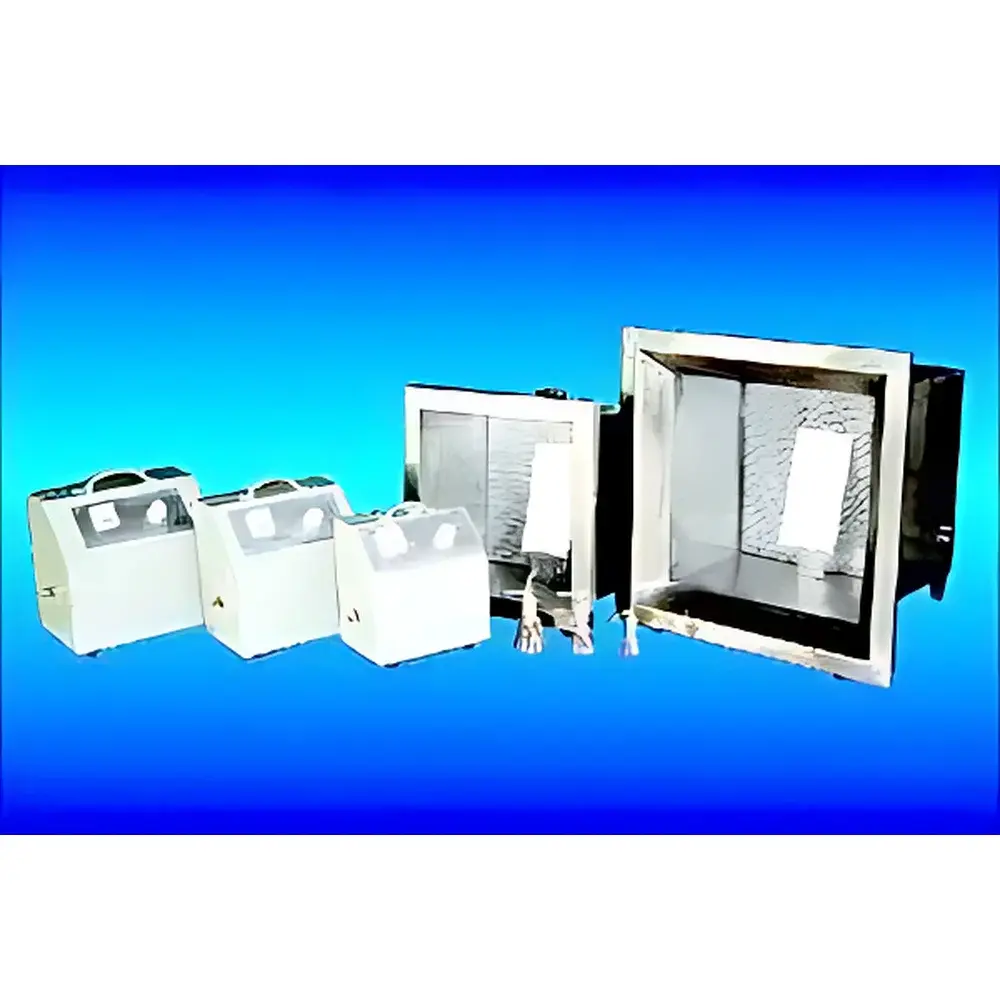
YOKO PN+PX Automated Spray Development Chamber for Thin-Layer Chromatography
| Brand | whYOKO |
|---|---|
| Origin | Hubei, China |
| Model | YOKO-PN+PX |
| Instrument Type | Preparative Thin-Layer Chromatography System |
| Operation Mode | Automatic |
| Wavelength Range | 200–700 nm |
| Wavelength Accuracy | ±1 nm |
| Power (PN-I) | 50 W |
| Airflow (PN-I) | 65 L/min |
| Noise Level (PN-I) | <48 dB(A) |
| Dimensions (PN-I) | 207 × 142 × 215 mm |
| Power (PX-II-A) | 50 W |
| Airflow (PX-II-A) | 5000 L/min |
| Dimensions (PX-II-A) | 480 × 480 × 420 mm |
| Construction | Full Stainless Steel Enclosure |
| Exhaust Fan | Centrifugal Type |
| Duct Diameter | Φ150 mm × 2 m Extendable Hose |
Overview
The YOKO PN+PX Automated Spray Development Chamber is a purpose-engineered integrated system designed specifically for safe, reproducible, and operator-protected spray-based visualization in thin-layer chromatography (TLC). Unlike manual spray techniques or repurposed consumer-grade atomizers, this system combines a precision-controlled, oil-free pneumatic delivery module (PN series) with a fully enclosed, corrosion-resistant development chamber (PX series) to eliminate uncontrolled aerosol dispersion of reagents—including corrosive acids (e.g., sulfuric acid for charring), oxidative agents (e.g., potassium permanganate), and fluorescent dyes. The system operates on the principle of controlled pneumatic nebulization: compressed air—regulated via stepless pressure and flow control—is directed through interchangeable glass spherical spray bottles to generate a fine, uniform mist (typical droplet diameter <20 µm) with minimal overspray and high spatial repeatability across TLC plates (up to 20 × 20 cm). Its optical transparency and optional UV-transparent front panel (254/365 nm compatible) allow real-time visual monitoring during development without opening the chamber.
Key Features
- Oil-free, brushless DC air compressor with continuous pressure and airflow regulation—enabling precise tuning of雾化 intensity across diverse reagent viscosities and volatility profiles.
- Interchangeable glass spherical spray bottles (three configurations supplied) optimized for low dead-volume delivery, rapid rinsing, and chemical resistance to organic solvents, mineral acids, and oxidants.
- Full stainless steel (AISI 304) chamber construction with seamless welds and electropolished interior surfaces—resistant to pitting, staining, and long-term acid exposure.
- High-capacity centrifugal exhaust fan (5000–8300 L/min) coupled with a Φ150 mm extendable duct (2 m length) ensuring >99.7% capture efficiency of airborne reagent aerosols per ISO 10121-1:2013 test methodology.
- Integrated acoustic damping design—PN-I unit operates below 48 dB(A) at 1 m distance, meeting ISO 7779 noise emission requirements for analytical laboratory environments.
- Modular architecture: PN units (I/II/III) scale with required airflow; PX chambers (II-A/II-B) scale with plate throughput and fume load—supporting method transfer between R&D and QC workflows.
Sample Compatibility & Compliance
The PN+PX system accommodates standard and oversized TLC plates (up to 20 × 20 cm), including silica gel, alumina, cellulose, and reversed-phase (RP-18) layers. It supports all common spray reagents: vanillin/H2SO4, anisaldehyde/H2SO4, iodine vapor, ninhydrin, Dragendorff’s reagent, ceric ammonium sulfate, and acidic charring solutions. All wetted components comply with USP for pharmaceutical-grade material contact. The stainless steel enclosure meets EN 14175-3:2016 specifications for laboratory fume cupboards. When operated with documented SOPs and maintenance logs, the system supports GLP-compliant documentation under OECD Principles of Good Laboratory Practice (Annex V) and aligns with FDA 21 CFR Part 11 expectations for instrument traceability when paired with validated electronic lab notebook (ELN) integration.
Software & Data Management
While the PN+PX system is hardware-centric and does not incorporate embedded microprocessor control or proprietary software, its operational parameters—air pressure, exposure duration, and reagent volume—are fully documentable within standard laboratory quality systems. Each PN unit includes calibrated analog pressure gauges (±0.5 bar accuracy) and flow meters (±3% FS), enabling manual parameter logging traceable to NIST-traceable calibration standards. For digital workflow integration, users may pair the system with third-party environmental monitoring platforms (e.g., DeltaTrak, Sensitech) to record chamber temperature/humidity during development—a critical variable for reproducible charring kinetics. Audit trails for maintenance (e.g., filter replacement, seal inspection) are maintained per ISO/IEC 17025:2017 clause 6.4.10.
Applications
- Routine qualitative and semi-quantitative TLC analysis in pharmaceutical stability studies (ICH Q1–Q5), where consistent spray application directly impacts Rf reproducibility and spot morphology.
- Preparative TLC fraction collection workflows requiring post-development derivatization prior to scraping—minimizing analyst exposure to neurotoxic reagents such as anisaldehyde or chlorinated solvents.
- Acid-catalyzed carbonization protocols for carbohydrate and terpenoid analysis, where precise thermal + chemical treatment timing is essential for selective charring without decomposition.
- Multi-step sequential spraying (e.g., first with iodine, then with sulfuric acid) enabled by chamber purge cycles—eliminating cross-contamination between reagent stages.
- Secondary use as a dedicated low-flow fume hood for small-scale hazardous reactions (e.g., diazomethane generation, thionyl chloride workups), leveraging its certified capture velocity (>0.5 m/s face velocity).
FAQ
Is the PN+PX system compatible with UV visualization at 254 nm and 365 nm?
Yes—the optional quartz-glass front panel (standard on PX-II-B) transmits >85% of incident UV light across 200–400 nm, enabling direct observation of fluorescence quenching or enhancement during spray development.
Can the system be validated for GMP-regulated environments?
Yes—while no embedded software requires 21 CFR Part 11 validation, the mechanical design, material certifications, and parameter traceability support IQ/OQ/PQ protocols per ASTM E2500-13 and EU Annex 15.
What maintenance intervals are recommended for the centrifugal exhaust fan?
Fan bearings require lubrication every 12 months; pre-filter mesh must be cleaned weekly and replaced quarterly under continuous operation, per ISO 16890-1:2016 particle filtration guidelines.
Does the system include reagent compatibility documentation?
Yes—a comprehensive chemical resistance matrix (covering >42 common TLC reagents, including concentrated H2SO4, HCl, KMnO4, and CH2Cl2) is provided with each shipment, referencing ASTM D543-20 and DIN 51364-2:2005 test data.
How is airflow uniformity verified across the chamber interior?
Uniformity is confirmed using ISO 17713-1:2021 tracer gas (SF6) decay testing—demonstrating <±8% velocity deviation across the 40 × 40 cm active zone at rated airflow.




