
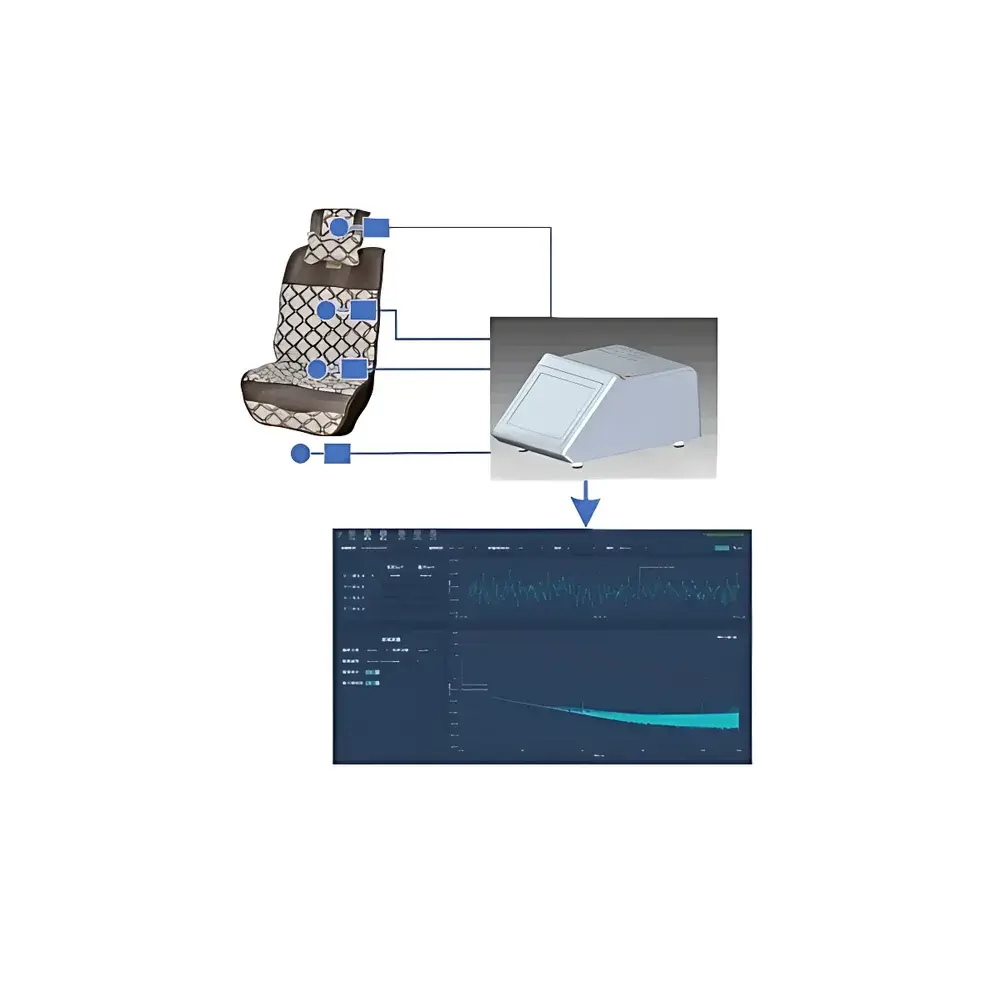
STT-OS-6C Mobile Electromagnetic Environment Online Monitoring System
| Brand | STT |
|---|---|
| Origin | Beijing, China |
| Manufacturer | STT Senfu Technology |
| Country of Origin | China |
| Model | OS-6C |
| Frequency Range | 1 Hz – 6 GHz |
| Electric Field Measurement Range | 0.1 V/m – 1000 V/m |
| Measurement Accuracy | ±0.1 V/m |
| Power Supply | Vehicle-mounted 12/24 V DC battery or external 220 V AC |
Overview
The STT-OS-6C Mobile Electromagnetic Environment Online Monitoring System is an integrated, vehicle-based real-time electromagnetic field (EMF) surveillance platform engineered for high-mobility environmental assessment and regulatory support. It operates on the principle of broadband isotropic electric field sensing—utilizing tri-axial E-field probes calibrated across a continuous frequency span from 1 Hz to 6 GHz—to capture spatially resolved EMF intensity data under dynamic operational conditions. Unlike stationary monitoring stations, the OS-6C is purpose-built for in-motion measurement, enabling continuous acquisition of electric field strength (V/m) while the host vehicle is traversing urban corridors, proximity zones of high-power transmission infrastructure, or radio-frequency emission sites. Its architecture supports simultaneous GPS georeferencing, GIS-integrated mapping, and time-synchronized data logging—ensuring traceable, location-aware datasets compliant with national electromagnetic environmental quality standards (e.g., GB 8702–2014) and international reference frameworks including ICNIRP 2020 guidelines.
Key Features
- Real-time mobile EMF monitoring during both static and vehicular motion—no requirement to halt for data acquisition
- Tri-axial isotropic electric field probe mounted on roof rack with weatherproof IP65 enclosure and low-profile aerodynamic housing
- Onboard monitoring host with embedded ARM-based data acquisition unit, supporting 100 Hz sampling rate and timestamped metadata tagging
- Integrated GNSS receiver (GPS + BeiDou + GLONASS) providing sub-5 m horizontal positioning accuracy and real-time speed/heading output
- Dual-mode power architecture: seamless auto-switching between vehicle battery (12/24 V DC) and external 220 V AC supply, with intelligent voltage regulation and surge protection
- 10.1-inch ruggedized touchscreen display inside cabin, running STT-EMView™ firmware with live waveform visualization, spectral density overlays, and threshold alarm indicators
- Modular software-defined radio (SDR)-compatible front-end for future expansion into frequency-selective analysis (e.g., LTE/5G band isolation)
Sample Compatibility & Compliance
The OS-6C is validated for use in heterogeneous electromagnetic environments—including near high-voltage substations (110 kV–1000 kV), broadcast antenna arrays, cellular base stations (2G–5G NR), radar installations, and industrial RF heating facilities. Its probe sensitivity (0.1 V/m minimum detectable field) and upper range (1000 V/m) align with Class A instrumentation requirements defined in IEC 62110:2019 (“Electric and magnetic field levels generated by AC power systems”) and ISO/IEC 17025-accredited calibration protocols. All hardware components meet EN 61326-1:2013 (EMC immunity and emissions) and RoHS 3 directive compliance. The system supports audit-ready data export in CSV, GeoJSON, and KML formats—enabling integration with municipal EMF management platforms and third-party GIS tools such as ArcGIS Pro or QGIS for regulatory reporting.
Software & Data Management
The STT-EMPlatform™ software suite provides centralized remote supervision, historical trend analysis, and automated report generation. It implements role-based access control (RBAC), encrypted TLS 1.3 communication, and full audit trail functionality—including user login history, parameter change logs, and data export records—meeting GLP-aligned documentation requirements for environmental monitoring programs. Raw time-series data are stored with embedded UTC timestamps, GPS coordinates, and probe calibration coefficients. Batch processing modules support grid-based interpolation (inverse distance weighting) to generate contour maps of electric field magnitude across surveyed areas. Exported reports include metadata headers compliant with ISO/IEC 17025 Clause 7.8.2, facilitating acceptance by environmental protection bureaus and public health authorities.
Applications
- Emergency response to suspected EMF overexposure incidents—rapid deployment within ≤15 minutes of dispatch
- Pre-commissioning surveys for new 5G macrocells or smart grid substations, verifying spatial compliance with local exposure limits
- Longitudinal urban EMF baseline studies—repeated transect measurements along fixed routes to assess temporal trends
- Public transparency initiatives: real-time EMF data feeds displayed at community centers or via municipal web portals using open APIs
- Scientific research on anthropogenic EMF propagation in complex built environments—integration with building footprint databases and terrain elevation models
- Regulatory compliance verification for green infrastructure projects (e.g., “low-EMF” substations or eco-base station deployments)
FAQ
Does the OS-6C comply with international EMF exposure standards such as ICNIRP or IEEE C95.1?
Yes—the system’s measurement uncertainty budget and probe calibration traceability are aligned with the metrological foundations of ICNIRP 2020 and IEEE Std C95.1–2019. Measurement reports include uncertainty statements per GUM (JCGM 100:2008).
Can the system operate continuously for extended periods without manual intervention?
It supports unattended operation up to 72 hours on standard vehicle battery capacity, with configurable sleep/wake cycles and automatic data buffering during network outages.
Is raw sensor data accessible for third-party analysis?
Yes—binary and ASCII-formatted time-series files (with full metadata headers) are available via USB, Ethernet, or secure SFTP; no proprietary lock-in or format obfuscation is applied.
How is probe calibration maintained during field use?
Each probe carries a NIST-traceable calibration certificate valid for 12 months; field verification routines using reference signal generators (e.g., Keysight E4438C) are supported through the onboard diagnostics menu.
Does the system support post-processing of motion artifacts in high-speed scenarios?
Yes—integrated inertial measurement unit (IMU) data are fused with GNSS signals using Kalman filtering to correct for Doppler-induced amplitude distortion and orientation-dependent probe response variations.
Related Products







