
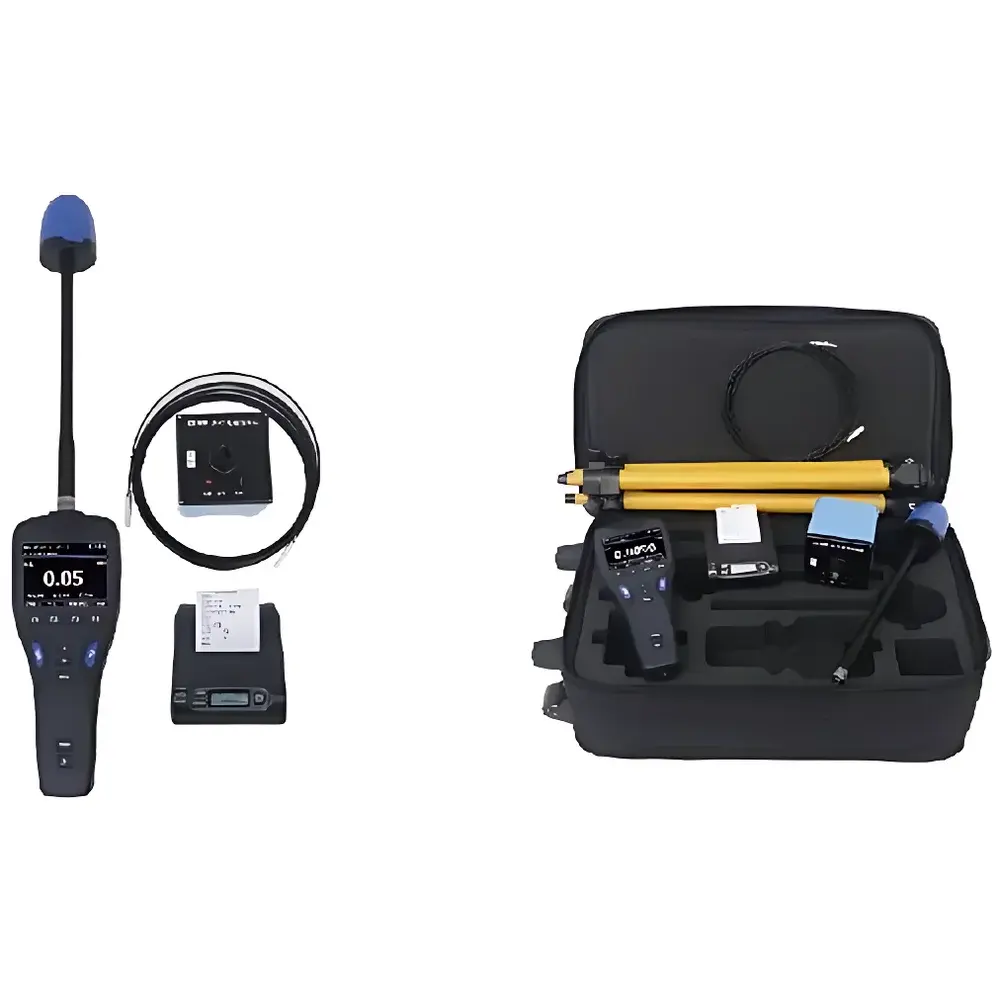
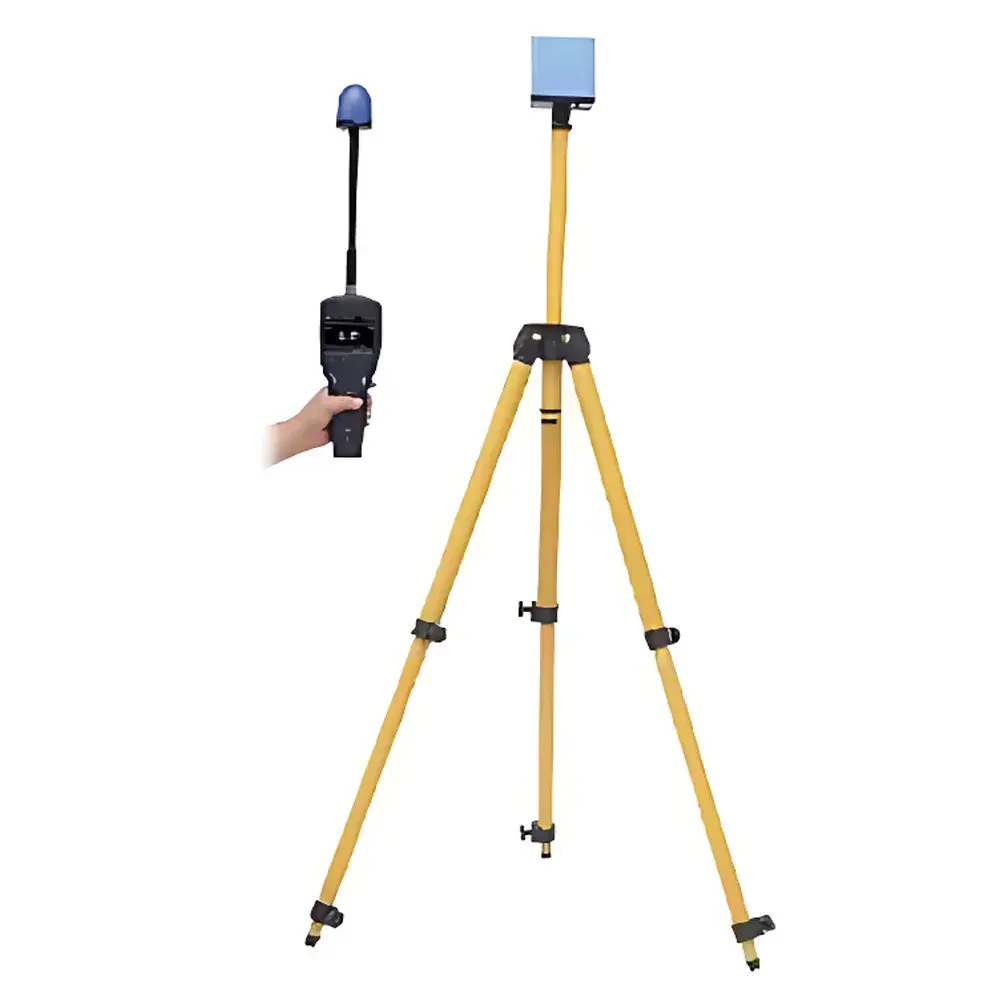
STT SEM-600 Electromagnetic Field Analyzer
| Brand | STT |
|---|---|
| Origin | Beijing, China |
| Manufacturer Type | Original Equipment Manufacturer (OEM) |
| Product Origin | Domestic (China) |
| Model | SEM-600 |
| Frequency Range | 1 Hz – 26.5 GHz |
| Measurement Accuracy | ±0.01 dB |
| Electric Field Range | 0.01 V/m – 100 kV/m |
| Magnetic Field Range | 0.1 nT – 10.00 mT |
| Power Density Range | 0.001 µW/cm² – 100.0 mW/cm² |
| Data Storage | >1,000,000 records (8 GB flash) |
| Operating Time | >14 h (rechargeable 6800 mAh Li-ion battery) |
| IP Rating | IP54 |
| Display | 4.1″ color LCD (320×240), anti-glare reflective technology |
| Environmental Sensors | Integrated temperature (–40 °C to +80 °C, ±0.4 °C), humidity (0–100 %RH, ±3 %RH), GPS (WGS-84, <2.5 m accuracy, 30 µs timing precision) |
| Connectivity | Bluetooth 5.0, USB 2.0, optical fiber interface |
| Printing | Built-in thermal printer module (127 dpi, 5.5 mm/s, 1.5 million line lifespan) |
Overview
The STT SEM-600 Electromagnetic Field Analyzer is a metrologically rigorous, wideband field measurement system engineered for compliance-grade electromagnetic environment assessment across low-frequency (LF) through millimeter-wave (mmWave) spectra. Operating on the principle of isotropic triaxial sensing—where orthogonal electric and magnetic field components are simultaneously acquired via calibrated broadband probes—the instrument delivers traceable, vector-summed field strength values in real time. Its 1 Hz–26.5 GHz continuous frequency coverage spans power-frequency harmonics (50/60 Hz), intermediate frequencies (IF), radiofrequency (RF) broadcast bands (AM/FM, TV), mobile communications (2G–5G NR, LTE), radar systems (L/S/C/X/Ku/Ka-bands), and industrial, scientific, and medical (ISM) equipment emissions (e.g., induction heaters, microwave ovens). Designed for regulatory enforcement, occupational health surveillance, and environmental impact assessment, the SEM-600 implements true RMS detection with statistical post-processing aligned to national and international exposure limit frameworks—including GB8702-2014, ICNIRP 1998/2010, EN 50492-2008, and GBZ2.2-2007.
Key Features
- Isotropic triaxial probe architecture supporting simultaneous E-field (V/m, kV/m) and H-field (A/m, µT, mT) measurements without manual mode switching
- Dual-domain display: real-time waveform overlay with concurrent numeric readouts of instantaneous, peak, min/max, arithmetic mean, RMS average (fully compliant with GB8702-2014 calculation methodology), and percentile-based statistical field strengths (E5, E50, E80, E95)
- Integrated environmental monitoring: co-located temperature, relative humidity, GPS geotagging, and precise UTC timestamping (30 µs resolution) synchronized to each field measurement
- High-visibility 4.1″ anti-glare reflective LCD (320×240) optimized for outdoor use under direct sunlight or low-light conditions—zero specular reflection, no viewing-angle dependency
- Robust field data management: 8 GB onboard flash memory stores >1,000,000 measurement records and >100,000 structured reports; supports discrete or continuous spatial averaging across up to 80 distinct locations with per-point metadata logging
- On-device thermal printing (127 dpi, 5.5 mm/s) enables immediate hardcopy generation in situ; Bluetooth 5.0 interface enables secure pairing with certified portable printers
- IP54-rated enclosure ensures operational reliability in dusty, humid, or intermittently wet environments typical of substation yards, rail corridors, and rooftop antenna sites
- 14+ hour continuous operation powered by a field-replaceable 6800 mAh Li-ion battery (4.2 V nominal); full recharge in <8 hours
Sample Compatibility & Compliance
The SEM-600 is compatible with a modular family of NIST-traceable, factory-calibrated isotropic probes—including LF-01 (1 Hz–100 kHz), RF-26 (10 MHz–26 GHz), and HF-30 (100 kHz–30 MHz)—each supplied with individual calibration certificates valid per ISO/IEC 17025 requirements. Probe selection determines measurable field quantities: electric field only (RF series), magnetic field only (HF series), or dual E/H (LF series). All probes utilize optical fiber signal transmission to eliminate cable-induced coupling artifacts and ensure galvanic isolation. The system conforms to measurement uncertainty budgets defined in HJ/T 10.2-1996 and HJ 681-2013, and its statistical averaging algorithms satisfy the temporal and spatial averaging provisions of ICNIRP 2010 and GB8702-2014. It supports weighted evaluation per exposure guidelines (e.g., frequency-dependent ICNIRP weighting curves), enabling direct %-of-limit reporting for regulatory documentation.
Software & Data Management
The optional STT SEM-SW-01 Full-Process Intelligent Management System provides a GLP-compliant workflow platform compatible with Android tablets (≥8″) and smartphones. It implements role-based access control, audit-trail logging per FDA 21 CFR Part 11 requirements, and electronic signature capability. Key modules include task assignment with geofenced site validation, dynamic report templating (auto-populated with GPS coordinates, environmental metadata, and probe calibration IDs), annotated site sketching with photo capture embedded directly into PDF reports, and centralized report review/approval routing. Raw binary data export (CSV, XML) preserves full traceability—including raw X/Y/Z component vectors, timestamped environmental parameters, and probe-specific sensitivity coefficients—for third-party analysis or archival in LIMS environments.
Applications
- Power infrastructure: AC/DC transmission line corridor surveys, transformer yard EMF mapping, railway electrification (25 kV AC, 1.5 kV DC) interference characterization
- Telecom compliance: 5G macro/micro-cell site audits, satellite earth station emission profiling, DAS (Distributed Antenna System) leakage verification
- Broadcast engineering: AM/LW/MW/SW/FM transmitter near-field/far-field validation against ITU-R P.1546 and national licensing conditions
- Industrial hygiene: workplace assessment around MRI scanners, RF welders, plasma etchers, and induction furnaces per GBZ2.2-2007
- Consumer electronics: wireless charging pad emissions testing (Qi/WPC standards), IoT device SAR surrogate measurements
- National defense: electronic warfare (EW) system EMSEC evaluation, radar cross-section (RCS) facility background noise monitoring
- Environmental impact assessment (EIA): baseline EMF characterization prior to new infrastructure deployment
FAQ
Does the SEM-600 support real-time spectral analysis?
No. The SEM-600 is a broadband field strength analyzer—not a spectrum analyzer. It measures total RMS field magnitude within user-defined frequency bands using analog RMS detectors and calibrated probe responses. For frequency-domain decomposition, external FFT-based instrumentation is required.
Can probe calibration certificates be renewed internationally?
Yes. STT maintains ISO/IEC 17025-accredited calibration laboratories in Beijing and offers recalibration services traceable to NIM (National Institute of Metrology, China) and EU NMIs upon request.
Is firmware update capability available over-the-air?
Firmware updates are delivered via USB-connected PC using STT’s certified configuration utility; no OTA capability is implemented to preserve measurement integrity and prevent unauthorized modification.
What is the maximum allowable ambient temperature during continuous measurement?
The specified operating range is –10 °C to +60 °C. Sustained operation above +50 °C may reduce battery service life and require periodic thermal stabilization pauses.
How does the instrument handle probe interchangeability and channel compensation?
Each probe contains an embedded EEPROM storing unique sensitivity factors, phase response corrections, and frequency-dependent correction matrices. The SEM-600 auto-reads this data upon connection and applies real-time digital compensation during signal processing.
Related Products







