
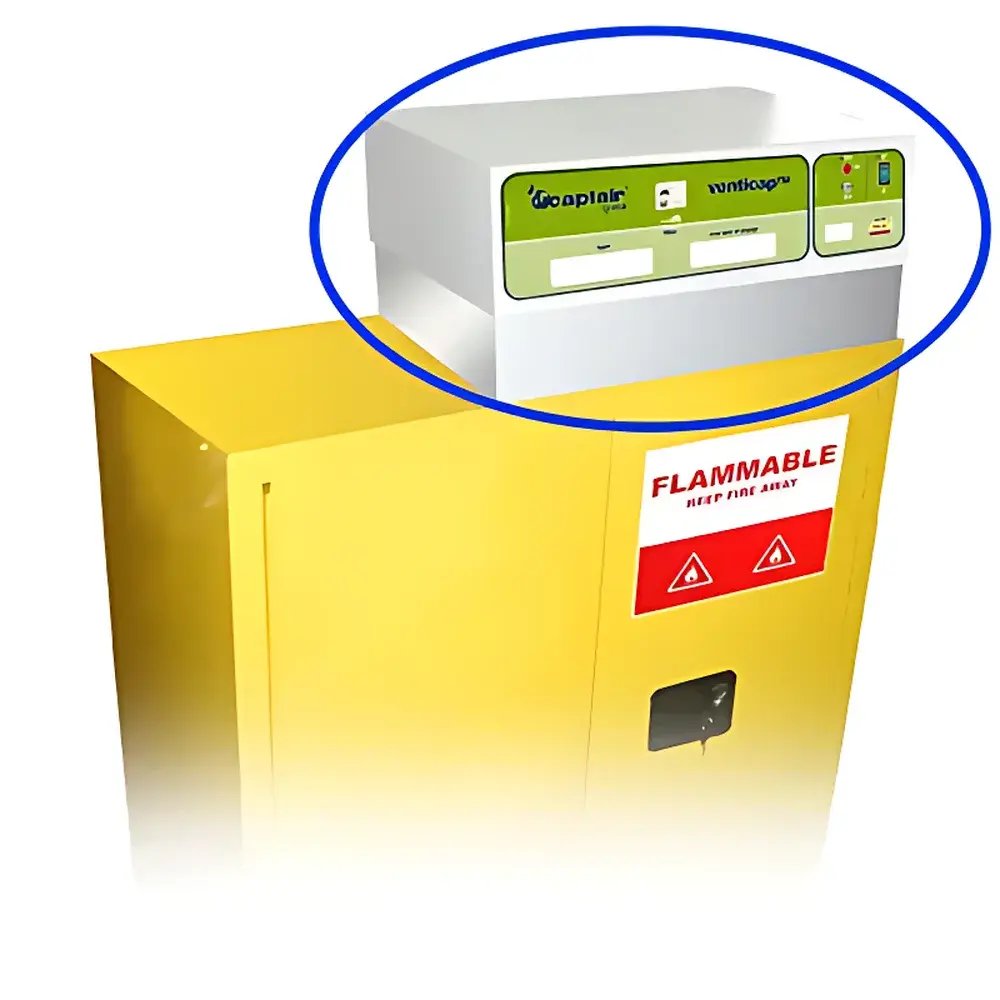
Captair Venticap® 502 Molecular Filtration Unit for Flammable Storage Cabinets
| Brand | Captair |
|---|---|
| Model | Venticap® 502 |
| Dimensions (L×W×H) | 570 × 390 × 270 mm |
| Sound Pressure Level | 57 dBA |
| Airflow Capacity | 75 m³/h |
| Power Supply | 220 V / 50 Hz |
| Power Consumption | 65 W |
| Current Draw | 0.8 A |
| Filtration Standard | Compliant with NFX 15-211 Class 2 (effluent concentration ≤ 50% of TLV) |
| Filter Type | Activated Carbon-Based Molecular Adsorption Media |
| Typical Service Life | 12 months under standard laboratory chemical storage conditions |
| Saturation Monitoring | Integrated outlet port with optional test kit |
| Alarm Functions | Visual and audible alerts for filter saturation and fan failure |
Overview
The Captair Venticap® 502 is an engineered molecular filtration unit designed exclusively for integration with flammable liquid storage cabinets in regulated laboratory, pharmaceutical, and industrial environments. It operates on the principle of forced-air recirculation combined with high-surface-area activated carbon adsorption to capture volatile organic compounds (VOCs) emitted from stored solvents and reagents. Unlike ducted exhaust systems that expel conditioned air outdoors—resulting in significant HVAC energy loss—the Venticap® 502 enables continuous, closed-loop air purification within the cabinet and surrounding workspace. Its airflow path is optimized for laminar flow dynamics, ensuring uniform contact between effluent vapors and the adsorbent media. The unit meets functional safety requirements for chemical containment as defined by European standard NFX 15-211 Class 2, verifying that residual emissions remain below 50% of the applicable Threshold Limit Value (TLV) at the cabinet’s breathing zone.
Key Features
- Plug-and-play installation: Mounts directly onto the top surface of standard flammable storage cabinets; connects via flexible ducting to existing ventilation ports.
- Dual-stage safety monitoring: Includes both fan operational status detection and real-time molecular filter saturation indication via dedicated outlet port (compatible with optional colorimetric test kits).
- Integrated dual-alarm system: Visual LED indicator and audible tone activate independently for fan failure and filter exhaustion—ensuring proactive maintenance scheduling without reliance on manual inspection logs.
- Energy-efficient recirculation design: Maintains interior air quality while reducing HVAC load; eliminates need for external venting infrastructure and associated building envelope penetrations.
- Modular filter cartridge: Pre-assembled carbon-based adsorbent module with standardized dimensions and documented service life (12 months typical under ISO 14644-1 Class 8 ambient conditions and moderate solvent volatility profile).
- Low-noise operation: Acoustic output limited to 57 dBA at 1 m distance—compliant with OSHA 29 CFR 1910.95 workplace noise exposure guidelines for continuous use areas.
Sample Compatibility & Compliance
The Venticap® 502 is compatible with all major brands of Type I and Type II flammable liquid storage cabinets conforming to NFPA 30, EN 14470-1, and FM Global Approval Standards. It has been validated for use with common laboratory solvents including acetone, ethanol, methanol, toluene, hexane, ethyl acetate, and chloroform—provided vapor concentrations remain within TLV thresholds during normal storage conditions. The unit’s filtration performance is certified per NFX 15-211 Class 2, a French standard widely referenced in EU GMP Annex 1 and ISO/IEC 17025-accredited laboratories for local exhaust ventilation validation. While not itself a regulatory certification body, the device supports compliance with OSHA 1910.1200 (Hazard Communication), EPA 40 CFR Part 68 (Risk Management Program), and EU REACH Article 5 obligations related to worker exposure control.
Software & Data Management
The Venticap® 502 is a standalone electromechanical device with no embedded firmware, network interface, or data logging capability. All operational parameters—including runtime hours, alarm event timestamps, and filter replacement history—are maintained manually via facility-maintained logbooks in accordance with GLP and ISO/IEC 17025 documentation requirements. Optional accessories include a calibrated TLV reference poster (ACGIH® 2023 TLVs and BEIs® edition) and a quarterly filter saturation verification kit compliant with ISO 10156 methodology. For laboratories operating under FDA 21 CFR Part 11, audit trails for maintenance actions must be recorded in validated electronic lab notebooks (ELN) or CMMS platforms.
Applications
- Continuous VOC abatement in analytical chemistry labs storing HPLC-grade solvents and calibration standards.
- Controlled atmosphere maintenance in QC/QA laboratories performing stability testing per ICH Q1 guidelines.
- Reduction of inhalation exposure risk during routine access to flammable storage cabinets in university teaching labs (per ANSI Z9.5–2022).
- Supplemental engineering control in facilities where structural constraints prohibit installation of dedicated ducted fume hoods.
- Support for LEED v4.1 IEQ Credit 3.2 (Indoor Air Quality Assessment) through documented reduction of indoor VOC load.
FAQ
What does NFX 15-211 Class 2 certification mean for workplace safety?
It confirms that the device limits post-filtration airborne concentrations of target chemicals to ≤50% of their respective TLVs at the operator’s breathing zone—validated under worst-case emission scenarios defined in the standard.
Can the Venticap® 502 be used with corrosive or acidic vapors?
No. This unit is specifically engineered for organic solvent vapors. Hydrogen chloride, nitric acid, or ammonia vapors require chemically impregnated media not included in the standard Venticap® 502 configuration.
How often must the filter be replaced?
Under typical usage (≤8 hrs/day, ambient temperature 20–25°C, RH <60%), replacement is recommended every 12 months. Actual service life depends on cumulative VOC mass loading and must be verified using the saturation test port.
Is electrical certification provided for international markets?
The unit carries CE marking per EMC Directive 2014/30/EU and Low Voltage Directive 2014/35/EU. UL/cUL listing is available upon request for North American installations.
Does this device eliminate the need for periodic cabinet leak testing?
No. Integrity verification of cabinet seals, gaskets, and door closure mechanisms remains mandatory per NFPA 30 Chapter 9 and manufacturer-recommended preventive maintenance schedules.



