
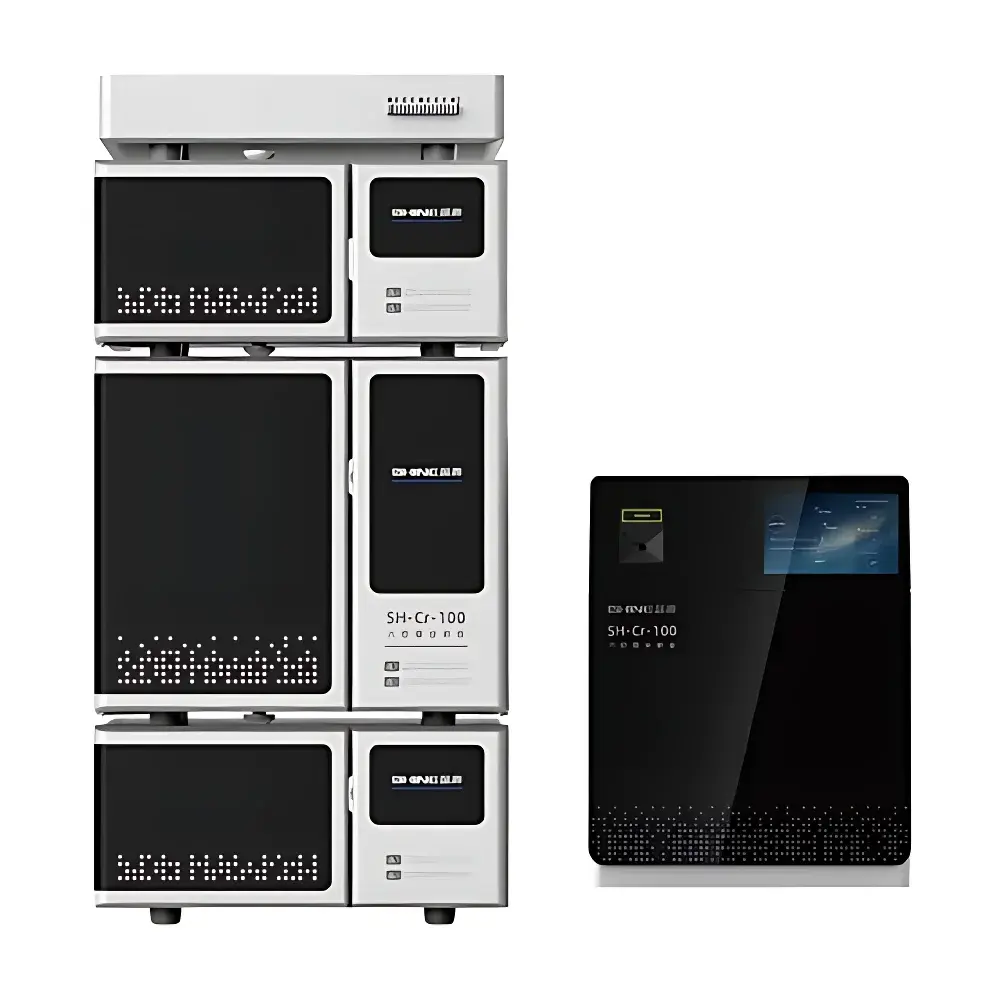
SHINE SH-Cr-100 Hexavalent Chromium Analyzer
| Brand | SHINE |
|---|---|
| Origin | Shandong, China |
| Manufacturer Type | Direct Manufacturer |
| Region Classification | Domestic (China) |
| Model | SH-Cr-100 |
| Instrument Type | Benchtop Laboratory Analyzer |
| Detection Principle | Post-Column Derivatization Coupled with Ion Chromatography–UV/Vis Spectrophotometry |
| Target Analyte | Chromium(VI) |
| Analysis Time | ≤3 min per sample |
| Accuracy/Precision | ±3% RSD |
| Detection Resolution | 0.01 ppb (as Cr(VI)) |
| Detection Range | 0.01 ppb – 10 ppm (as Cr(VI)) |
| Optical Detection Wavelength | 540 nm |
| Derivatization Reagent | 1,5-Diphenylcarbazide (DPC) in acidic medium |
| Compliance | Designed for ASTM D5281, ISO 17294-2, and EPA Method 218.7 workflows |
Overview
The SHINE SH-Cr-100 Hexavalent Chromium Analyzer is a dedicated benchtop laboratory instrument engineered for the selective, sensitive, and regulatory-compliant quantification of chromium(VI) in aqueous environmental samples—including drinking water, surface water, wastewater, leachates, and industrial effluents. Unlike generic spectrophotometric or electrochemical systems, the SH-Cr-100 implements a validated two-step analytical strategy: high-resolution anion-exchange ion chromatography (IC) followed by on-line post-column derivatization with 1,5-diphenylcarbazide (DPC). In acidic conditions, Cr(VI) oxidizes DPC to form a stable, intensely colored diphenylcarbazone–Cr(III) complex with maximum absorbance at 540 nm. This approach eliminates interferences from Cr(III), Fe(III), Mo(VI), and V(V), which commonly compromise direct colorimetric methods. The system’s dual high-performance IC pumps—separately optimized for separation and reagent delivery—ensure pulse-free derivatization flow, critical for baseline stability and sub-ppt detection capability. Its architecture conforms to the core technical requirements of EPA Method 218.7, ISO 17294-2:2016, and ASTM D5281, making it suitable for laboratories operating under GLP, ISO/IEC 17025, or state-certified environmental testing frameworks.
Key Features
- Dual independent high-pressure IC pumps: One for eluent delivery (separation column), one for precise, low-pulse derivatization reagent infusion—minimizing baseline noise and enhancing signal-to-noise ratio
- Integrated UV/Vis photometer with fixed 540 nm wavelength optics and temperature-stabilized flow cell for reproducible absorbance measurement
- Automated column switching and valve sequencing enabling unattended analysis of up to 48 samples per batch via optional autosampler interface
- High-resolution anion-exchange column (e.g., AS23 or equivalent) with carbonate/bicarbonate eluent system for baseline separation of Cr(VI) from common anions (Cl⁻, SO₄²⁻, NO₃⁻, PO₄³⁻)
- Touchscreen HMI (10.1″ capacitive display) with embedded firmware supporting method storage, calibration curve generation, QC flagging, and audit-ready event logging
- Modular design with field-replaceable components (pump seals, detector lamp, column oven) to minimize downtime and extend service intervals
Sample Compatibility & Compliance
The SH-Cr-100 accepts clarified, filtered (0.45 µm membrane), and acid-preserved (HNO₃, pH <2) aqueous samples without matrix-induced suppression or enhancement effects. It supports direct injection of drinking water and low-TDS surface waters; higher-matrix samples (e.g., landfill leachate, electroplating rinse water) require dilution or solid-phase extraction (SPE) pretreatment using Cr(VI)-selective cartridges (e.g., Agilent Bond Elut EPA 300). All operational parameters—including gradient profile, derivatization flow rate, reaction coil length, and dwell time—are configurable to meet method-specific validation criteria. Data output complies with 21 CFR Part 11 requirements when paired with SHINE’s optional LIMS-integrated workstation software, including electronic signatures, audit trails, and secure user access levels (admin/operator/analyst).
Software & Data Management
Control and data acquisition are managed via SHINE ChromoLink™ v3.2 software, a Windows-based platform supporting ICH Q2(R2)-aligned validation documentation templates. The software enables real-time chromatogram visualization, peak integration using tangent skim or valley-to-valley algorithms, multi-point linear/nonlinear calibration (including weighted least-squares), and automatic limit checking against regulatory thresholds (e.g., EPA MCL = 10 µg/L for Cr(VI) in drinking water). Raw data files (.chd) are stored in vendor-neutral format with embedded metadata (instrument ID, operator, timestamp, method version, QC results). Export options include CSV, PDF analytical reports, and XML for seamless ingestion into ELN or LIMS platforms.
Applications
- Regulatory compliance monitoring for Cr(VI) in municipal drinking water per U.S. EPA Unregulated Contaminant Monitoring Rule (UCMR 5) and EU Drinking Water Directive (2020/2184)
- Industrial wastewater discharge verification under NPDES permits and ISO 14001 environmental management systems
- Soil and sediment leaching studies (TCLP/SPLP extracts) per EPA Methods 1311/1312
- Quality control of chromate conversion coatings in aerospace and automotive manufacturing
- Research applications involving redox speciation kinetics and Cr(VI) reduction pathways in natural attenuation studies
FAQ
What regulatory methods does the SH-Cr-100 validate against?
The system is configured to meet the instrumental and procedural specifications of EPA Method 218.7, ISO 17294-2:2016, and ASTM D5281. Full method validation kits—including certified reference materials (CRMs), column qualification standards, and derivatization reagent stability protocols—are available upon request.
Can the SH-Cr-100 quantify Cr(VI) in seawater or high-chloride matrices?
Yes—with appropriate matrix-matched calibration and use of a chloride-tolerant separation column (e.g., Thermo Scientific Dionex IonPac AS22-4µm). Chloride interference is mitigated by optimizing eluent concentration and gradient slope to resolve Cr(VI) from Cl⁻ within 8 minutes.
Is column regeneration or cleaning required between runs?
No routine regeneration is needed. The AS23-type column demonstrates >2,000 injections stability under standard operating conditions. A weekly 10-minute NaOH flush (0.1 M) is recommended for long-term retention time reproducibility.
Does the system support remote diagnostics or predictive maintenance?
Yes—via optional Ethernet-connected SHINE RemoteCare™ module, which monitors pump pressure profiles, lamp intensity decay, and seal wear metrics, triggering service alerts before performance drift occurs.
What is the typical lifetime of the DPC reagent solution?
When stored refrigerated (4 °C) under inert gas and protected from light, the DPC reagent remains stable for ≥72 hours with ≤2% absorbance drift at 540 nm—sufficient for full-shift operation.
Related Products







