
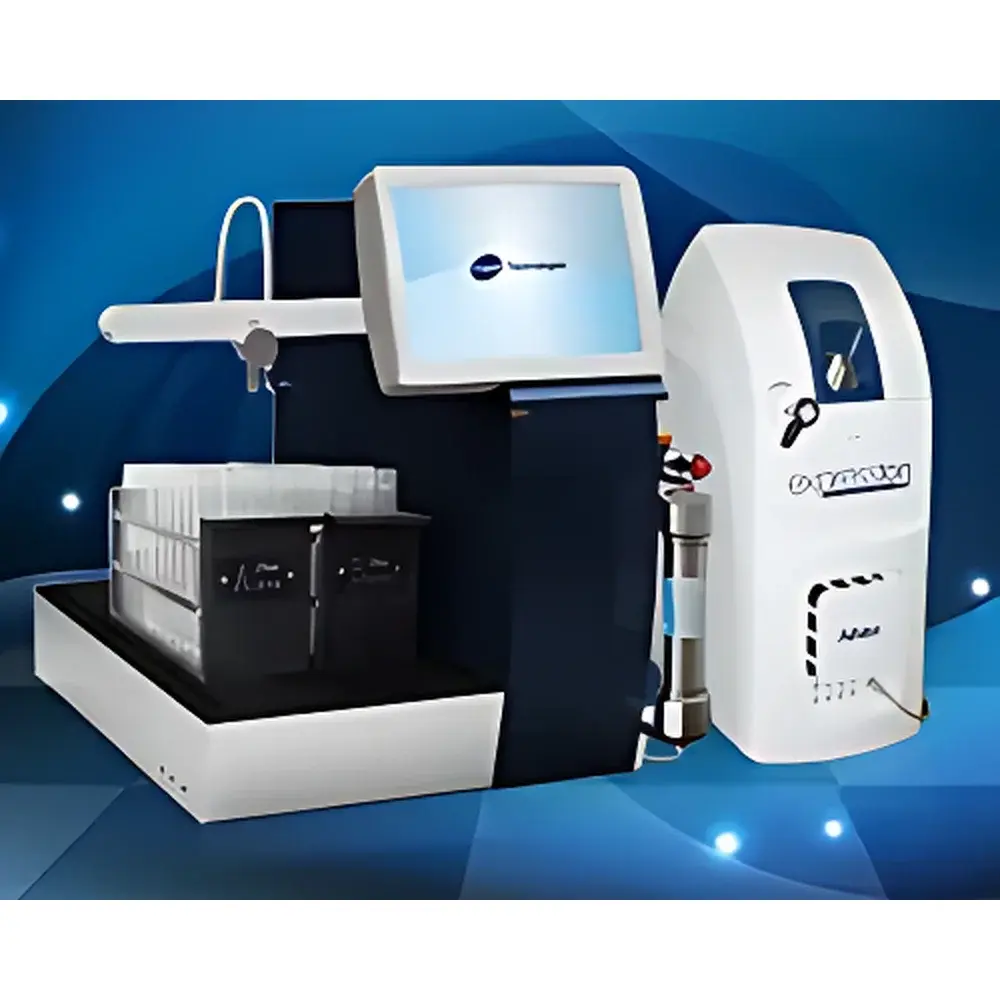
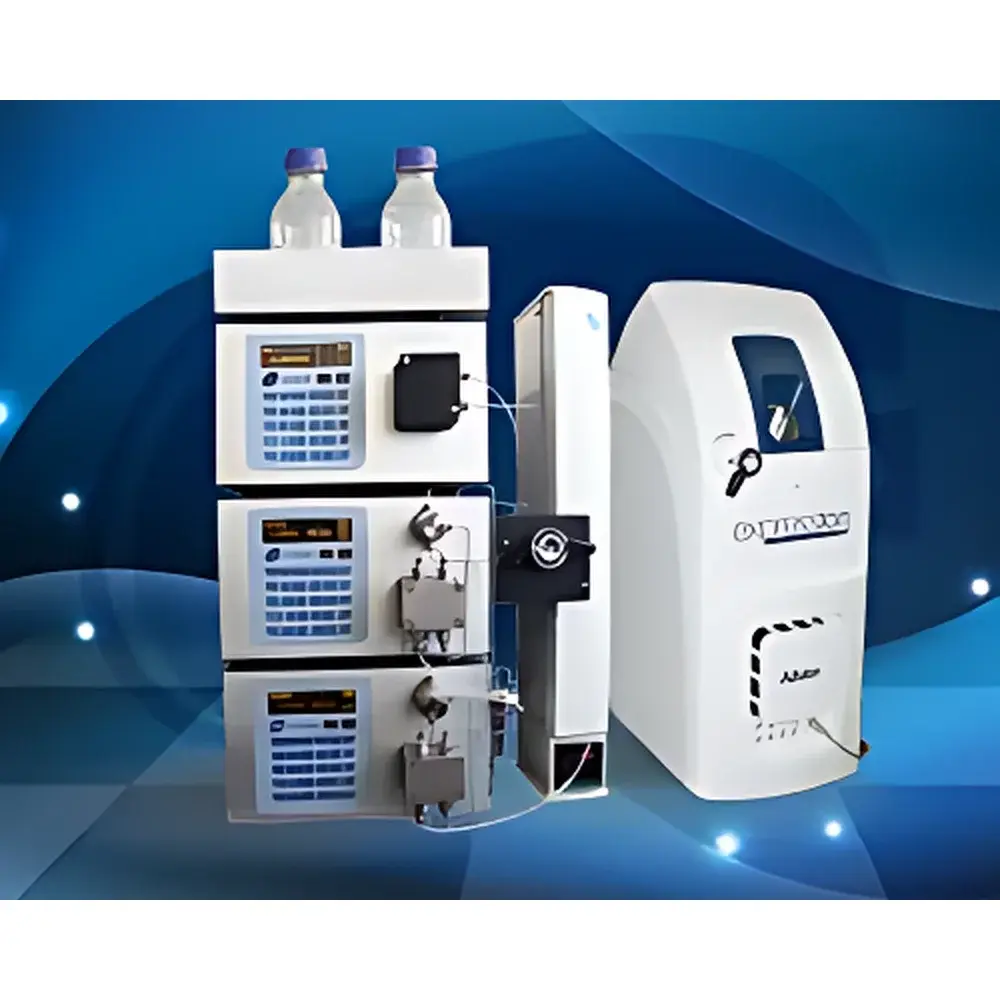
Agela CHEETAH cMS Liquid Chromatography-Mass Spectrometry System
| Brand | Agela |
|---|---|
| Model | CHEETAH HP100 / Agela cMS |
| Instrument Type | Single Quadrupole LC-MS |
| Mass Range | m/z 10–1200 |
| Sensitivity | S/N ≥ 100:1 (100 pg reserpine, full scan |
| Resolution | 0.5–0.7 Da (FWHM) |
| Mass Accuracy | ±0.1 Da |
| Mass Stability | ±0.1 Da |
| ESI Ion Source | Standard |
| Polarity | Positive/Negative Switchable |
| Scan Speed | 5000 Da/sec (UPLC-compatible) |
| Flow Rate Compatibility | 10–100 µL/min |
| HPLC/Purification Pump Flow Range | 0.1–100 mL/min |
| Max Pressure | 20 MPa |
| UV Detection | 200–400 nm (D₂ lamp), optional 200–800 nm (D₂ + W lamp) |
| Wavelength Accuracy | ±1 nm |
| Bandwidth | 8 nm |
| Flow Precision | ±1% |
| Flow RSD | ≤0.3% |
| Pressure Pulsation | ≤0.3 MPa |
| Fraction Collector | 2D robotic, customizable coordinates, tube sizes: 13/15/18/25 mm |
| Operating System | Windows XP (industrial-grade PC) |
| Compliance | Designed for GLP-compliant workflows |
Overview
The Agela CHEETAH cMS is an integrated liquid chromatography–mass spectrometry (LC-MS) platform engineered to bridge analytical characterization and preparative-scale purification in a single, unified workflow. Unlike conventional LC-MS systems optimized solely for detection, the CHEETAH cMS uniquely combines a high-pressure preparative liquid chromatograph (CHEETAH HP100) with a robust single quadrupole mass spectrometer (cMS) via proprietary valve-switching interface technology. This architecture enables real-time MS-triggered fraction collection—allowing users to isolate target compounds directly from complex mixtures based on accurate mass identification, not just UV absorbance. The system operates on the principle of electrospray ionization (ESI) coupled with quadrupole mass filtering, delivering reliable unit-resolution mass analysis across m/z 10–1200 with sub-Da resolution (0.5–0.7 Da FWHM) and mass accuracy maintained within ±0.1 Da over extended acquisition periods.
Key Features
- Integrated dual-function platform: Simultaneous analytical LC-MS analysis and preparative-scale compound isolation (0.1–100 mL/min flow range, up to 20 MPa)
- ESI source with patented right-angle orthogonal ion injection geometry—minimizing solvent cluster interference and enhancing signal stability under high-flow or high-salt conditions
- Single quadrupole mass analyzer with high-energy conversion electron multiplier detector, optimized for sensitivity in both full-scan (S/N ≥ 100:1 at 100 pg reserpine) and selected ion monitoring (SIM) modes (S/N ≥ 100:1 at 10 pg reserpine)
- Modular detection options: Standard UV-Vis diode array detection (200–400 nm); optional tungsten lamp extension (200–800 nm); compatibility with ELSD and RID for non-UV-active analytes
- 2D robotic fraction collector with programmable X-Y coordinate mapping, supporting four standard tube formats (13 mm, 15 mm, 18 mm, 25 mm) and customizable collection logic (time-, peak-, or MS-triggered)
- Industrial-grade Windows XP control computer with touch-screen interface, enabling intuitive method setup, real-time chromatogram/total ion current (TIC) visualization, and on-the-fly gradient and flow rate adjustment
Sample Compatibility & Compliance
The CHEETAH cMS accommodates a broad range of sample matrices—including natural product extracts, synthetic intermediates, pharmaceutical impurities, and metabolite standards—without requiring extensive pre-purification. Its ESI source tolerates moderate levels of buffer salts and organic modifiers common in reversed-phase and HILIC separations. The system’s fluidic path employs SS316 stainless steel, PFA tubing, and quartz flow cells to ensure chemical inertness and minimize adsorption losses. From a regulatory standpoint, the platform is designed to support Good Laboratory Practice (GLP) and current Good Manufacturing Practice (cGMP) environments. When deployed with validated instrument control and data acquisition software (e.g., Agela’s proprietary cMS Suite v3.x or third-party compliant packages), it meets foundational requirements for electronic record integrity under FDA 21 CFR Part 11—including user authentication, audit trail generation, and secure data archiving. While not pre-certified as a Class I medical device, its performance specifications align with ASTM D7242 (for hydrocarbon analysis) and USP chromatographic system suitability criteria when operated within defined method parameters.
Software & Data Management
Control and data handling are managed through a dedicated Windows XP–based application suite that provides synchronized operation of the preparative pump, UV detector, mass spectrometer, and fraction collector. Key software capabilities include method templating for repeatable purification–analysis sequences, real-time TIC and extracted ion chromatogram (XIC) display, automated peak integration with mass-based threshold triggering, and export of raw data in open formats (.mzML, .csv, .cdf). All acquisition events—including valve actuation timestamps, pressure logs, and detector voltage settings—are time-stamped and logged to enable full traceability. The system supports post-run reprocessing with adjustable smoothing, baseline correction, and deconvolution algorithms. For laboratories operating under regulated quality systems, optional software validation packages are available to document installation qualification (IQ), operational qualification (OQ), and performance qualification (PQ) protocols.
Applications
- Targeted isolation of bioactive compounds from botanical extracts or fermentation broths using MS-guided fractionation
- Rapid purity assessment and structural confirmation of synthetic APIs during route scouting and process development
- Impurity profiling and identification in pharmaceutical stability studies per ICH Q3B(R2) guidelines
- Metabolite identification workflows where preparative LC-MS serves as a bridge between in vitro incubation and NMR structure elucidation
- Method development for challenging separations involving isomers, regioisomers, or labile molecules requiring gentle ionization and immediate fraction recovery
- Quality control of column-packed materials (e.g., C18, phenyl-hexyl, HILIC phases) using standardized test mixtures with MS-verified elution profiles
FAQ
Is the CHEETAH cMS compatible with UPLC systems?
Yes—the cMS detector supports scan speeds up to 5000 Da/sec and accepts flow rates from 10–100 µL/min, making it fully compatible with ultra-high-performance liquid chromatography (UPLC) gradients and narrow-bore columns.
Can the system operate in negative ion mode?
Yes—the ESI source supports rapid polarity switching between positive and negative modes within a single run, enabling comprehensive coverage of ionizable compounds without hardware reconfiguration.
What level of mass accuracy can be expected during long-duration runs?
Under standard calibration conditions (e.g., lock mass correction using infused tuning compound), mass stability remains within ±0.1 Da over 8-hour continuous acquisition, meeting typical requirements for semi-quantitative identification in natural products research.
Does the system support 21 CFR Part 11 compliance out-of-the-box?
The hardware architecture supports audit-trail-capable software deployment; however, full 21 CFR Part 11 compliance requires validated software configuration, role-based access controls, and electronic signature implementation—services available through Agela’s professional support team.
Are consumables such as ESI needles and quadrupole rods supplied by Agela?
Yes—Agela provides OEM-specified replacement parts including ESI emitters, skimmer cones, quadrupole assemblies, and UV flow cells, all manufactured to original dimensional and material specifications.





