
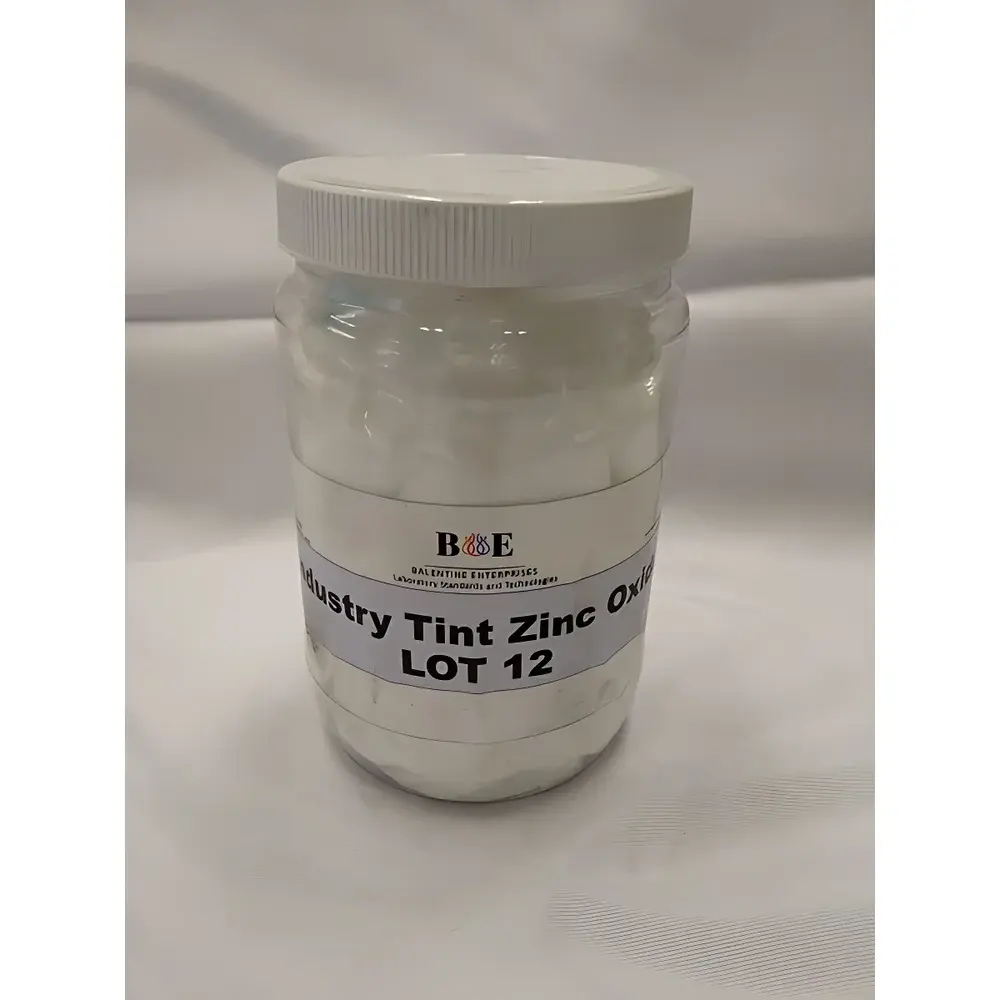
Balentine Enterprises ASTM D3265 Certified Zinc Oxide for Colorant Applications
| Brand | Balentine Enterprises (B&E) |
|---|---|
| Origin | USA |
| Supplier Type | Authorized Distributor |
| Import Status | Imported |
| Model | D3265 ZnO |
| Price | Upon Request |
| Specific Surface Area | 2.97 m²/g |
| Pb Content | ≤0.0011% |
| Cd Content | <0.0001% |
| Fe Content | <0.0001% |
| Moisture | 0.09% |
| ZnO Purity | >99.9% |
| +325 Mesh Retain | <0.0001% |
Overview
Balentine Enterprises ASTM D3265 Certified Zinc Oxide is a high-purity, specification-grade zinc oxide material explicitly manufactured and tested in strict conformance with ASTM D3265 – Standard Specification for Zinc Oxide Used in Pigment and Colorant Applications. Unlike generic industrial-grade ZnO, this material is engineered for reproducible optical performance, chemical consistency, and minimal interference in colorimetric systems—particularly where zinc oxide serves as a white pigment base, UV-absorbing co-pigment, or functional additive in chromophore-stabilized formulations. Its compliance with ASTM D3265 ensures traceable batch-to-batch equivalence in critical parameters including surface area, heavy metal impurities (Pb, Cd, Fe), moisture content, particle size distribution (via +325 mesh retention), and minimum ZnO assay. The material is synthesized via the French process (indirect method), yielding particles with controlled morphology, low agglomeration tendency, and intrinsic UV absorption (UVA/UVB) due to its wide bandgap (~3.3 eV). It is not a nanoscale dispersion or colloidal suspension; rather, it is a dry, free-flowing, micronized powder with primary particle dimensions typically ranging from 100–500 nm—optimized for compatibility with pigment grinding, resin dispersion, and ink formulation processes under ISO 8781-2 and ASTM D281 test protocols.
Key Features
- Full compliance with ASTM D3265 specification—including certified test reports for specific surface area (2.97 m²/g), ZnO purity (>99.9%), and heavy metal limits (Pb ≤ 0.0011%, Cd < 0.0001%, Fe < 0.0001%)
- Low moisture content (0.09%) ensuring minimal hydrolytic degradation during storage and improved stability in solvent-based and high-solids coating systems
- Controlled +325 mesh retention (<0.0001%) confirming absence of coarse grit that could compromise gloss, haze, or print fidelity in premium colorant applications
- High refractive index (n ≈ 1.9) enabling effective light scattering with lower optical opacity than TiO₂ (n ≈ 2.6), thus supporting higher transparency in tinted polymers and cosmetic emulsions
- Surface-treated variants available (silica-, alumina-, or stearate-coated) to enhance dispersibility in polar/non-polar media per ASTM D281-17 and ISO 8781-3
Sample Compatibility & Compliance
This ASTM D3265 ZnO is validated for use in QC/QA laboratories performing pigment qualification per ASTM D442, D1210, and D281; in R&D settings developing UV-stable colorants for automotive clearcoats (SAE J2527), textile dyes (AATCC TM183), and pharmaceutical excipients (USP heavy metals); and in regulatory submissions requiring documented conformance to FDA 21 CFR 73.275 (zinc oxide as color additive) and EU Commission Regulation (EC) No 1223/2009 (cosmetic safety assessment). All batches are accompanied by CoA (Certificate of Analysis) traceable to NIST-traceable reference methods and include full uncertainty budgets for surface area (BET), loss on drying, and ICP-MS–quantified elemental impurities. The material meets GLP documentation requirements for raw material qualification under ISO/IEC 17025-accredited testing environments.
Software & Data Management
While the material itself is a physical reference standard—not an instrument—the associated analytical data package integrates seamlessly into LIMS (Laboratory Information Management Systems) and ELN (Electronic Lab Notebook) platforms via structured CSV or PDF/A-2 compliant CoAs. Each certificate includes unique batch ID, manufacturing date, expiration date (24 months from production under sealed, desiccated storage), and QR-coded access to full audit trail metadata. For customers operating under FDA 21 CFR Part 11, Balentine Enterprises provides digitally signed CoAs with time-stamped electronic signatures and immutable hash verification. Raw test data (e.g., BET isotherms, ICP-MS chromatograms, sieve analysis logs) is retained for 10 years and available upon formal request for GMP or regulatory inspection readiness.
Applications
- Rubber compounding: As a co-activator in sulfur vulcanization systems—reducing ZnO loading by up to 50% while maintaining scorch safety and crosslink density per ASTM D5513
- Ceramic glazes: Functioning as a flux and opacifier in low-temperature frit formulations (≤1100°C), improving thermal expansion matching and reducing crazing per ISO 10545-13
- Functional textiles: Enabling durable UV protection (UPF >50) and antimicrobial activity (ISO 20743) when incorporated into polyester or nylon masterbatches
- Coatings & inks: Delivering superior weatherability in architectural acrylics (ASTM D4587) and improved photostability in organic pigment dispersions (ISO 105-B02)
- Pharmaceutical & cosmetic excipients: Meeting USP , Ph. Eur. 2.2.2, and JP XVII monograph requirements for ZnO used in topical sunscreen products (SPF validation per ISO 24443)
FAQ
Is this material classified as “nanomaterial” under ECHA or OECD definitions?
No. While primary particles fall within the 100–500 nm range, the material is supplied as a dry, non-dispersed, aggregated powder with no intentional nanoformulation. It does not meet the EC No 2011/696/EU definition requiring ≥50% of particles in the 1–100 nm range in number size distribution.
Can this ZnO be used in food-contact applications?
Not without additional certification. ASTM D3265 addresses colorant performance—not food safety. For food-contact use, separate compliance with FDA 21 CFR 182.8991 or EFSA Panel on Food Additives is required.
What is the recommended storage condition to maintain specification integrity?
Store in original sealed container at 15–25°C, relative humidity <40%, away from direct sunlight and oxidizing agents. Avoid repeated opening to prevent moisture uptake beyond 0.15%.
Do you offer custom particle size distributions or surface modifications?
Yes. Balentine Enterprises collaborates with OEM mills and silane suppliers to deliver application-specific variants—e.g., hydrophobic silica-coated grades for polyolefin masterbatches or phosphate-stabilized forms for aqueous inkjet inks—subject to minimum order quantities and extended lead times.



