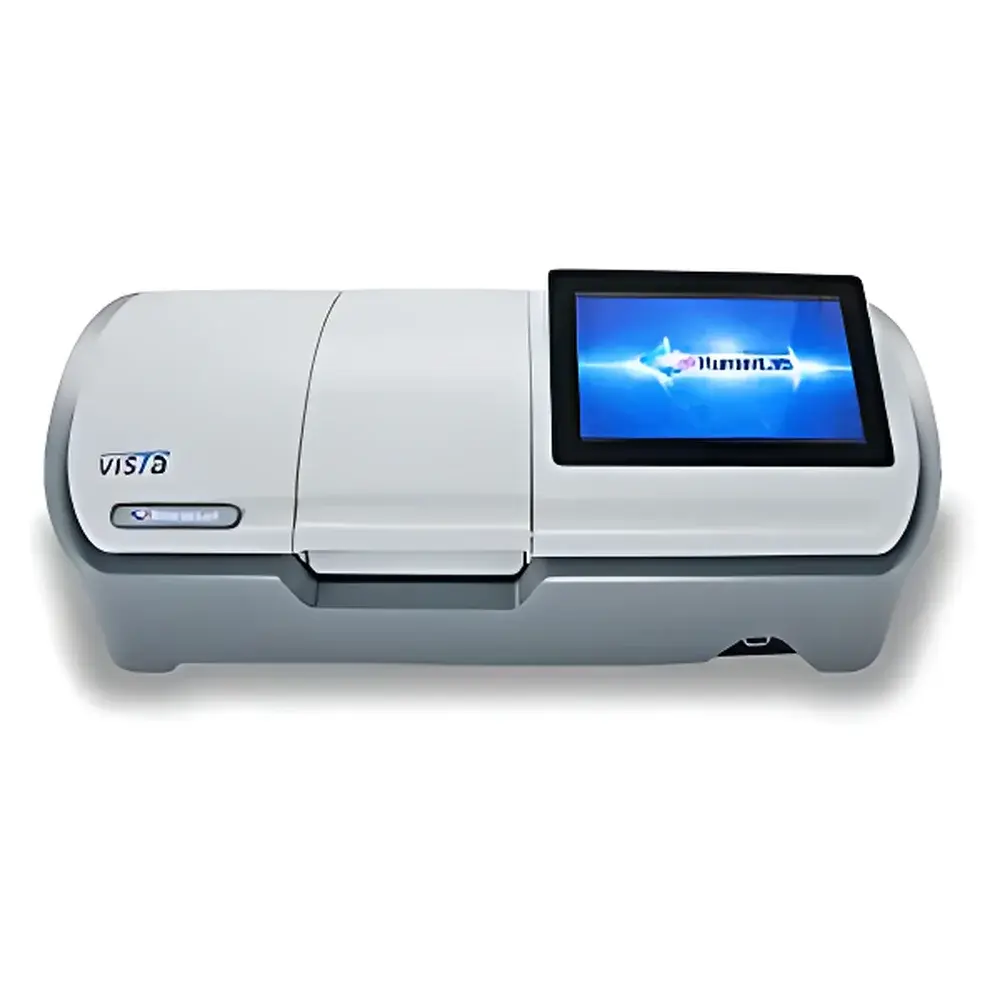
HunterLab Vista Molten Colorimeter for Bisphenol A (BPA)
| Brand | HunterLab |
|---|---|
| Origin | USA |
| Model | Vista |
| Instrument Type | Benchtop Colorimeter |
| Optical Geometry | d/8° Integrating Sphere |
| Light Source | Full-Spectrum LED Array |
| Spectral Range | 400 nm – 700 nm |
| Repeatability | 0.02 ΔE* |
| Compliance | GB/T 6234.7–2014, GB/T 28113–2011, ASTM E1164, CIE 15:2004, ASTM D1003 |
Overview
The HunterLab Vista Molten Colorimeter for Bisphenol A (BPA) is a purpose-engineered benchtop spectrophotometer designed to quantify color and haze in thermally melted organic chemical intermediates—specifically those that are solid at ambient temperature and exhibit optical clarity when molten. Unlike general-purpose colorimeters, the Vista implements a dual-mode optical architecture optimized for high-precision transmission measurement of hot, viscous, and thermally stable samples in standardized melt cells. Its operation adheres to the physical principles of spectrophotometric transmittance analysis under controlled thermal conditions, where spectral reflectance and scattering contributions are minimized through precise d/8° integrating sphere geometry and collimated beam path design. The instrument directly supports regulatory and quality control workflows in fine chemical manufacturing, particularly for BPA purity verification, where molten color serves as a sensitive indicator of oxidation byproducts, trace metal contamination, or thermal degradation.
Key Features
- Full-spectrum LED illumination (400–700 nm) with 5-year rated lifetime and minimal spectral drift—ensuring long-term photometric stability without lamp replacement.
- Dual-mode transmission capability: simultaneous measurement of total transmittance (TTRAN), regular transmittance (RTRAN), and haze (per ASTM D1003) in a single acquisition cycle (<5 s).
- High-fidelity optical train: 256-element diode array detector coupled with a high-resolution concave holographic grating; effective spectral bandwidth <10 nm; wavelength accuracy ±0.5 nm.
- Integrated thermal management interface compatible with standard heated sample holders (e.g., ASTM D1209-compliant quartz cuvettes up to 100 mm pathlength).
- Automatic calibration routine with NIST-traceable ceramic standards; self-diagnostic system monitors LED intensity, detector linearity, and sphere coating integrity.
- Compact footprint (290 × 340 × 320 mm) with spill-resistant sample compartment and ergonomic tilt-adjustable touchscreen (1280 × 800 resolution).
Sample Compatibility & Compliance
The Vista is validated for use with industrially relevant molten-phase organic compounds including bisphenol A (BPA), phenol, phthalic anhydride, maleic anhydride, terephthalic acid dimethyl ester (DMT), trimellitic anhydride (TMA), ethylenediamine, and dioctyl phthalate (DOP). It meets the instrumental requirements of GB/T 6234.7–2014 (“Test methods for organic chemical products — Part 7: Determination of molten color”) and GB/T 28113–2011 (“Industrial bisphenol A — Specifications”), both of which mandate measurement under defined melt temperature, cell geometry, and observer illuminant conditions (CIE D65/10°). Additionally, the system conforms to international metrological standards including CIE 15:2004, ASTM E1164 (practice for obtaining spectrophotometric data), and DIN 5033-7 for colorimetric evaluation. All color and haze data outputs are traceable to SI units and support audit-ready documentation per GLP and ISO/IEC 17025 laboratory accreditation frameworks.
Software & Data Management
Vista operates on embedded ColorQC™ firmware with optional PC-based EasyMatch QC software for advanced reporting and statistical process control (SPC). Data export supports CSV, XML, and PDF formats compliant with FDA 21 CFR Part 11 requirements—including electronic signatures, audit trails, and user-access-level permissions. Measurement sequences can be preconfigured with pass/fail limits aligned to internal specifications or customer-facing certificates of analysis (CoA). Raw spectral data (31-point interpolated at 10 nm intervals) is retained with timestamp, operator ID, environmental sensor logs (ambient temperature/humidity), and instrument calibration history—enabling full forensic traceability during regulatory inspections or technical dispute resolution.
Applications
- Quantitative assessment of BPA batch-to-batch consistency in polymer-grade production lines.
- Early detection of oxidative discoloration during storage or transport of heat-sensitive intermediates.
- Validation of purification efficacy following crystallization or distillation processes.
- Supporting root-cause analysis in nonconformance investigations linked to yellowness index (YI E313), APHA/Pt-Co scale deviations, or haze excursions.
- Enabling automated release testing in continuous manufacturing environments via OPC UA or Modbus TCP integration.
FAQ
What sample temperature range is supported for molten measurements?
The Vista itself does not heat samples; it is designed for integration with externally heated sample cells operating from 80 °C to 180 °C. Users must maintain thermal equilibrium prior to insertion using calibrated heating blocks or circulating baths.
Does the instrument require annual recalibration by HunterLab service engineers?
No. The built-in self-calibration routine and NIST-traceable reference standards enable user-performed verification per ISO/IEC 17025 Section 6.5. Users may perform intermediate checks daily or per shift; formal recalibration is recommended every 12 months or after impact events.
Can haze and color be measured simultaneously on the same sample aliquot?
Yes. The Vista acquires full spectral data in one scan and computes CIE L*a*b*, YI E313, APHA, and ASTM D1003 haze concurrently—eliminating sequential measurement errors and thermal drift between modes.
Is method validation documentation available for GB/T 28113–2011 compliance?
Yes. HunterLab provides a Method Validation Kit including SOP templates, uncertainty budget worksheets, and interlaboratory comparison reports aligned with CNAS-CL01:2018 requirements.