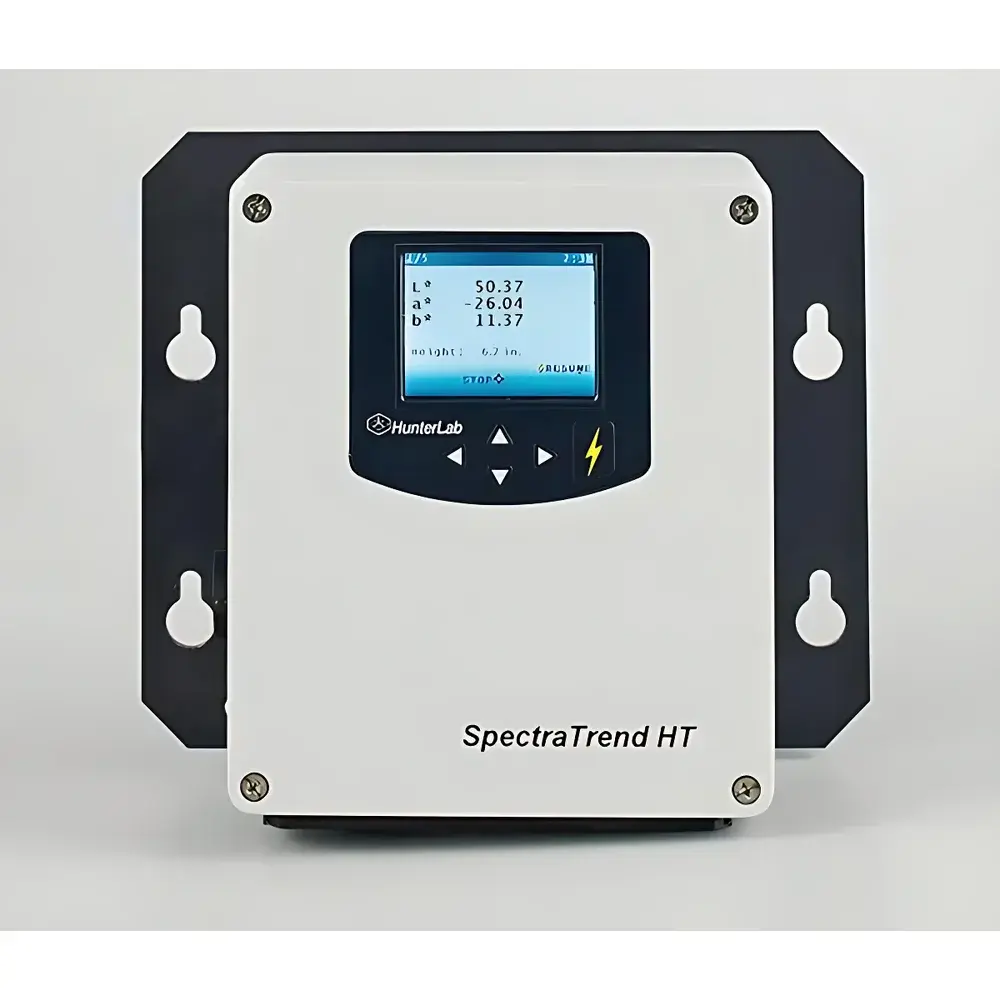
HunterLab SpectraTrend HT Online Color Measurement System for Plastic Pellets
| Brand | HunterLab |
|---|---|
| Origin | USA |
| Model | SpectraTrend HT |
| Product Type | Spectrophotometric Colorimeter |
| Instrument Type | In-line |
| Optical Geometry | 0/45° Integrating Sphere |
| Light Source | Full-spectrum Balanced Solid-State LED System |
| Spectral Range | 400–700 nm |
| Spectral Bandwidth | 10 nm |
| Repeatability (ΔE*ab) | ≤ 0.03 |
| Measurement Distance | Up to 100 mm (4 in) |
| IP Rating | NEMA 4 / IP56 |
| Interface | Standard Ethernet (No RS-232 Required) |
| Software | HunterLab EasyMatch QC v5.x or later |
| Compliance | Supports FDA 21 CFR Part 11 (audit trail, electronic signature), ASTM E308, ISO 11664, CIE No. 15, USP <1061>, GMP/GLP-aligned workflows |
Overview
The HunterLab SpectraTrend HT is an industrial-grade, in-line spectrophotometric color measurement system engineered for continuous, non-contact color and height monitoring of plastic pellets during extrusion, conveying, and blending processes. Operating on the CIE 1931 colorimetric system and compliant with ASTM E308 and ISO 11664 standards, it employs a 0/45° optical geometry with a high-stability solid-state LED source spanning 400–700 nm at 10 nm bandwidth. Unlike benchtop colorimeters, the SpectraTrend HT integrates real-time height sensing—enabling automatic geometric compensation for variable sample position, conveyor belt vibration, or irregular pellet bed depth. This dual-parameter acquisition (L*a*b*, ΔE*ab, and physical height in mm) ensures metrological integrity under dynamic production conditions, supporting Process Analytical Technology (PAT) frameworks and Quality by Design (QbD) initiatives mandated by FDA and ICH guidelines.
Key Features
- Non-contact, high-speed measurement at up to 5 Hz—optimized for moving streams of granular or particulate materials without physical interference.
- Integrated height sensor compensates for distance-induced spectral deviation, correcting color values in real time based on actual sample-to-sensor standoff (range: 25–100 mm).
- Robust NEMA 4 / IP56-rated enclosure designed for harsh manufacturing environments—including dust, moisture, and incidental impact exposure.
- Full-spectrum balanced LED illumination delivers stable, repeatable irradiance across the visible spectrum, eliminating lamp aging drift and reducing calibration frequency.
- Ethernet-native architecture enables direct integration into plant-wide SCADA, MES, or PLC networks—no serial converters, COM port dependencies, or distance-limited cabling.
- Factory-calibrated inter-instrument agreement (IIA) ensures consistent color reporting across multiple units deployed across global production lines or supplier sites.
Sample Compatibility & Compliance
The SpectraTrend HT is validated for heterogeneous, free-flowing materials including virgin and recycled plastic pellets (PP, PE, PET, ABS), food-grade granules (cereal, snack pieces, frozen dough), and coated particles (vinyl, metal flakes, pharmaceutical excipients). Its 0/45° geometry minimizes directional reflectance artifacts common in textured or semi-crystalline surfaces. The system supports Good Manufacturing Practice (GMP) and GLP compliance through configurable user roles, audit-trail-enabled EasyMatch QC software, and full 21 CFR Part 11 functionality—including electronic signatures, data immutability, and revision-controlled method storage. All spectral and colorimetric outputs conform to CIE 15:2018, ISO/CIE 11664-4:2019, and ASTM D2244 for color difference reporting.
Software & Data Management
HunterLab EasyMatch QC v5.5+ serves as the central interface for configuration, real-time visualization, and statistical process control. It displays synchronized L*a*b*, ΔE*ab, and height trends; generates SPC charts (X-bar/R, CUSUM); exports raw spectra and processed color data directly to Microsoft Excel (.xlsx) or CSV formats; and supports custom report templates compliant with internal QA protocols or external customer requirements. The software allows tolerance definition per color space (CIELAB, CMC, DIN99, DE2000), automated Pass/Fail flagging, and seamless integration with LIMS or SAP QM modules via ODBC or REST API. Audit trails log all user actions, parameter changes, and calibration events—fully traceable for regulatory inspection.
Applications
The SpectraTrend HT is deployed in polymer compounding lines to detect masterbatch dispersion inconsistencies before pelletizing; in food extrusion systems to monitor browning kinetics of baked snacks or meat analogs; in pharmaceutical continuous manufacturing to verify color uniformity of coated tablets or granules; and in recycling facilities to sort post-consumer plastics by spectral fingerprint. Typical use cases include: real-time detection of off-spec batches during startup/shutdown transitions; closed-loop feedback to extruder barrel temperature zones; correlation of color shift with melt index or thermal degradation; and validation of cleaning-in-place (CIP) efficacy via residual pigment detection on conveyors.
FAQ
What is the maximum allowable conveyor speed for reliable measurement?
The system supports material velocities up to 1.2 m/s when configured with appropriate sampling window timing and height-triggered acquisition logic.
Can the SpectraTrend HT distinguish between surface oxidation and bulk discoloration in polyolefins?
While not a subsurface probe, its 0/45° geometry combined with spectral derivative analysis in EasyMatch QC enables empirical differentiation of surface vs. bulk effects when correlated with accelerated aging studies.
Is factory recalibration required annually?
No scheduled recalibration is mandated; however, verification using NIST-traceable ceramic tiles or certified plastic standards is recommended quarterly per ISO/IEC 17025 quality systems.
Does the system support custom color spaces beyond CIELAB?
Yes—EasyMatch QC includes built-in calculation engines for CMC(2:1), DIN99, DE2000, Yellowness Index (ASTM E313), Whiteness Index (CIE/ISO 11475), and user-defined multi-variable indices.
How is background interference from conveyor belts mitigated?
The height sensor triggers measurement only when a pellet is within the optimal focal zone; background subtraction algorithms further suppress spectral contributions from underlying substrates using real-time baseline referencing.