
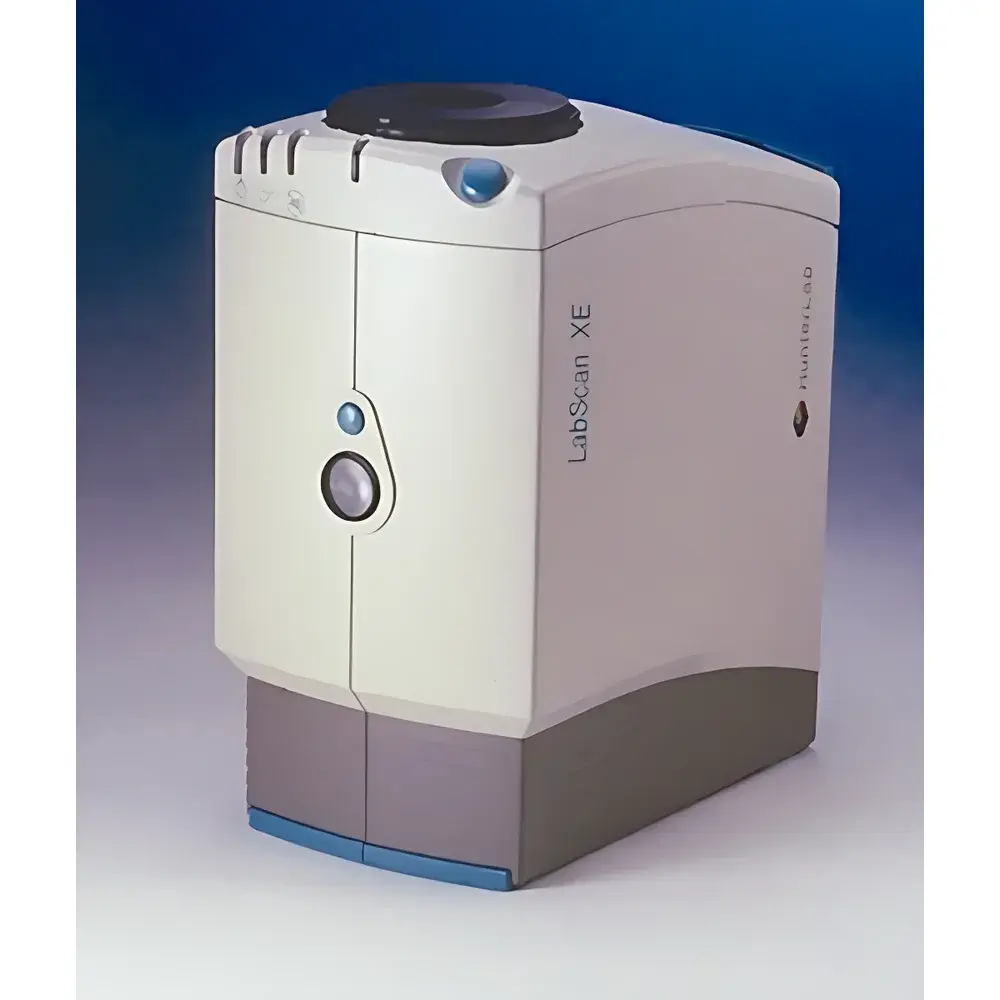
HunterLab LabScan XE Color Difference Meter
| Brand | HunterLab |
|---|---|
| Origin | USA |
| Model | LSXE |
| Instrument Type | Benchtop |
| Optical Geometry | 0°/45° Integrating Sphere |
| Light Source | Pulsed Xenon Lamp |
| Spectral Range | 400–700 nm |
| Wavelength Interval | 10 nm |
| Detector | 256-element Silicon Photodiode Array |
| Spectral Separation | Diffraction Grating |
| Repeatability | ≤ 0.09 ΔE* (CIELAB, avg. of 20 readings on white tile) |
| Measurement Aperture | Standard 44 mm LAV (5 apertures available: 3, 8, 15, 25, 44 mm) |
| Measurement Time | ≤ 3 s |
| Reflectance Range | 0–150% |
| Illuminant | CIE D65 (Xenon + UV-filtered optics) |
| Compliance | ASTM E308, ISO 7724-1, CIE No. 15, USP <1061>, FDA 21 CFR Part 11 (with EasyMatch-QC v5.0+) |
| Operating Temp. | 10–40 °C |
| Storage Temp. | −20–70 °C |
| Humidity | 10–90% RH (non-condensing) |
| Interface | RS-232C, optional USB/Ethernet via PC adapter |
Overview
The HunterLab LabScan XE is a high-precision benchtop spectrophotometer engineered for color measurement under standardized 0°/45° optical geometry. Unlike diffuse d/8° instruments, the LSXE replicates human visual perception by eliminating directional scattering effects from surface texture—making it uniquely suited for evaluating appearance-critical materials where gloss, grain, weave, or embossing influence perceived color. Its dual-beam optical architecture, combined with pulsed xenon illumination and diffraction-grating-based spectral separation, ensures stable photometric response across the visible spectrum (400–700 nm) with 10 nm reporting intervals. The instrument conforms to CIE 15:2018, ISO 7724-1, and ASTM E308 for spectral data acquisition and colorimetric computation, delivering CIELAB (L*, a*, b*), ΔE*00, whiteness (WI), yellowness (YI), K/S, opacity, metamerism index, and spectral reflectance curves—all traceable to NIST-calibrated standards.
Key Features
- 0°/45° fixed-angle optical design optimized for texture-sensitive samples—minimizes inter-instrument and observer variability in QC environments;
- Pulsed xenon lamp with D65 spectral simulation and enhanced UV output, enabling accurate assessment of fluorescent whitening agents (FWAs) per ISO 105-J03 and Hohensteiner textile certification protocols;
- Five interchangeable apertures (3 mm to 44 mm LAV), supporting heterogeneous surfaces, small parts, and bulk powders without repositioning or averaging artifacts;
- Ring-shaped photodetector array compensates for polarization effects in coated films, laminated substrates, and woven textiles;
- Auto-focusing variable-optics system reduces stray light contribution, improving signal-to-noise ratio—particularly critical at low reflectance or near-spectral boundaries;
- Integrated status LEDs and top-mounted trigger button streamline operator workflow in high-throughput production labs;
- Robust thermal management enables stable operation across ambient temperatures from 10–40 °C, meeting GLP-compliant environmental requirements.
Sample Compatibility & Compliance
The LabScan XE accommodates opaque solids (e.g., plastic pellets, painted panels, ceramic tiles), translucent films, liquids (in cuvettes), and textured fabrics—including denim, nonwovens, and brushed metals. Its 0°/45° geometry inherently rejects specular components, eliminating the need for gloss traps or mechanical gloss compensation. Regulatory alignment includes full support for pharmaceutical color control per USP , food-grade pigment verification per FDA guidance, and automotive paint conformity per SAE J1545. When paired with HunterLab’s IQ/OQ/PQ validation kits, the system satisfies GMP audit requirements including 21 CFR Part 11 electronic record integrity, user-access controls, and audit-trail generation.
Software & Data Management
Controlled via HunterLab EasyMatch-QC v5.0+, the LSXE supports automated pass/fail evaluation against multi-limit tolerances (ΔL*, Δa*, Δb*, ΔE*, ΔC*, ΔH*), batch trending, and SPC charting. The software provides full spectral data export (CSV, XML, CxF/x), cross-platform compatibility with third-party formulation systems (e.g., Datacolor MATCHTEXT, X-Rite InkFormulation), and customizable reporting templates compliant with ISO/IEC 17025 documentation standards. All measurements include embedded metadata: date/time stamp, operator ID, instrument serial number, calibration history, and environmental conditions—ensuring full traceability for internal audits and regulatory submissions.
Applications
- Plastics: PET, PP, ABS, EVA pellet and powder color consistency across extrusion batches;
- Coatings & Inks: Quantitative hue shift analysis during solvent evaporation or curing;
- Textiles: Shade matching for dyed denim, reactive-printed cotton, and UV-stabilized outdoor fabrics;
- Pharmaceuticals: Tablet coating uniformity, capsule shell color release testing per ICH Q5C;
- Foods: Natural pigment stability monitoring (e.g., anthocyanins in berries, curcumin in spices);
- Building Materials: Color retention evaluation of weathered metal cladding and mineral-coated roofing sheets.
FAQ
Does the LabScan XE require annual recalibration?
Yes—HunterLab recommends annual factory recalibration using NIST-traceable ceramic tiles and spectral irradiance standards. Field verification with supplied calibration check tiles should be performed daily or per shift.
Can the LSXE measure fluorescent samples accurately?
Yes—the pulsed xenon source delivers elevated UV energy (360–400 nm) and is optically filtered to match CIE D65, enabling reliable FWA quantification per ISO 11475 and ASTM D6290.
Is the 0°/45° geometry suitable for metallic or pearlescent finishes?
No—metallic, gonio-apparent, or effect pigments require multi-angle goniophotometry (e.g., X-Rite MA98 or BYK-mac). The LSXE is optimized for non-iridescent, texture-dependent surfaces.
What spectral resolution does the LSXE provide?
It reports reflectance at 10 nm intervals across 400–700 nm (61 data points), with optical bandwidth ≤ 10 nm FWHM as defined by CIE 15:2018.
How is compliance with FDA 21 CFR Part 11 achieved?
Through EasyMatch-QC’s role-based access control, electronic signatures, immutable audit trails, and secure data encryption—validatable using HunterLab’s IQ/OQ documentation package.




