
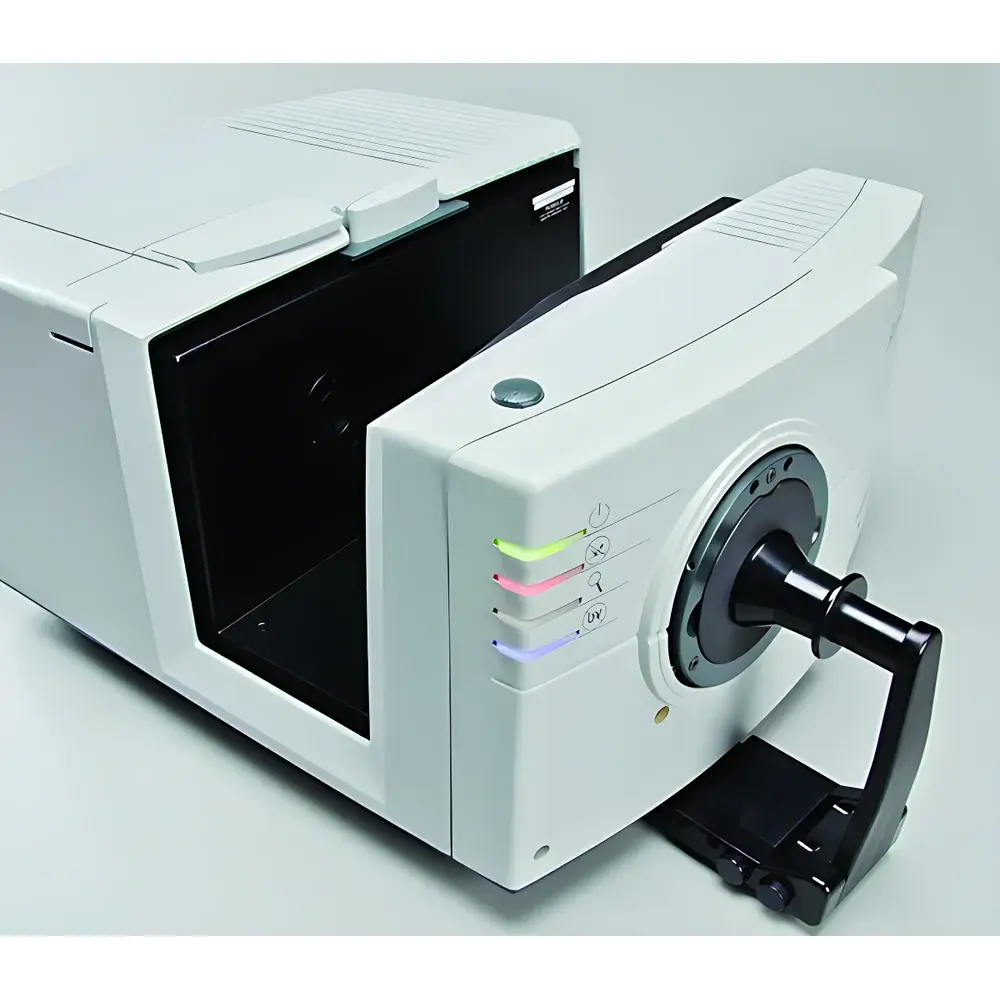
HunterLab UltraScan VIS Platinum-Cobalt / Gardner / Color Measurement Instrument
| Brand | HunterLab |
|---|---|
| Origin | USA |
| Manufacturer Type | Authorized Distributor |
| Product Category | Imported Instrument |
| Model | UltraScan VIS Platinum-Cobalt / Gardner / Color Measurement Instrument |
| Product Type | Colorimeter |
| Instrument Form Factor | Benchtop |
| Optical Geometry | d/8° Integrating Sphere |
| Light Source | Pulsed Xenon Lamp |
| Spectral Range | 360 nm – 780 nm |
| Repeatability | ΔE* ≤ 0.03 |
Overview
The HunterLab UltraScan VIS Platinum-Cobalt / Gardner / Color Measurement Instrument is a high-precision benchtop spectrophotometer engineered for quantitative color, haze, and transmission analysis across liquid, solid, and translucent samples. Based on CIE-recommended spectral response (360–780 nm), it employs dual-beam silicon photodiode array detection with real-time reference beam correction—ensuring stability against lamp drift and thermal variation. Its d/8° integrating sphere geometry conforms to ASTM D1003 (haze), ASTM D5386 (liquid color), ISO 7724, and CIE No. 15:2018, enabling compliant measurement of diffuse transmittance, specular-included (SCI) and specular-excluded (SCE) reflectance, and Yellowness Index (YI), Platinum-Cobalt (Pt-Co), and Gardner scale values. Designed for laboratory environments demanding traceable, repeatable results, the UltraScan VIS delivers <0.03 ΔE* repeatability under controlled conditions—meeting GLP and GMP-aligned operational requirements.
Key Features
- Robust optical platform constructed from precision-machined stainless steel and vibration-damped base structure—minimizing mechanical drift and optical misalignment.
- Dual-aperture system (25 mm and 9.5 mm port diameters) accommodates diverse sample formats including large-volume cuvettes, opaque solids, and thin films without reconfiguration.
- Pulsed xenon lamp with D65 spectral simulation provides stable, flash-based illumination—eliminating heat-induced sample degradation and enabling rapid (<2 s) full-spectrum acquisition.
- Integrated SCE/SCI mode switching via motorized baffle—automatically configurable per measurement protocol for consistent compliance with ASTM E308, ISO 11664, and USP <631>.
- Ergonomic sample stage with three-sided open access and adjustable height support—optimized for bottles, tablets, plaques, and irregularly shaped specimens.
- Internally coated measurement port with spectrally neutral matte finish—reducing stray light and ensuring uniform field illumination across all aperture sizes.
Sample Compatibility & Compliance
The UltraScan VIS supports rigorous color evaluation of transparent liquids (e.g., beverages, solvents, pharmaceuticals), translucent polymers (PET preforms, automotive glazing), opaque solids (paint chips, ceramic tiles, textile swatches), and semi-crystalline materials (milk, silica suspensions). Its d/8° sphere design enables accurate transmission assessment of turbid media per ASTM D1003 and ISO 14782. The instrument meets essential regulatory frameworks including FDA 21 CFR Part 11 (when used with validated EasyMatch QC software), ISO/IEC 17025 calibration traceability (NIST-traceable standards included), and ICH Q5E stability-indicating methodology requirements. Optional accessories—including liquid cell holders, powder cells, and haze compensation kits—extend compliance to ASTM D3159 (plastic film clarity) and ASTM D6290 (pigment dispersion quality).
Software & Data Management
Operated exclusively via HunterLab’s EasyMatch QC v5.x software, the UltraScan VIS supports audit-trail-enabled workflows compliant with 21 CFR Part 11 Annex 11 and GLP documentation standards. Software features include customizable pass/fail tolerances per L*a*b*, YI, Pt-Co, or Gardner indices; statistical process control (SPC) charting with Cp/Cpk calculation; multi-instrument fleet synchronization; and export to CSV, XML, or LIMS-compatible formats. Built-in wavelength validation uses certified holmium oxide and neutral density filters—automatically logged with timestamp, operator ID, and environmental metadata (temperature/humidity). All calibrations are stored with electronic signatures and version-controlled revision history.
Applications
This instrument serves as a primary color measurement platform in quality control laboratories across industries requiring standardized visual assessment: beverage formulation (juice, dairy, syrups), polymer manufacturing (PET bottle preforms, automotive lenses), pharmaceutical excipient release testing (liquid APIs, suspensions), paint & coatings (pigment dispersion consistency), cosmetics (lipstick opacity, foundation shade matching), and industrial chemicals (sulfuric acid yellowness, silicone fluid clarity). Its ability to resolve subtle hue shifts in saturated reds and deep blacks—without metamerism-related error—makes it critical for R&D validation where spectral fidelity outweighs speed.
FAQ
Does the UltraScan VIS comply with ASTM D1209 and D5386 for platinum-cobalt color measurement?
Yes—its 360–780 nm spectral range, NIST-traceable calibration, and integrated Pt-Co algorithm meet all requirements of ASTM D1209 (water-white liquids) and D5386 (non-aqueous transparent liquids).
Can it measure haze and clarity of plastic sheets per ASTM D1003?
Yes—the d/8° sphere geometry, calibrated haze reference tile, and automated %Haze calculation module satisfy both Method A (total transmittance) and Method B (diffuse transmittance) protocols.
Is the instrument suitable for measuring metallic or pearlescent coatings?
No—this model does not support multi-angle gonio-spectrophotometry. For effect pigments, HunterLab recommends the MiniScan EZ or UltraScan PRO with optional 45°/0° geometry.
What maintenance is required beyond daily calibration?
Annual NIST-traceable recalibration is recommended; no lamp replacement is needed during typical 5-year service life due to xenon flash longevity (>2 million flashes).
How is data integrity ensured during networked operation?
EasyMatch QC enforces role-based access control, electronic signatures, and immutable audit logs synchronized with domain authentication servers—fully aligned with ISO 13485 and ICH GCP data governance mandates.





