
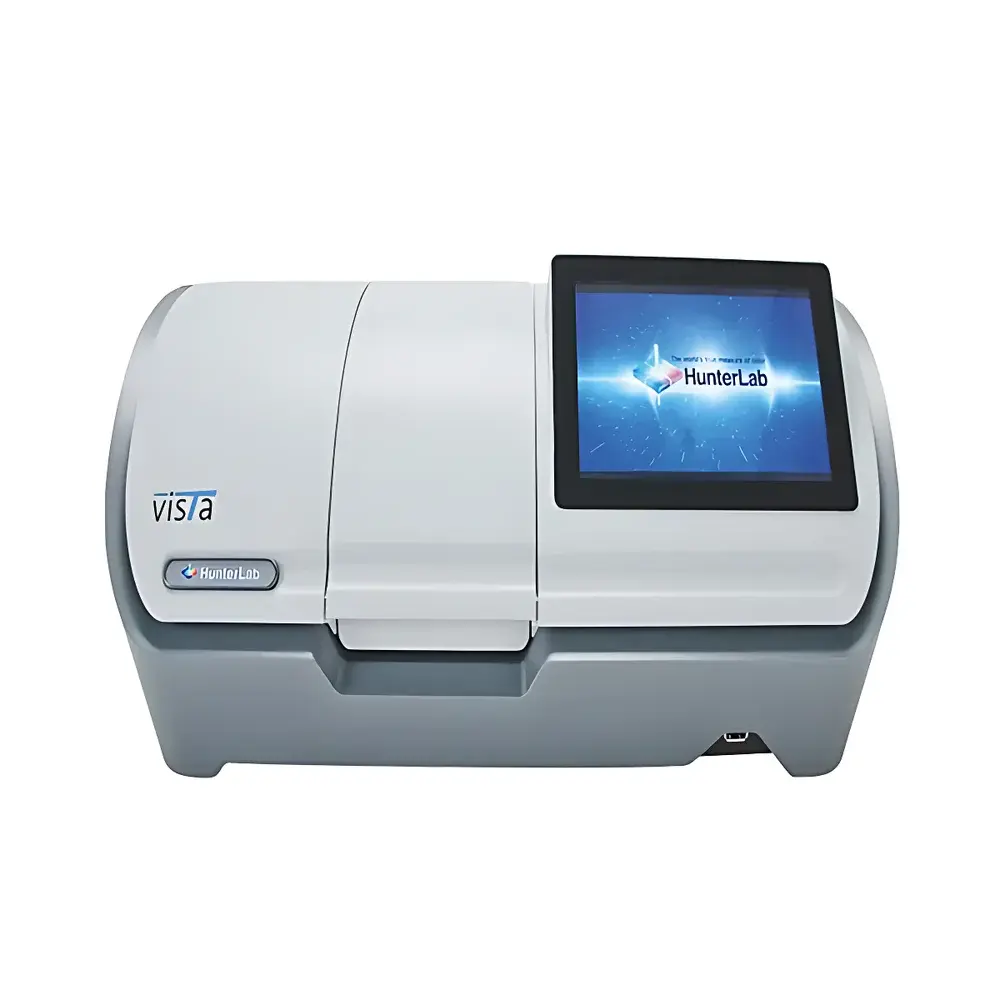
HunterLab Vista Dual-Function Spectrophotometer for Color and Haze Measurement
| Brand | HunterLab |
|---|---|
| Origin | USA |
| Model | Vista |
| Instrument Type | Benchtop |
| Optical Geometry | 8°/diffuse (8/d) |
| Light Source | Full-Spectrum LED Array |
| Spectral Range | 400 nm – 700 nm |
| Repeatability | < 0.02 ΔE* |
| Compliance | ASTM D1003 (Haze), ASTM E1164, CIE 15:2004, ISO/CIE 11664, JIS Z 8722 Condition E, DIN 5033 Teil 7 |
| Measurement Modes | Total Transmission (TTRAN), Regular Transmission (RTRAN), Haze |
| Display | 1280×800 Color Touchscreen |
| Power Supply | 100–240 VAC, 47–63 Hz, 60 W |
Overview
The HunterLab Vista is a dual-function benchtop spectrophotometer engineered for simultaneous, high-precision measurement of colorimetric parameters and optical clarity metrics—including haze, transmittance, and standardized color indices—in transparent and translucent liquid and solid samples. It employs a double-beam spectral photometric architecture with a 76-mm integrating sphere and a 256-element diode array detector coupled to a high-resolution concave holographic grating. The instrument operates on the principle of diffuse transmission (Td/0°) and total transmission (Tt/0°), enabling compliance with ASTM D1003 for haze and ASTM E1164 for colorimetry. Its full-spectrum LED illumination source provides stable, xenon-free, and drift-compensated output across 400–700 nm, with spectral bandwidth ≤10 nm and wavelength resolution <3 nm—ensuring metrological traceability to CIE 15:2004 and ISO/CIE 11664 standards. Designed for regulated laboratory environments, the Vista supports GLP/GMP workflows through audit-trail-capable software and configurable user permissions.
Key Features
- Dual-mode optical path: Simultaneous acquisition of color and haze in a single measurement cycle (<5 s for haze, <2.5 s for color)
- Comprehensive spectral engine: 256-channel diode array with concave holographic grating delivering <3 nm FWHM resolution and 0.003% photometric resolution
- Calibration-stable illumination: Full-spectrum LED array rated for 5-year operational life, eliminating lamp replacement and intensity drift
- Multi-standard compliance: Native support for ASTM D1003 (haze), ASTM E1164 (color), ISO 2768 (general tolerances), and JIS Z 8722 Condition E
- Broad index library: Real-time calculation of APHA/PtCo, Hazen, ASTM Color, Saybolt, Gardner, YI E313/D1925, ADMI, Lovibond Red/Yellow (LovR/LovY), and CIE Whiteness/Tint
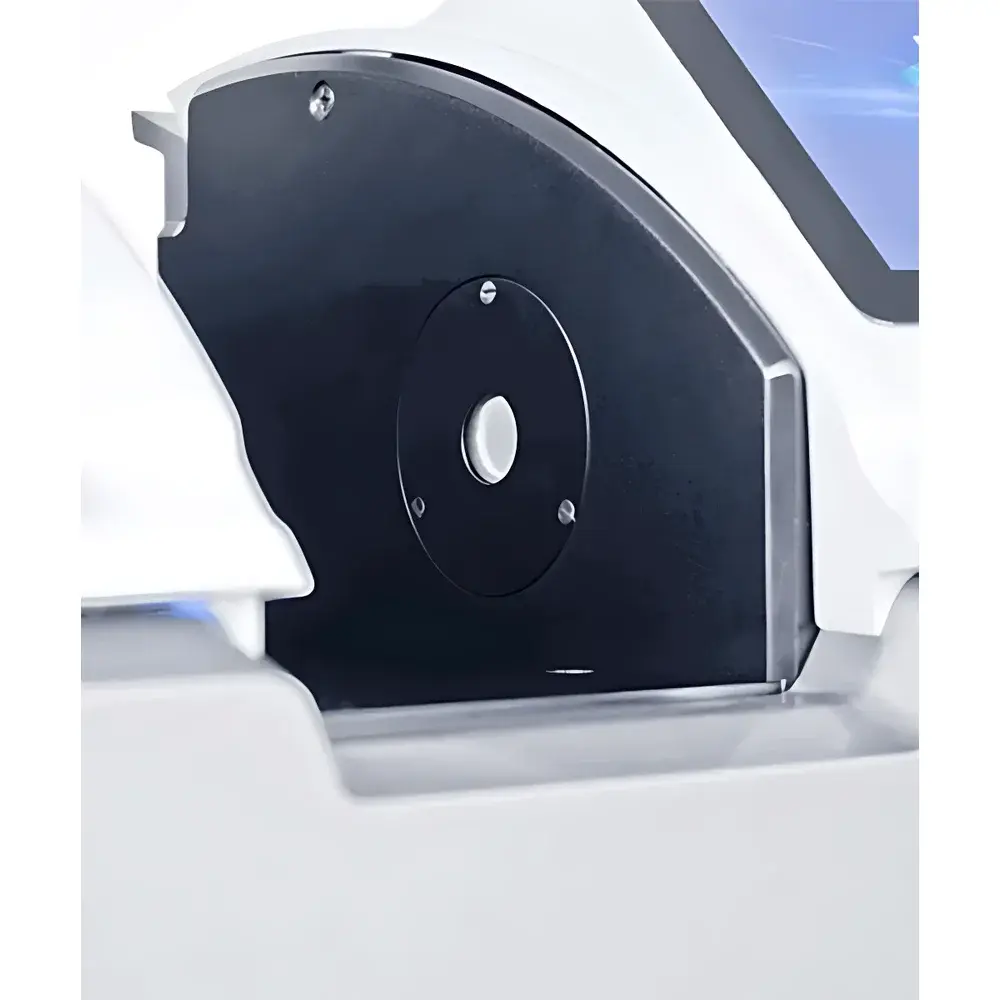
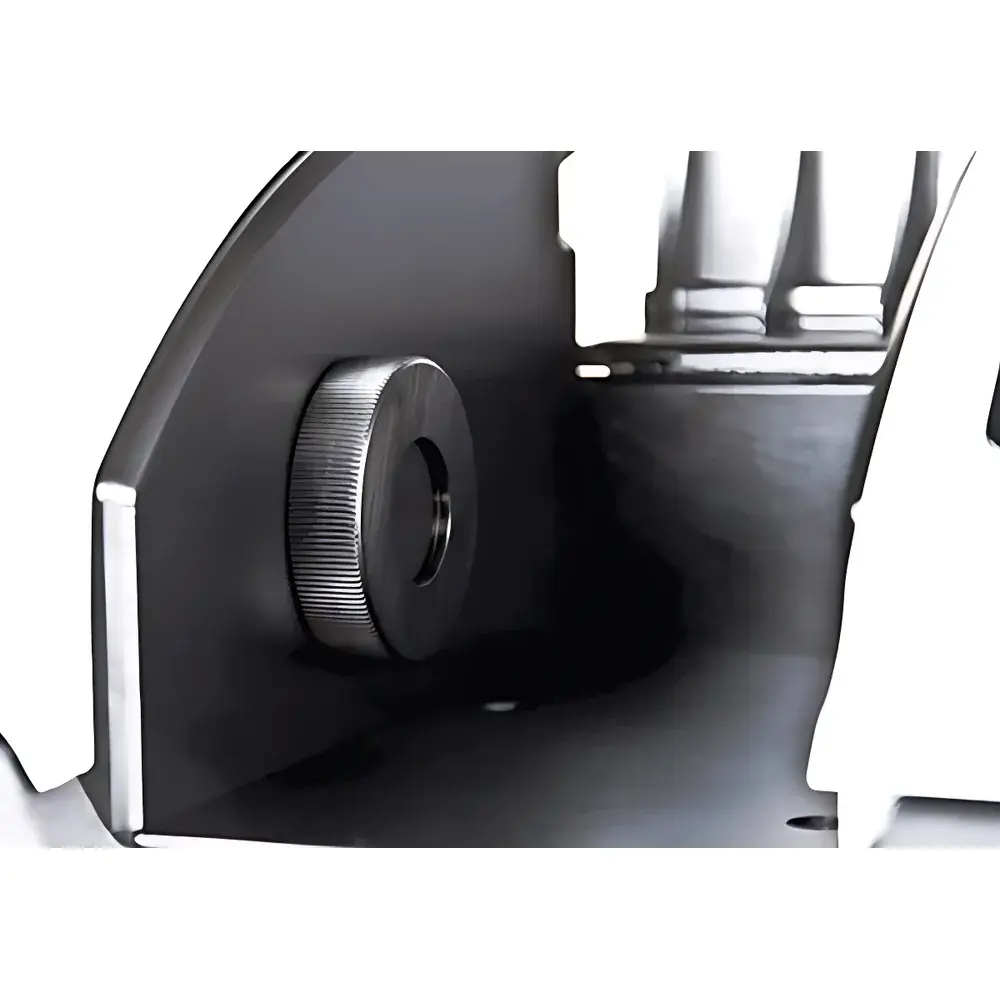
- Robust mechanical design: Precision-machined aluminum housing, 18.5 mm illumination / 9.1 mm measurement aperture, and 100 mm optical path length optimized for cuvette and sheet measurements
Sample Compatibility & Compliance
The Vista accommodates standard 10 mm, 20 mm, and 50 mm pathlength cuvettes (quartz or glass), as well as flat-sheet specimens up to 3 mm thickness. Its Td/0° geometry meets ASTM D1003 Section 8.2 for plastic film and resin haze evaluation, while its Tt/0° mode satisfies ISO 14782 for transmittance quantification. All color calculations conform to CIE 15:2004 spectral integration protocols and are referenced to standard illuminants D65/10° and C/2°. Instrument consistency is validated using NIST-traceable transmission filters, with inter-unit agreement maintained at ΔE* (D65/10) < 0.15 (average) and < 0.25 (maximum) across the visible spectrum. Haze repeatability is verified at ±0.30% for 10% nominal haze levels per ASTM D1003 Annex A2.
Software & Data Management
Vista is operated via Vision software—a Windows-based platform compliant with FDA 21 CFR Part 11 requirements. It features electronic signatures, role-based access control, automated calibration logging, and immutable audit trails for all measurement, calibration, and configuration events. Data export supports CSV, XML, and PDF formats with embedded metadata (instrument ID, date/time stamp, operator, standard reference ID). Method templates can be locked, version-controlled, and deployed across networked instruments. Raw spectral data (31-point or 10-nm interval) is stored alongside calculated indices, enabling retrospective reprocessing using updated algorithms or alternative observer functions (e.g., CIE 1931 2° vs. CIE 1964 10°).
Applications
- Quality control of pharmaceutical liquids (injectables, syrups) per USP and EP 2.2.17 for color and clarity
- Polymer and packaging R&D: Quantifying yellowing (YI E313), haze development during UV aging, and batch-to-batch chromatic consistency
- Chemical manufacturing: Monitoring Pt-Co/Hazen color progression in solvents, acids, and intermediates per ASTM D1209/D1044
- Foods & beverages: Objective assessment of juice clarity (haze), oil yellowness (Gardner), and syrup browning (ADMI)
- Paints & coatings: Measuring transmitted color through thin films and correlating haze with pigment dispersion stability
- Regulatory submissions: Generating GxP-compliant reports for FDA, EMA, and PMDA filings requiring traceable color and optical property data
FAQ
Does the Vista comply with FDA 21 CFR Part 11 for electronic records?
Yes—Vision software includes full Part 11 functionality: electronic signatures, audit trail with time-stamped event logging, and secure user authentication.
Can haze and color be measured simultaneously on the same sample?
Yes—the Vista acquires full spectral data in a single scan and computes both haze (per ASTM D1003) and CIE L*a*b* (per ASTM E1164) concurrently without repositioning or recalibration.
What is the minimum sample volume required for liquid measurements?
For standard 10-mm pathlength cuvettes, minimum fill volume is 3.5 mL; for micro-cuvettes (4-mm path), volume drops to 0.8 mL.
Is NIST-traceable calibration available for the Vista?
HunterLab provides factory-calibrated transmission and reflectance standards traceable to NIST SRM 2035 and SRM 930e, with optional annual recalibration services.
How does the Vista handle highly scattering or turbid samples?
The instrument’s dual-beam ratioing architecture and high-dynamic-range detector (0–150% transmittance) maintain accuracy even at >90% haze; however, samples exceeding ASTM D1003’s 99% upper limit require dilution or alternate methodology.





