
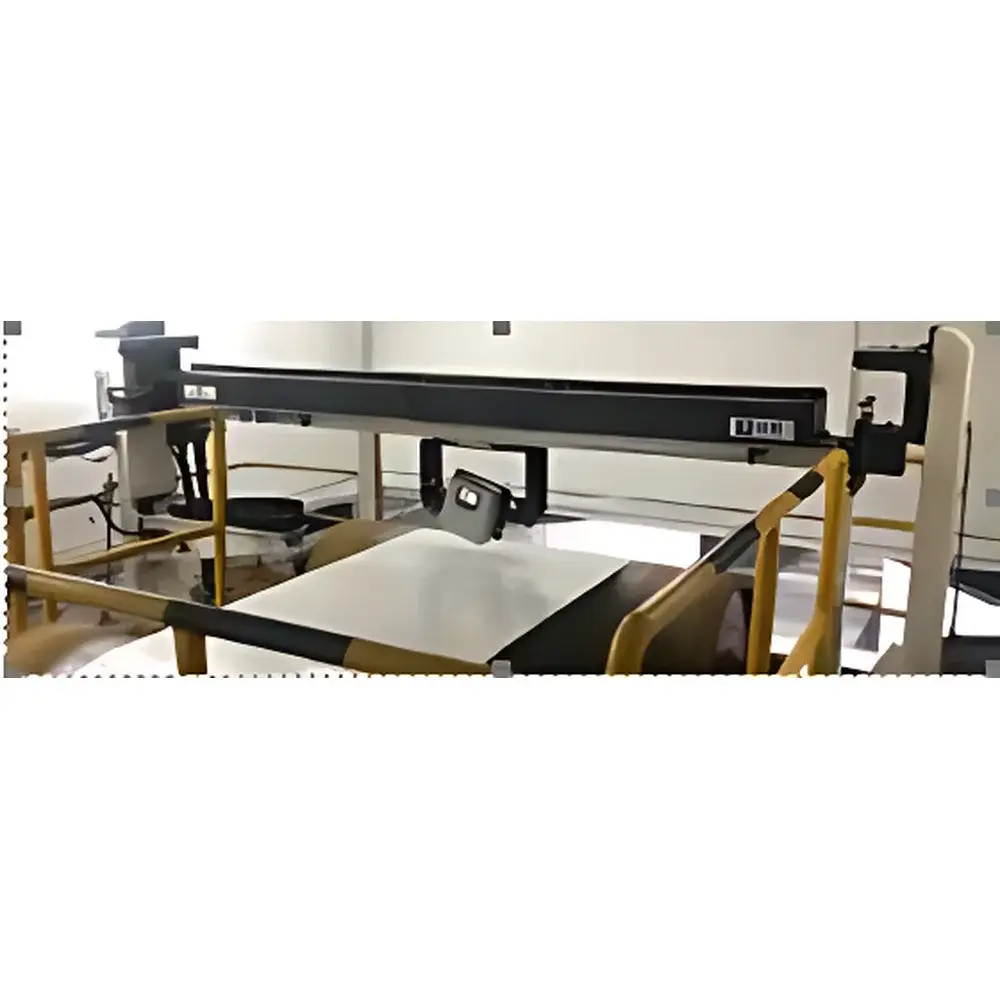
HunterLab SpectraTrend-HT Online Paper Color Measurement System
| Brand | HunterLab |
|---|---|
| Origin | USA |
| Model | SpectraTrend-HT |
| Product Type | Spectrophotometric Color Measurement System |
| Instrument Type | In-line |
| Optical Geometry | 0°/45° Integrating Sphere |
| Light Source | Full-spectrum Balanced Solid-State LED Array |
| Spectral Range | 400–700 nm |
| Spectral Bandwidth | 10 nm |
| Repeatability (ΔE*ab) | ≤ 0.03 |
| Measurement Distance | Up to 100 mm (4 in) |
| Measurement Speed | Up to 5 Hz |
| IP Rating | NEMA 4 / IP56 |
| Interface | Standard Ethernet (TCP/IP), PLC-compatible, No RS-232 Required |
| Software Platform | HunterLab EasyMatch QC v5.x or later |
Overview
The HunterLab SpectraTrend-HT is a purpose-built, in-line spectrophotometric color measurement system engineered for real-time, non-contact color and height monitoring on paper manufacturing lines. Operating on the principle of 0°/45° reflectance geometry with a full-spectrum solid-state LED illumination source and a high-stability integrating sphere, it delivers laboratory-grade spectral data under dynamic production conditions. Unlike offline benchtop instruments or legacy color sensors, the SpectraTrend-HT captures full visible spectra (400–700 nm at 10 nm resolution) for each measurement—enabling precise calculation of CIE L*a*b*, ΔE*ab, whiteness, yellowness, brightness (ISO 2470), and custom color indices per ISO 11664, ASTM E308, and TAPPI T452. Its integrated height-sensing capability allows automatic compensation for web lift, caliper variation, or conveyor vibration—ensuring metrological consistency across variable sample geometries without mechanical contact or operator intervention.
Key Features
- True in-line spectrophotometry: Full 400–700 nm spectral acquisition at up to 5 measurements per second
- Simultaneous color + height measurement: Dual-sensor architecture enables real-time geometric correction for surface topography and web positioning
- Robust industrial enclosure: NEMA 4 / IP56-rated housing suitable for humid, dusty, or temperature-fluctuating paper mill environments
- Self-calibrating optical path: Automated recalibration intervals configurable via software—eliminating manual calibration drift and personnel exposure risks
- Full-width traverse mechanism: Motorized cross-web scanning with auto-probe retraction and audible/visual alarm during maintenance access
- Height-gated measurement logic: Triggers only when material is present and within user-defined height tolerance—rejecting conveyor belt background and ambient interference
- Ethernet-native architecture: Standard TCP/IP connectivity supports multi-sensor daisy-chaining, centralized data aggregation, and direct integration with DCS/SCADA or MES platforms
Sample Compatibility & Compliance
The SpectraTrend-HT is validated for continuous monitoring of uncoated and coated paper webs, board, tissue, and specialty substrates—including those with optical brightening agents (OBAs), pigmented fillers, or surface sizing. Its 0°/45° geometry complies with ISO 5-4, ASTM E308, and TAPPI T424 for diffuse reflectance measurements on planar, semi-gloss, and textured surfaces. The system meets functional requirements for Process Analytical Technology (PAT) implementation per FDA Guidance for Industry (2004), supports statistical process control (SPC) aligned with Six Sigma DMAIC methodology, and generates audit-trail-capable metadata required under GLP and GMP frameworks. All spectral data and event logs are timestamped and traceable to instrument serial number, firmware revision, and calibration history—facilitating 21 CFR Part 11-compliant validation when deployed with EasyMatch QC’s secure user-role management.
Software & Data Management
HunterLab EasyMatch QC serves as the central analytical and operational interface. It provides synchronized visualization of color values (L*, a*, b*, ΔE*ab, CMC, ΔE00), spectral curves, height traces, and pass/fail status per user-defined tolerances. Trend charts support SPC charting (X-bar/R, CUSUM), while spectral libraries enable batch-to-batch comparison and deviation root-cause analysis. Reports export natively to Microsoft Excel (.xlsx) or PDF with customizable templates—including summary dashboards, shift-level summaries, or full spectral archives. Role-based permissions (administrator, operator, QA reviewer) enforce procedural integrity, and all data modifications are logged with user ID, timestamp, and action type—supporting regulatory audit readiness.
Applications
While optimized for paper and board production—where rapid detection of shade shifts, filler inconsistencies, or coating defects directly impacts grade compliance—the SpectraTrend-HT is broadly applicable to continuous or semi-continuous processes involving flat, flexible, or granular materials. Documented use cases include color uniformity monitoring in extruded plastic films, baked goods (breads, cookies, crackers), meat products (patties, sausages), cereals, vinyl flooring, textiles, and metal-coated foils. Its height-aware measurement engine uniquely addresses challenges in low-contrast, high-gloss, or variable-thickness substrates where traditional color sensors fail due to specular reflection or geometric error.
FAQ
How does the SpectraTrend-HT compensate for paper web height variation?
It employs a co-aligned triangulation-based height sensor that dynamically adjusts spectral normalization coefficients in real time—correcting for changes in working distance, angle of incidence, and diffuse reflectance loss due to lift or flutter.
Can it replace lab-based color measurement for quality release?
Yes—when installed, calibrated, and maintained per HunterLab’s IQ/OQ/PQ protocols, its inter-instrument agreement (IIA) and repeatability (≤0.03 ΔE*ab) meet ISO 13655 and ASTM D2244 criteria for production-floor equivalence to reference-grade benchtop spectrophotometers.
Is Ethernet connectivity mandatory for operation?
Yes—no RS-232 or USB interface is provided; all configuration, diagnostics, and data streaming occur over standard IEEE 802.3 Ethernet using HTTP, FTP, or Modbus TCP for PLC integration.
Does it require regular lamp replacement?
No—the solid-state LED light source has a rated lifetime exceeding 10 years at continuous operation and maintains stable spectral output without warm-up or degradation-related recalibration cycles.
How is traceability ensured across multiple units in one facility?
Each unit stores unique calibration certificates, spectral characterization files, and firmware signatures; EasyMatch QC synchronizes master standards and propagates updates across networked devices with version-controlled deployment logs.




