
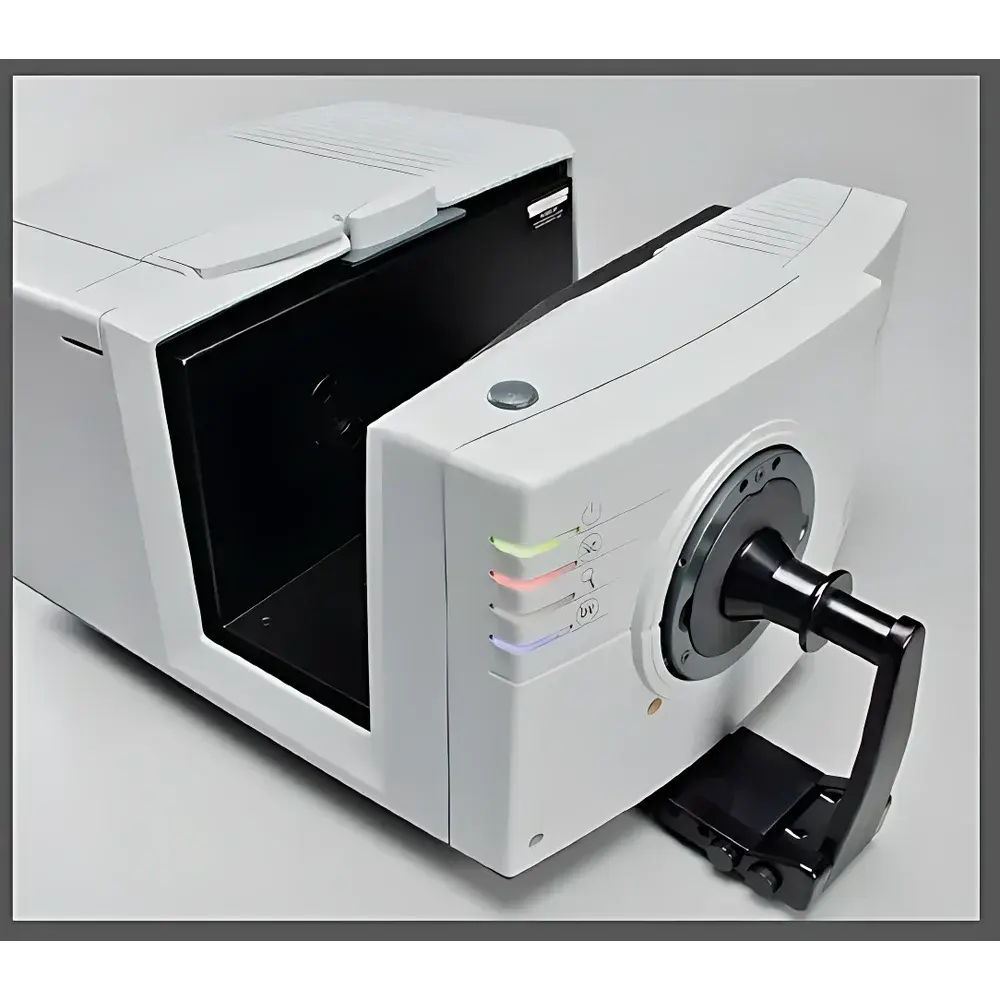
HunterLab UltraScan VIS Automotive Interior & Exterior Color Measurement Spectrophotometer
| Brand | HunterLab |
|---|---|
| Origin | USA |
| Model | UltraScan VIS Automotive Interior & Exterior Color Measurement Spectrophotometer |
| Product Type | Spectrophotometric Colorimeter |
| Instrument Type | Benchtop |
| Optical Geometry | d/8° integrating sphere |
| Light Source | Pulsed Xenon Lamp |
| Spectral Range | 360 nm – 780 nm |
| Repeatability | ΔE*ab ≤ 0.03 |
Overview
The HunterLab UltraScan VIS Automotive Interior & Exterior Color Measurement Spectrophotometer is a high-precision, benchtop spectrophotometer engineered for rigorous color quality control in automotive manufacturing and supply chain environments. Operating on the principle of diffuse illumination and 8° viewing geometry (d/8°) with integrated sphere technology, it conforms to CIE-recommended spectral response (360–780 nm) and meets ISO 11664, ASTM E308, and CIE 15 standards for spectral colorimetry. Its pulsed xenon light source provides stable, flash-based illumination that closely approximates CIE Standard Illuminant D65—enabling consistent color evaluation under daylight-simulated conditions without thermal drift or lamp aging artifacts. Designed specifically for the dimensional and optical challenges of automotive components—including curved trim, textured surfaces, coated plastics, laminated glass, and multi-layered composites—the UltraScan VIS delivers metrologically traceable color data (L*a*b*, L*C*h*, ΔE*ab, ΔE00, Yellowness Index, Whiteness Index, etc.) with exceptional inter-instrument agreement (<0.15 ΔE*ab typical) and long-term stability.
Key Features
- Dual-beam silicon photodiode array detector with real-time reference beam correction at every wavelength—ensuring high photometric accuracy and minimizing signal drift during rapid measurement cycles.
- Robust mechanical-optical architecture: precision-machined stainless-steel fasteners, vibration-damped optical platform, and thermally stabilized electronics for operation in production-floor environments (15–30 °C, 20–80% RH non-condensing).
- Two interchangeable apertures (25 mm and 9.5 mm) accommodate diverse sample geometries—from large instrument panels and door trims to small injection-molded fasteners and paint chips.
- Configurable measurement modes: Specular Component Included (SCI) and Specular Component Excluded (SCE), selectable via software or front-panel interface; ideal for evaluating both surface appearance and substrate color in coated and textured materials.
- Open three-sided transmission port with ≥100 mm vertical clearance—enabling measurement of oversized automotive glass, laminates, and thick molded parts without disassembly.
- Integrated status indicator LEDs provide immediate visual feedback for mode selection, calibration state, and measurement readiness—reducing operator error in high-throughput QC labs.
Sample Compatibility & Compliance
The UltraScan VIS supports measurement of opaque solids (painted body panels, leather, carpet, fiber-reinforced composites), translucent materials (headlamp lenses, diffuser films), transparent liquids (coolants, brake fluids, window wash solutions), and semi-crystalline polymers (PP/TPO blends, PC/ABS alloys). It complies with automotive OEM color specification protocols including GMW14872, Ford CETP 00.00-L-467, and VW TL 210. All measurements adhere to ISO/IEC 17025-accredited laboratory practices when operated within validated workflows. The instrument’s optical cavity coating and calibrated ceramic standards (certified per NIST-traceable protocols) ensure long-term spectral fidelity across the full 360–780 nm range.
Software & Data Management
Controlled via HunterLab’s EasyMatch QC v5.x software, the UltraScan VIS supports GLP/GMP-compliant data handling with full audit trail functionality (21 CFR Part 11 compliant when deployed with electronic signature modules). Software features include multi-user role-based access control, customizable pass/fail tolerancing (ΔE*ab, ΔL*, Δa*, Δb*), statistical process control (SPC) charting, batch reporting, and direct export to LIMS or MES platforms via CSV, XML, or ODBC. Calibration verification routines include built-in spectral standard checks using certified filter sets and white tile validation—automatically logged with timestamps and operator IDs.
Applications
- Color matching and batch-to-batch consistency verification of automotive interior trims (dashboard substrates, seat fabrics, headliners)
- Quantitative assessment of exterior paint film uniformity, gloss interference, and weathering-induced hue shift (per SAE J2527)
- Transmittance and haze measurement of laminated windshields and LED lighting covers (ASTM D1003)
- Quality gate inspection of injection-molded polymer components (grilles, mirror housings, console bezels)
- Raw material qualification of pigments, masterbatches, and solvent-based coatings prior to production release
- Long-term stability monitoring of chromaticity in UV-stabilized polycarbonate and acrylic glazing systems
FAQ
What spectral standard does the UltraScan VIS use for illuminant simulation?
It employs a pulsed xenon lamp with spectral power distribution matched to CIE Illuminant D65, verified per CIE Publication 15:2018 and maintained through factory calibration with NIST-traceable standards.
Is the instrument suitable for measuring curved or irregular automotive surfaces?
Yes—the 25 mm aperture and optional accessories (e.g., universal sample clamp, contour holder) enable repeatable positioning on non-planar surfaces such as door sills, bumpers, and wheel arch liners.
How is inter-instrument agreement ensured across multiple UltraScan VIS units in a global supply chain?
HunterLab provides inter-instrument agreement (IIA) certification packages, including serialized calibration tiles, cross-unit verification reports, and optional on-site IIA validation services aligned with AIAG CQI-19 guidelines.
Does the system support automated integration into factory automation networks?
Yes—EasyMatch QC offers OPC UA and Modbus TCP interfaces for seamless integration with PLCs, SCADA systems, and Industry 4.0 data lakes.
Can the UltraScan VIS measure metamerism between different light sources?
Yes—it calculates metamerism index (MI) and performs multi-illuminant comparisons (D65, A, F2, F7, etc.) using full spectral data, supporting compliance with ISO 18314-1 for advanced color analysis.





