
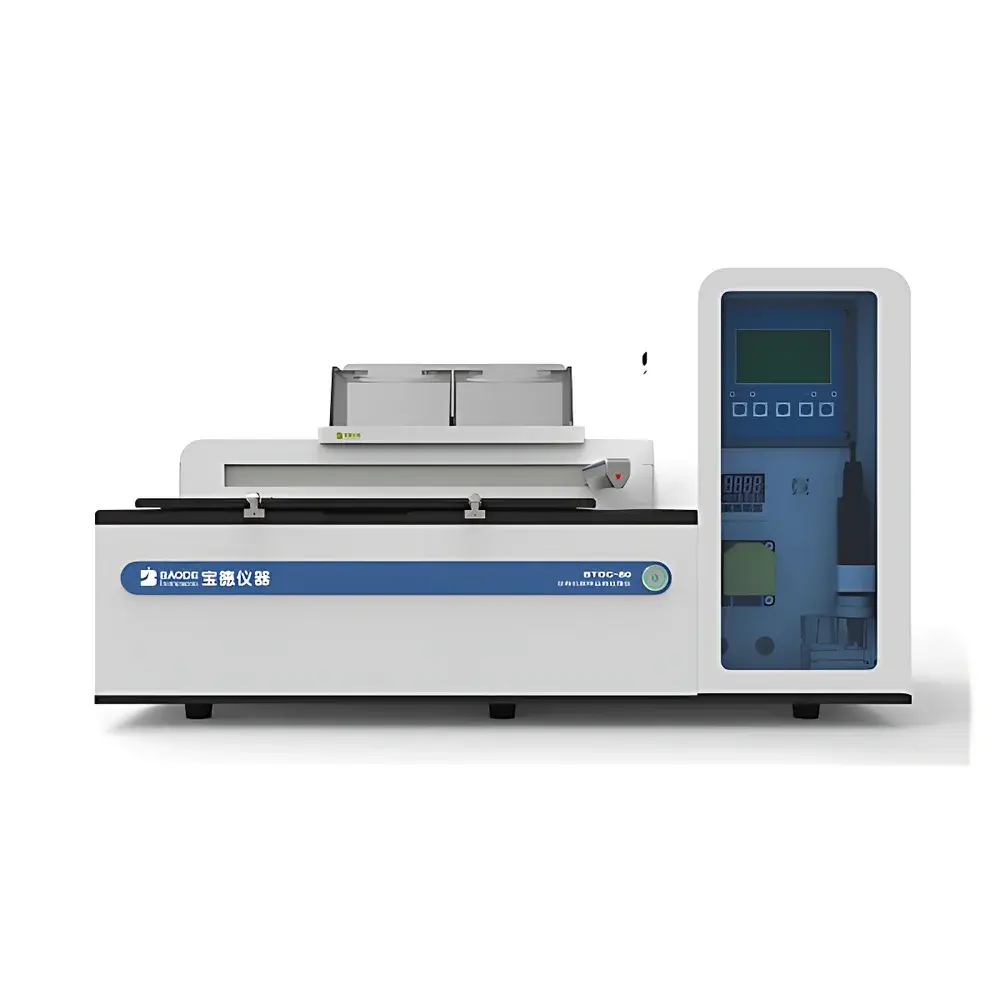
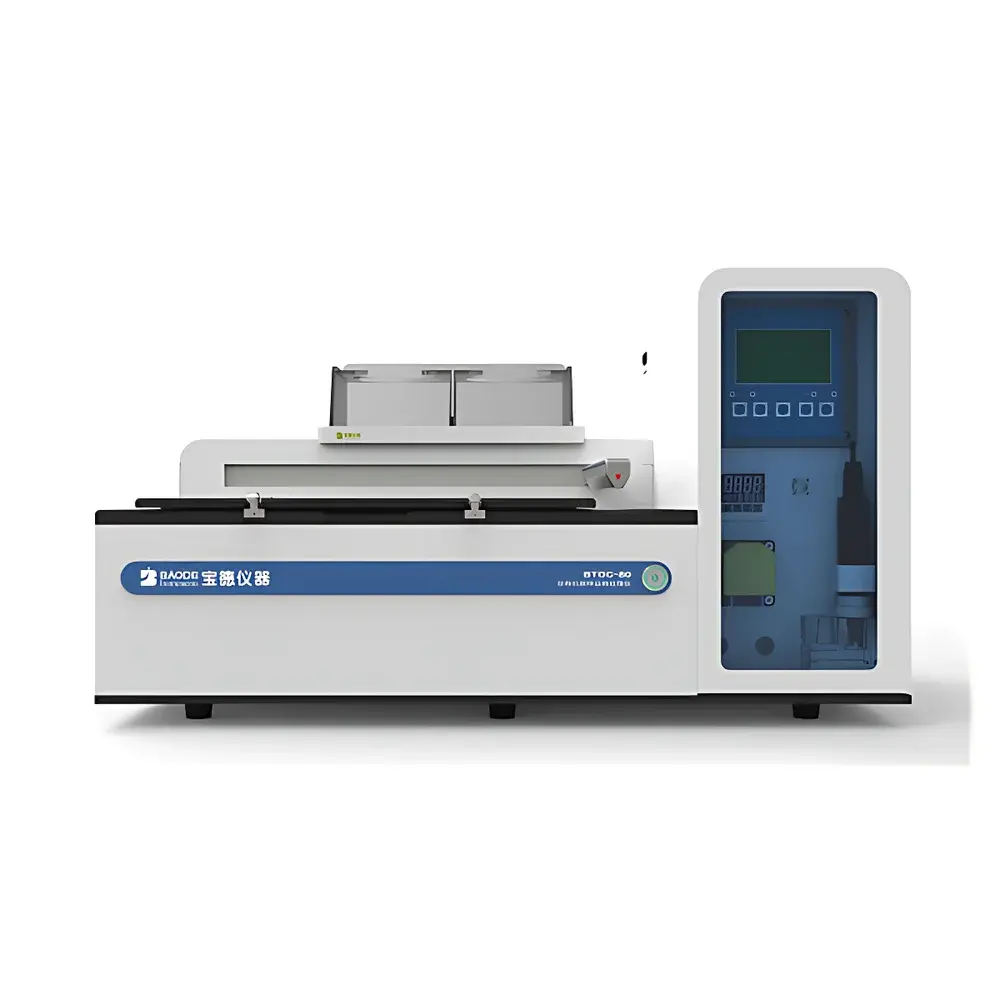
BTOC-80 Automated Total Organic Carbon (TOC) Sample Pretreatment Workstation by Baode Instruments
| Brand | Baode Instruments |
|---|---|
| Origin | Beijing, China |
| Manufacturer Type | Original Equipment Manufacturer (OEM) |
| Product Category | Domestic |
| Model | BTOC-80 |
| Pricing | Upon Request |
| Sample Capacity | 80 samples per batch |
| Average Processing Time per Sample | 3 minutes |
Overview
The BTOC-80 Automated Total Organic Carbon (TOC) Sample Pretreatment Workstation is an integrated, benchtop-scale laboratory system engineered specifically for the standardized pretreatment of solid geological samples—primarily sedimentary rocks—prior to high-precision TOC quantification via combustion-based elemental analyzers (e.g., carbon-sulfur analyzers). Designed in collaboration with the National Geological Experimental Testing Center and manufactured by Baode Instruments Co., Ltd., the BTOC-80 implements a fully automated, sequence-controlled workflow aligned with the requirements of GB/T 19145–2003, “Determination of Total Organic Carbon in Sedimentary Rocks.” Its operational principle centers on acidification-driven inorganic carbon removal (typically using hydrochloric acid), followed by controlled thermal drying and vacuum-assisted residue clearance—critical steps that eliminate carbonate interference and ensure measurement fidelity in downstream TOC analysis. The system operates without manual intervention across all core stages: reagent metering, timed acid reaction, multi-stage rinsing, endpoint detection via conductivity or pH shift logic, and final low-temperature drying. This eliminates inter-operator variability and significantly reduces exposure to volatile acids and aerosols, supporting occupational safety and analytical traceability.
Key Features
- Fully automated 80-position sample carousel with indexed positioning and robotic arm–assisted vial handling
- Multi-channel precision peristaltic pump system delivering HCl solution with ±1.5% volumetric accuracy across 0.5–10 mL ranges
- Programmable temperature-controlled heating module (ambient to 120 °C, ±2 °C stability) for accelerated acid digestion and drying cycles
- Integrated vacuum manifold with pressure-sensing feedback for real-time waste evacuation and rinse efficiency optimization
- Endpoint recognition algorithm based on dynamic conductivity monitoring during rinse cycles, minimizing over-rinsing and solvent consumption
- Compact footprint (W × D × H: 760 × 620 × 680 mm) enabling safe operation inside standard fume hoods (EN 14175 compliant)
- Modular construction with corrosion-resistant PTFE-coated fluid paths and borosilicate glass reaction vessels
Sample Compatibility & Compliance
The BTOC-80 accepts standard 10–15 mL borosilicate glass vials containing powdered rock specimens (particle size ≤150 µm, mass range 0.1–1.0 g). It accommodates heterogeneous lithologies including shale, limestone, sandstone, and mudstone. All process parameters—including acid concentration, dwell time, rinse volume, and drying temperature—are configurable to meet method-specific adaptations required for high-carbonate or pyrite-rich matrices. The system supports full audit trail generation and user-level access control, facilitating compliance with GLP (Good Laboratory Practice) and ISO/IEC 17025:2017 documentation requirements. While not certified under FDA 21 CFR Part 11, its software architecture includes timestamped action logs, electronic signature fields, and non-editable raw data export—features routinely validated during third-party lab accreditation audits.
Software & Data Management
The workstation is operated via a Windows-based HMI (Human-Machine Interface) application with intuitive graphical workflow builder. Users can define custom protocols using drag-and-drop step sequencing or load pre-validated methods stored in encrypted XML templates. All instrument events—including pump actuation, temperature ramp profiles, vacuum cycle duration, and endpoint confirmation signals—are logged in UTC-referenced CSV files with SHA-256 checksums. Data export supports direct integration with LIMS platforms via OPC UA or FTPS protocols. Software updates are delivered through signed firmware packages with version rollback capability and SHA-256 hash verification.
Applications
- Routine TOC determination in petroleum system evaluation and source rock characterization
- Geochemical baseline studies for environmental site assessments involving hydrocarbon-contaminated sediments
- Quality assurance in inter-laboratory round-robin testing programs adhering to GB/T 19145–2003 or ASTM D7573–22
- Method development for alternative acid systems (e.g., phosphoric acid for reactive carbonate suppression)
- High-throughput screening of unconventional reservoir samples in exploration geochemistry labs
FAQ
What sample types are compatible with the BTOC-80?
The system is validated for powdered sedimentary rock samples meeting GB/T 19145–2003 particle size and mass specifications; it is not designed for liquid water samples or soils with high clay swelling potential.
Does the BTOC-80 include built-in acid neutralization or waste treatment?
No—it routes acidic effluent to external neutralization traps or centralized lab waste systems; integration with inline NaOH scrubbers is available as an optional accessory.
Can processing parameters be exported for regulatory submission?
Yes—full parameter sets, execution logs, and calibration records are exportable in PDF and CSV formats with embedded digital signatures.
Is remote monitoring supported?
The system supports Ethernet-connected status polling via Modbus TCP; real-time video streaming or remote control requires additional IT infrastructure and is not natively implemented.
What maintenance intervals are recommended?
Peristaltic pump tubing replacement every 3 months under continuous use; quarterly verification of vacuum seal integrity and thermal sensor calibration using NIST-traceable references.
Related Products







