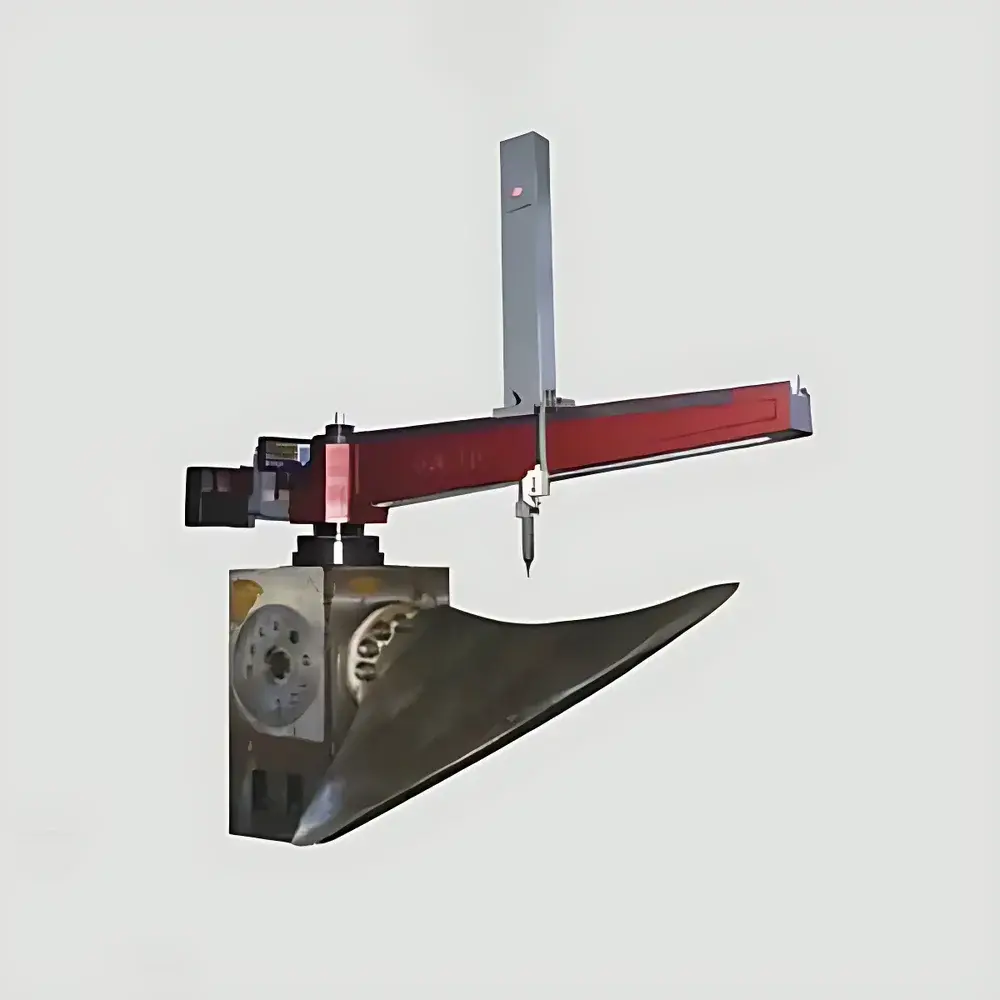
API LJG-B Propeller Pitch Measuring Machine
| Brand | API |
|---|---|
| Origin | Sichuan, China |
| Manufacturer Type | Authorized Distributor |
| Country of Origin | China |
| Model | LJG-B |
| Pricing | Available Upon Request |
Overview
The API LJG-B Propeller Pitch Measuring Machine is a specialized coordinate measuring system engineered for high-accuracy geometric metrology of large- and medium-scale rotating and helical-surface components—particularly marine and aerospace propellers. It operates on a polar-coordinate (radial-angular-height) measurement architecture, enabling direct, traceable evaluation of critical blade geometry parameters including pitch distribution, radius deviation, chord length, twist angle, and local profile conformity. Unlike conventional CMMs, the LJG-B integrates mechanical kinematic compensation with real-time sensor feedback to address inherent challenges in propeller metrology: thermal drift across large structures, gravitational sag in extended horizontal arms, and backlash-induced angular uncertainty in rotary axes. Its design adheres to fundamental principles of geometric tolerancing per ISO 1101 and ASME Y14.5, supporting verification of GD&T callouts such as total runout, profile of a surface, and position tolerance relative to datum features defined on the hub or root section.
Key Features
- Proprietary transverse arm deflection suppression mechanism—dynamically counteracts gravity-induced bending during radial extension, maintaining sub-arcsecond angular stability over measurement ranges up to 3,000 mm radius.
- Full-range automatic axis balancing and backlash tracking system—continuously monitors encoder phase lag and adjusts servo torque in real time to eliminate dead-zone errors in azimuth and elevation axes.
- IP65-rated high-resolution linear and angular displacement sensors—sealed against dust, moisture, and oil mist commonly encountered in shipyard or turbine manufacturing environments.
- Dedicated self-centering collet fixture with kinematic mounting interface—ensures repeatable alignment between the measurement coordinate frame and the original CNC machining datum, minimizing datum transformation uncertainty.
- Integrated thermal drift compensation algorithm—uses dual-point temperature monitoring (arm base + probe tip) to correct for coefficient-of-expansion-induced scale errors in real time.
Sample Compatibility & Compliance
The LJG-B accommodates propeller assemblies with diameters from 800 mm to 4,200 mm and maximum weights up to 3,500 kg. It supports both fixed-pitch and controllable-pitch propellers, including NiAl bronze, stainless steel, composite, and titanium alloy blades. Measurement protocols are compatible with ISO 484-1 (marine propellers), ISO 19902 (offshore structures), and ASTM F2227 (aerospace propulsion components). The system’s calibration methodology follows ISO/IEC 17025 requirements for testing laboratories, and its uncertainty budget documentation satisfies internal audit requirements under ISO 9001:2015 Clause 7.1.5. Traceability is maintained through NIM (National Institute of Metrology, China)–certified master artifacts and laser interferometer validation at accredited third-party labs.
Software & Data Management
The LJG-B runs on proprietary metrology software compliant with ISO 10360-6 for CMM performance verification. It provides full GD&T reporting per ASME Y14.5–2018, including color-mapped deviation plots, cross-sectional slice analysis, and statistical process control (SPC) charting for pitch variation across blade spans. Raw point cloud data is exportable in standard formats (IGES, STEP AP214, ASCII XYZ) for integration into CAD-based reverse engineering workflows. Audit trail functionality logs all operator actions, parameter changes, and calibration events—supporting GLP/GMP environments where 21 CFR Part 11 electronic record integrity is required. Data encryption and role-based access control ensure secure handling of proprietary blade geometry files.
Applications
- Final inspection of cast and machined propellers prior to hydrodynamic testing or installation.
- In-process verification during multi-axis CNC milling of blade surfaces to reduce rework cycles.
- Wear assessment and refurbishment qualification for in-service marine propellers post-overhaul.
- Validation of additive-manufactured blade prototypes against nominal CAD models.
- Root cause analysis of cavitation-induced erosion patterns via localized pitch deviation correlation.
FAQ
What is the maximum allowable propeller diameter the LJG-B can measure?
The system supports propellers up to 4,200 mm in diameter with optional extended-arm configurations.
Does the LJG-B support automated measurement routines for batch production?
Yes—programmable inspection sequences with part-family templates enable unattended operation for repetitive geometries.
Is NIST-traceable calibration documentation provided with delivery?
Each unit ships with a factory calibration certificate referencing NIM-standard artifacts; on-site verification services are available upon request.
Can the LJG-B integrate with existing MES or QMS platforms?
Native OPC UA and RESTful API interfaces allow bidirectional data exchange with common manufacturing execution and quality management systems.
What environmental conditions are required for optimal performance?
Recommended operating range: 15–25 °C ambient temperature, ≤60% RH, vibration isolation per ISO 230-2 Class 3; no forced-air cooling required.