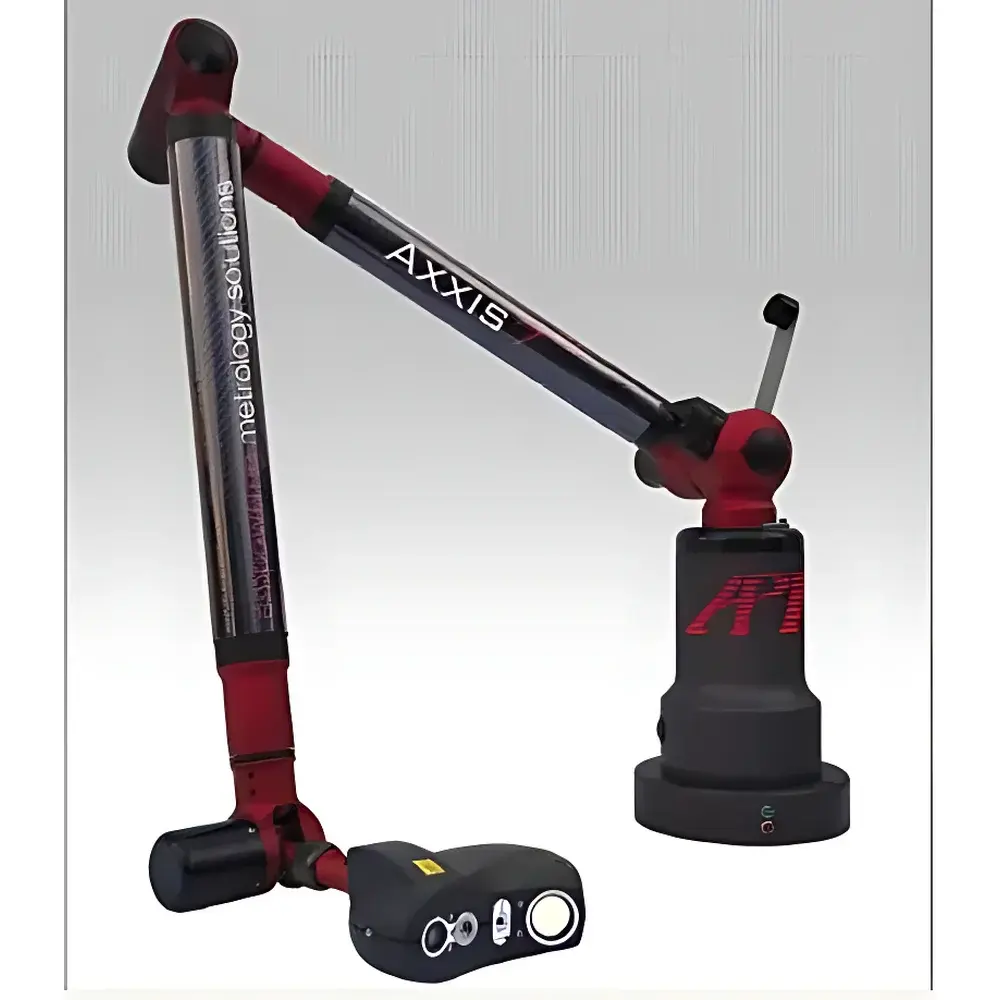
API Axxis Portable 3D Laser Scanning System
| Brand | API |
|---|---|
| Origin | USA |
| Model | Axxis |
| Probe Weight | < 400 g |
| Sampling Rate | Up to 26,000 points/sec |
| Depth of Field | 100–200 mm |
| Measurement Accuracy | ±0.05 mm (2σ) |
| Repeatability | ±0.02 mm (3σ) |
| Operating Temperature | 0–45 °C |
| Relative Humidity | < 70 % RH |
| Compliance | ISO 10360-8 (for articulated arm-based laser scanning systems), ASTM E2924-22 (Standard Guide for 3D Scanning Systems in Industrial Metrology) |
Overview
The API Axxis Portable 3D Laser Scanning System is an integrated metrology solution combining a high-precision articulated coordinate measuring arm with a non-contact laser line scanner. Engineered for industrial-grade geometric measurement, it operates on the principle of triangulation-based laser profilometry—projecting a structured laser line onto the object surface and capturing its deformation via a high-resolution CMOS sensor array. This enables dense point cloud acquisition with sub-millimeter spatial fidelity, supporting both dimensional verification and full-surface digitization. Unlike fixed-frame CMMs or optical scanners requiring controlled lab environments, the Axxis system delivers traceable, NIST-traceable measurements directly on the shop floor, in design studios, or at legacy production sites—without reliance on vibration-isolated foundations or climate-controlled enclosures.
Key Features
- Fully portable architecture: Articulated arm with 6 or 7 degrees of freedom (configurable), rated IP54 for dust and splash resistance, enabling robust operation in manufacturing cells, assembly lines, and field service locations.
- Integrated laser scanning probe: Weighing under 400 g, optimized for ergonomic single-operator use; features real-time point cloud streaming and adaptive exposure control for consistent capture across reflective, matte, or mixed-finish surfaces.
- High-density data acquisition: Sustained sampling rate of up to 26,000 points per second with 0.05 mm (2σ) volumetric accuracy and 0.02 mm (3σ) repeatability—validated per ISO 10360-8 Annex D for articulated arm laser scanning systems.
- Dual-mode metrology capability: Seamlessly combines tactile probing (for GD&T-compliant feature inspection—holes, planes, cylinders, slots) with non-contact laser scanning (for freeform surfaces, organic geometries, and reverse engineering).
- Thermal stability compensation: Embedded temperature sensors and material-specific thermal drift algorithms ensure measurement integrity across ambient shifts from 0 °C to 45 °C, meeting ASTM E2924-22 environmental performance requirements.
Sample Compatibility & Compliance
The Axxis system accommodates objects ranging from micro-components (e.g., earphone housings, dental implants) to large-scale assemblies (automotive body-in-white, aircraft fuselage sections). Its 100–200 mm depth of field supports scanning of recessed features, deep cavities, and undercuts without repositioning. Surface compatibility includes painted metal, injection-molded plastics, composites, ceramics, and human tissue (for medical anthropometric applications). All hardware and firmware comply with IEC 61000-6-2 (EMC immunity) and IEC 61000-6-4 (EMC emissions). Calibration certificates are issued per ISO/IEC 17025-accredited procedures, and system validation reports support FDA 21 CFR Part 11 audit trails when paired with compliant software platforms.
Software & Data Management
The Axxis platform interfaces natively with industry-standard metrology software including PowerINSPECT (Delcam), Geomagic Control X, and PolyWorks Inspector. These applications provide ASME Y14.5-compliant GD&T reporting, automated deviation mapping, first-article inspection workflows, and statistical process control (SPC) integration. Raw point cloud data is exported in standard formats (ASC, STL, PLY, PTX), ensuring interoperability with CAD/CAM tools (Siemens NX, CATIA, SolidWorks) and additive manufacturing pipelines. Software modules support full audit logging, user access controls, electronic signatures, and revision-controlled report generation—fully aligned with GLP/GMP documentation requirements.
Applications
- Automotive R&D: Full-vehicle scan-to-CAD for styling validation, Class-A surfacing, and aerodynamic analysis; rapid prototyping of interior trims, lighting assemblies, and powertrain components.
- Aerospace & Defense: On-site inspection of composite tooling, turbine blade profiles, and airframe structural parts—reducing downtime associated with part transport to metrology labs.
- Medical Device Development: Anthropometric scanning for prosthetic socket design, craniofacial reconstruction planning, and ergonomic assessment of surgical instruments.
- Cultural Heritage Digitization: Contactless capture of sculptures, archaeological artifacts, and historical machinery—preserving geometry without physical handling risk.
- Tool & Die Manufacturing: In-process verification of mold cavity surfaces, electrode wear analysis, and die tryout validation prior to mass production.
FAQ
Does the Axxis system require external calibration artifacts or reference spheres for routine operation?
No. The articulated arm employs internal encoder feedback and dynamic kinematic calibration (per ISO 10360-2), while the laser scanner undergoes factory-performed triangulation calibration. Field recalibration is optional and performed using API’s certified calibration kits—typically recommended every 12 months or after mechanical impact.
Can the Axxis be used in environments with ambient lighting or moving machinery?
Yes. The laser module operates at 650 nm with narrow-band optical filtering and pulsed illumination timing, minimizing interference from fluorescent, LED, or incandescent sources. Vibration tolerance is rated to 0.5 g RMS per ISO 10360-1 Annex F.
Is the system compatible with ISO 2768 general tolerances and ASME B46.1 surface texture standards?
While the Axxis captures raw topography data, quantitative surface finish evaluation requires post-processing in compliant software (e.g., Geomagic Control X with surface roughness add-ons). The system itself satisfies ISO 10360-8 for geometric accuracy but does not replace dedicated profilometers for Ra/Rz certification.