
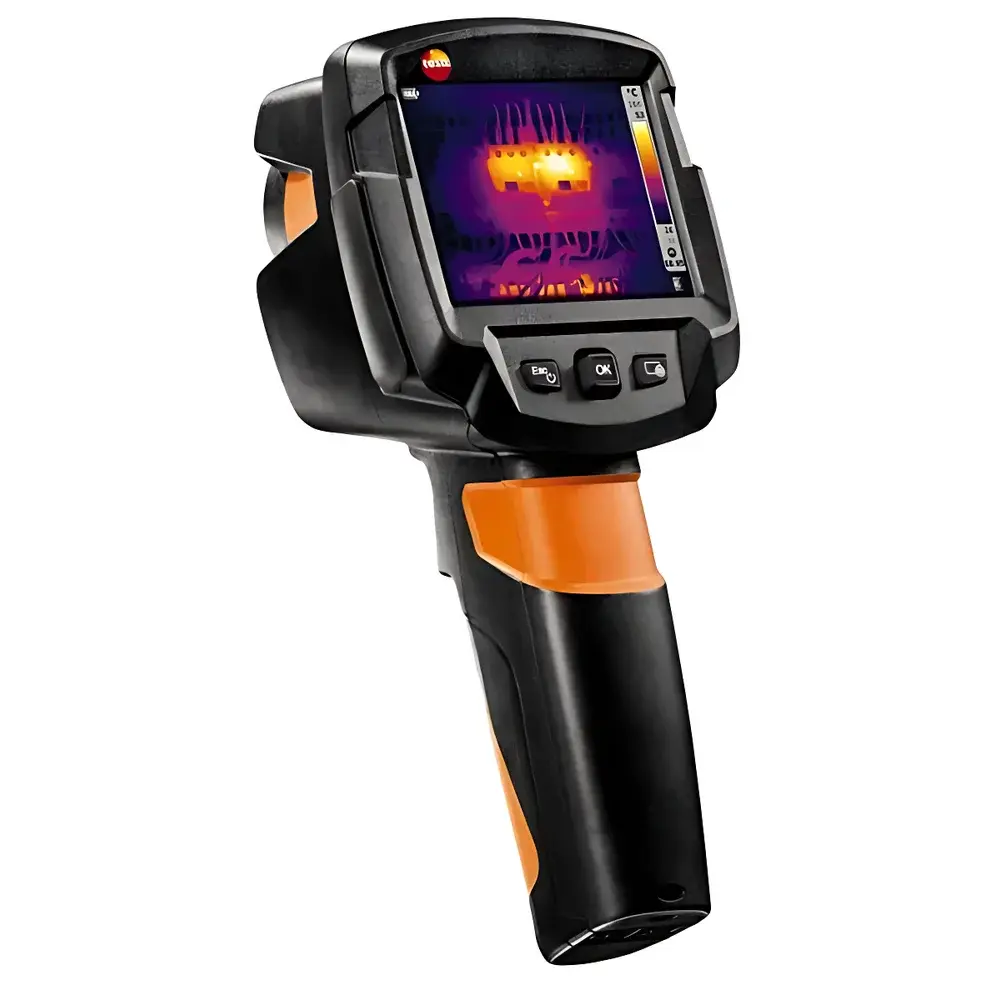
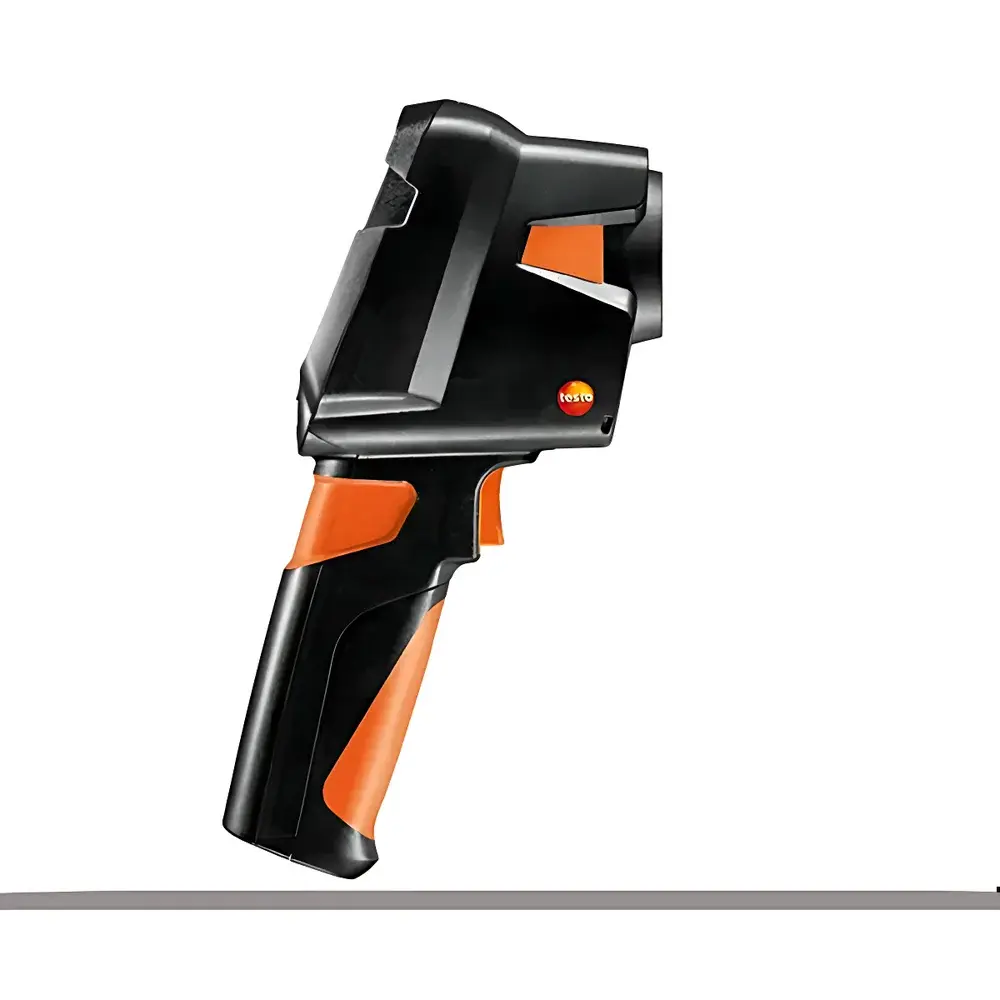
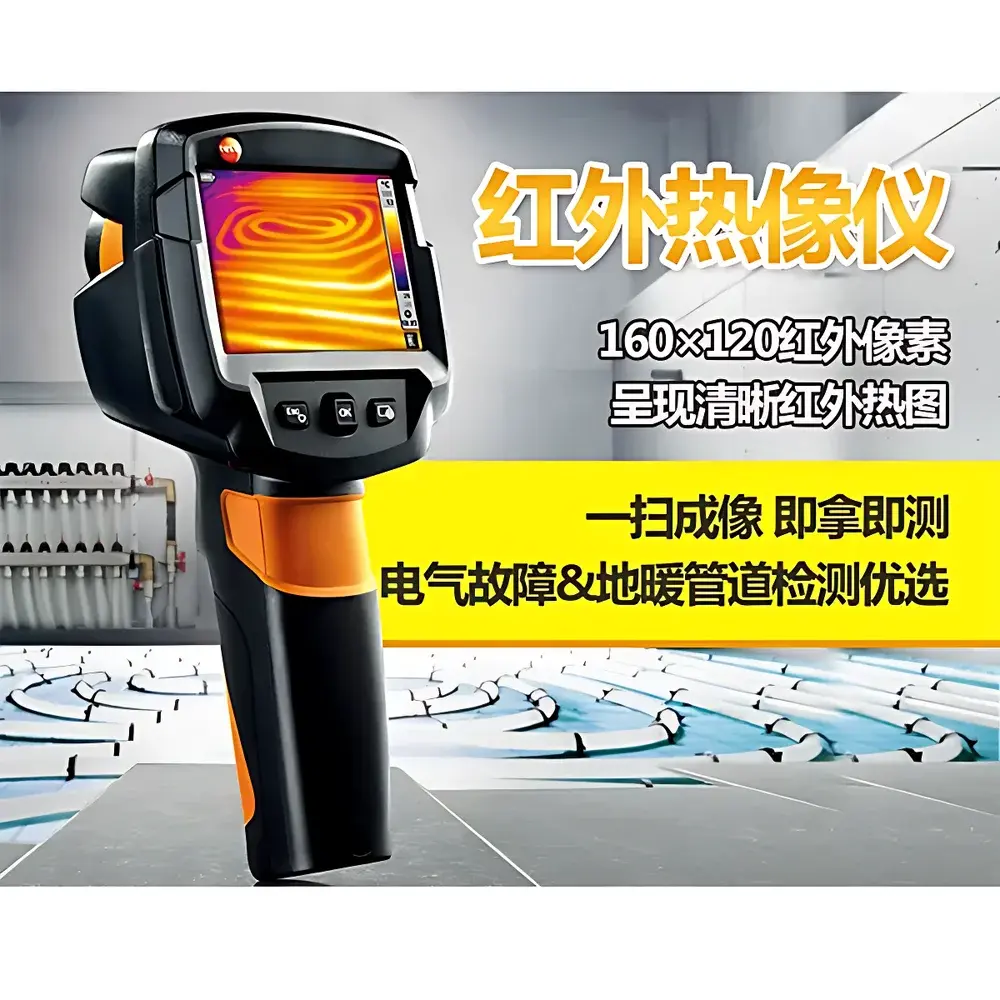
testo 869 Infrared Thermal Imaging Camera
| Brand | testo |
|---|---|
| Origin | Germany |
| Model | 869 |
| Thermal Resolution | 160 × 120 pixels |
| Image Resolution | 19,200 IR pixels |
| Spectral Range | 7.5–14 µm |
| NETD | < 0.12 °C |
| Temperature Range | −20 to +280 °C |
| Accuracy | ±2 °C or ±2% of reading |
| Frame Rate | 9 Hz @ 160 × 120 |
| Measurement Principle | Non-contact infrared radiometry |
| Detector Type | Uncooled microbolometer |
| Operating Mode | Handheld, battery-powered |
| Thermal Sensitivity Mode | Auto hot/cold spot tracking |
| Data Export Format | JPEG |
| Software Included | testo IRSoft (PC-based analysis suite) |
| Power Supply | Rechargeable Li-ion battery + AC adapter |
| Interface | USB 2.0 |
Overview
The testo 869 Infrared Thermal Imaging Camera is a handheld, uncooled microbolometer-based thermographic instrument engineered for industrial maintenance, building diagnostics, and electrical system inspection. It operates on the principle of passive infrared radiometry—detecting mid-wave to long-wave infrared radiation (7.5–14 µm) emitted by objects and converting it into a quantitative thermal map. With a native thermal resolution of 160 × 120 pixels (19,200 measurement points), the device delivers spatially resolved surface temperature data without physical contact, enabling rapid identification of thermal anomalies in real time. Its non-refrigerated detector architecture ensures operational reliability across ambient temperatures while maintaining low power consumption and extended field deployment capability. Designed for routine thermographic surveys—not laboratory-grade metrology—the testo 869 complies with fundamental requirements for qualitative and semi-quantitative thermal assessment per ISO 18436-7 (Condition monitoring and diagnostics of machines — Thermography) and supports traceable temperature reporting under general industrial QA/QC frameworks.
Key Features
- Uncooled VOx microbolometer detector with spectral response optimized for 7.5–14 µm atmospheric transmission window
- Real-time thermal imaging at 9 Hz frame rate (160 × 120 resolution), sufficient for dynamic scanning of electrical panels, HVAC ducts, and building envelopes
- Thermal sensitivity (NETD) < 0.12 °C at 30 °C object temperature—enabling reliable detection of subtle thermal gradients in insulation defects or early-stage component degradation
- Temperature measurement range from −20 °C to +280 °C, calibrated across the full span with accuracy of ±2 °C or ±2% of reading (whichever is greater), referenced to NIST-traceable blackbody sources
- On-device hot/cold spot auto-tracking algorithm that dynamically identifies and labels extremum temperature points within the field of view
- Integrated LED illumination and digital camera for simultaneous visible-light reference imagery, facilitating precise spatial correlation during post-processing
- Ruggedized ergonomic housing rated IP54 for dust and water resistance, suitable for workshop, rooftop, and substation environments
Sample Compatibility & Compliance
The testo 869 is compatible with all non-reflective, opaque surfaces exhibiting emissivity ≥ 0.6—typical of painted metals, concrete, PVC, rubber, and oxidized copper. For low-emissivity targets (e.g., bare aluminum, stainless steel), users must apply corrective emissivity settings or use testo’s optional high-emissivity tape (part no. 0554 7710). The instrument conforms to EN 61326-1:2013 (EMC for electrical equipment) and EN 61000-6-2/6-3 for industrial immunity and emission profiles. While not certified for intrinsically safe (ATEX/IECEx) zones, its design meets general-purpose safety requirements for Class I, Division 2 environments. Data acquisition workflows align with GLP-aligned documentation practices when used with testo IRSoft’s audit trail-enabled report generation.
Software & Data Management
The included testo IRSoft software (Windows-compatible) provides comprehensive post-capture analysis: emissivity correction, isotherm overlay, delta-T measurement, customizable color palettes, and multi-image comparison tools. All thermal images are stored as embedded-radiometric JPEG files—retaining full pixel-level temperature metadata—and can be exported as CSV for integration into CMMS or ERP platforms. IRSoft supports FDA 21 CFR Part 11-compliant user access control (role-based permissions), electronic signature logging, and immutable audit trails for regulated industries. Firmware updates and calibration certificate management are handled via secure USB interface; no cloud dependency or mandatory online activation is required.
Applications
- Electrical infrastructure: Locating overloaded connections, loose terminations, phase imbalances, and failing breakers in switchgear, transformers, and distribution panels
- Building science: Identifying thermal bridging, missing insulation, air leakage paths, and moisture-related thermal anomalies in walls, roofs, and windows
- Mechanical systems: Monitoring bearing temperatures, motor windings, pump casings, and heat exchanger surfaces for predictive maintenance indicators
- HVAC commissioning: Verifying duct integrity, airflow distribution, coil performance, and refrigerant charge status through surface temperature mapping
- Facility energy audits: Quantifying envelope heat loss/gain and prioritizing retrofit interventions based on thermal severity scoring
FAQ
Is the testo 869 suitable for quantitative thermography in ISO 55001 asset management programs?
Yes—when operated with documented emissivity settings, ambient compensation, and periodic verification against traceable references, it satisfies baseline data quality requirements for thermal health assessment within ISO 55001-aligned maintenance strategies.
Does the device support radiometric video recording?
No—the testo 869 captures still radiometric JPEG frames only; radiometric video functionality requires higher-tier models such as the testo 872 or 885 series.
Can IRSoft generate PDF reports compliant with EN 13187 or ASTM C1060?
Yes—IRSoft includes preconfigured templates aligned with EN 13187 (building thermography) and ASTM C1060 (field detection of thermal insulation deficiencies), including mandatory metadata fields and signature blocks.
What is the recalibration interval recommendation?
testo recommends biennial factory recalibration using blackbody reference sources; field verification with a calibrated contact thermometer on a stable thermal target is advised prior to critical inspections.
Is the battery pack replaceable in the field?
Yes—the rechargeable Li-ion battery (testo part no. 0515 0055) is user-swappable without tools and maintains >80% capacity after 500 charge cycles.





