
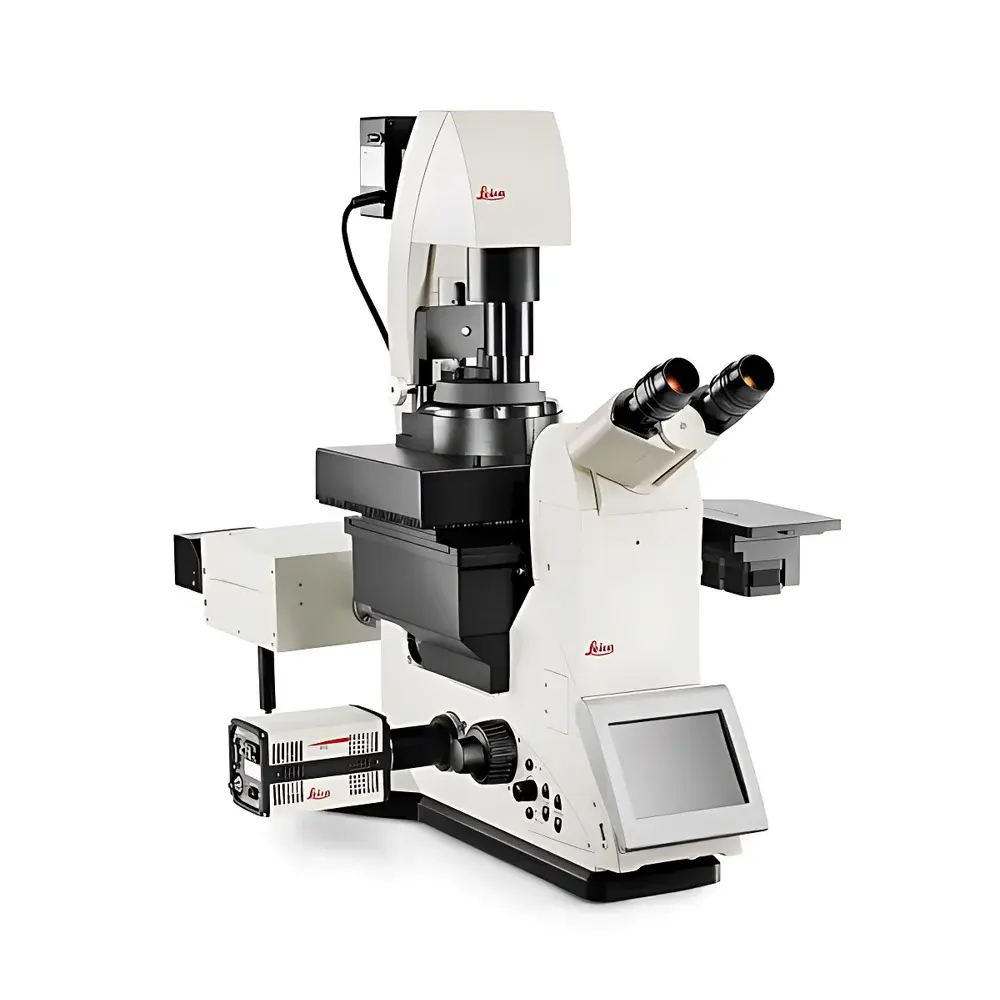
Leica INFINITY TIRF Total Internal Reflection Fluorescence Microscopy System
| Brand | Leica |
|---|---|
| Origin | Germany |
| Model | INFINITY TIRF |
| Instrument Type | Inverted Fluorescence Microscope |
| Excitation Source | Laser (405–640 nm, 1–5 lines, 60–150 mW per line) |
| Optical Architecture | Infinity-Corrected Dual-Path TIRF/EPI/Hi-Lo Illumination Module |
| Integration Platform | Leica DMi8 Inverted Microscope Base |
| Detection | sCMOS (e.g., DFC9000) with Adaptive Focus Control (AFC) |
| Objective Compatibility | PLAN APO TIRF Series |
| Software | LAS X (with TIRF alignment assistant, multi-modal acquisition, audit trail & metadata logging per frame) |
| Regulatory Context | Compliant with GLP/GMP documentation workflows |
Overview
The Leica INFINITY TIRF is a high-precision total internal reflection fluorescence (TIRF) microscopy system engineered for quantitative, single-molecule–level observation of dynamic events at the plasma membrane and submembrane regions of living cells. Built upon the Leica DMi8 inverted microscope platform and integrated with the proprietary INFINITY optical path architecture, this system leverages the physical principle of evanescent wave excitation—generated when laser light undergoes total internal reflection at the glass–water interface—to restrict fluorophore excitation to a ~100 nm axial depth above the coverslip. This yields exceptional signal-to-noise ratio (SNR), minimal out-of-focus background, and sub-diffraction spatial resolution in the axial dimension—critical for studying receptor trafficking, synaptic vesicle docking, focal adhesion assembly/disassembly, and real-time nanoscale protein clustering. The system is not a standalone module but a fully co-engineered imaging solution, where mechanical stability, thermal drift compensation (via AFC), and optical path calibration are synchronized at the hardware–software interface to ensure reproducibility across experiments and users.
Key Features
- Integrated dual-path illumination: Simultaneous or sequential switching between epifluorescence (EPI), Hi-Lo (interference-based optical sectioning), and TIRF modes—all within a single optical train and controlled via LAS X software.
- Automated TIRF angle optimization: Motorized prism positioning combined with real-time sensor feedback enables specimen-specific critical angle determination and beam alignment, eliminating manual trial-and-error setup.
- Multi-laser compatibility: Supports up to five discrete laser lines (405 nm to 640 nm), each independently modulated and power-regulated (60–150 mW), enabling robust multicolor single-particle tracking (SPT), dSTORM, GSDIM, and uPAINT acquisitions.
- High-fidelity optical train: Utilizes Leica’s PLAN APO TIRF objective series (e.g., 63×/1.47 NA, 100×/1.47 NA), optimized for minimal spherical aberration and maximum transmission in the evanescent field regime.
- Full motorization and environmental control readiness: DMi8 base includes motorized Z-focus, filter turrets, stage, and optional incubation chamber integration for long-term live-cell TIRF time-lapse under physiological conditions.
Sample Compatibility & Compliance
The INFINITY TIRF system accommodates standard No. 1.5H glass-bottom dishes, chambered coverslips, and microfluidic cell culture devices. Its evanescent field depth is tunable (typically 60–200 nm) depending on incident angle, refractive index mismatch, and wavelength—enabling consistent imaging across diverse sample preparations including adherent mammalian cells, primary neurons, endothelial monolayers, and reconstituted lipid bilayers. All optical components meet ISO 10110 surface quality standards; mechanical stages comply with ISO 9283 repeatability specifications. For regulated environments, LAS X software supports user role management, electronic signatures, audit trails, and raw data integrity per FDA 21 CFR Part 11 requirements when deployed with validated IT infrastructure.
Software & Data Management
LAS X serves as the unified acquisition and analysis environment, providing dedicated modules for TIRF alignment validation, multi-channel registration, drift correction (via fiducial or cross-correlation algorithms), and quantitative particle detection (e.g., Gaussian fitting for single-molecule localization). Metadata—including laser power, angle, exposure time, Z-position, and environmental parameters—is embedded into every TIFF/OME-TIFF frame. Batch processing pipelines support automated dSTORM reconstruction (using ThunderSTORM or native LAS X STORM tools), SPT trajectory generation (with MSD analysis), and colocalization statistics (Manders’ coefficients, nearest-neighbor distance mapping). Data export conforms to FAIR principles (Findable, Accessible, Interoperable, Reusable) through OME-NGFF-compatible formats.
Applications
- Single-molecule dynamics: Real-time tracking of EGFR, integrin, or neurotransmitter receptor diffusion and confinement at the plasma membrane.
- Synaptic nanostructure: Nanoscale mapping of PSD-95, Bassoon, or Synaptotagmin clusters in cultured neurons using dSTORM.
- Exocytosis/endocytosis kinetics: High-temporal-resolution visualization of vesicle docking, fusion pore expansion, and clathrin-coated pit maturation.
- Cell–matrix adhesion: Quantitative analysis of vinculin, talin, and paxillin recruitment dynamics during focal adhesion turnover.
- Hybrid multimodal workflows: Seamless transition between TIRF, FRAP, photoactivation (PA-GFP), optogenetic stimulation (ChR2), and laser ablation—all controlled from a single LAS X interface.
FAQ
What is the typical evanescent field penetration depth achievable with INFINITY TIRF?
Penetration depth ranges from ~60 nm (at 405 nm, high NA) to ~180 nm (at 640 nm, lower incident angle), adjustable via precise prism rotation and calibrated in real time using built-in reference sensors.
Can INFINITY TIRF be retrofitted onto an existing Leica DMi8 system?
Yes—provided the DMi8 is equipped with dual infinity ports, motorized nosepiece, and LAS X 3.5.1 or later; full compatibility requires verification of optical path length matching and firmware version.
Does the system support time-lapse TIRF imaging over several hours?
Yes—when combined with Leica’s Adaptive Focus Control (AFC), environmental chamber (37°C, 5% CO₂), and low-phototoxicity acquisition protocols (e.g., EMCCD or sCMOS binning), stable focus and minimal drift are maintained across extended acquisitions.
How is laser safety managed during multi-line operation?
All lasers are Class 3B or 4 devices integrated into the WSU laser combiner box with interlocked shutter control, beam dump monitoring, and automatic power ramping—fully compliant with IEC 60825-1 and local institutional laser safety officer (LSO) protocols.
Is raw image data stored with full acquisition metadata?
Yes—every acquired frame includes embedded EXIF and OME-XML metadata covering illumination parameters, objective ID, Z-position, temperature, CO₂ level (if sensors connected), and user-defined experimental tags.





