
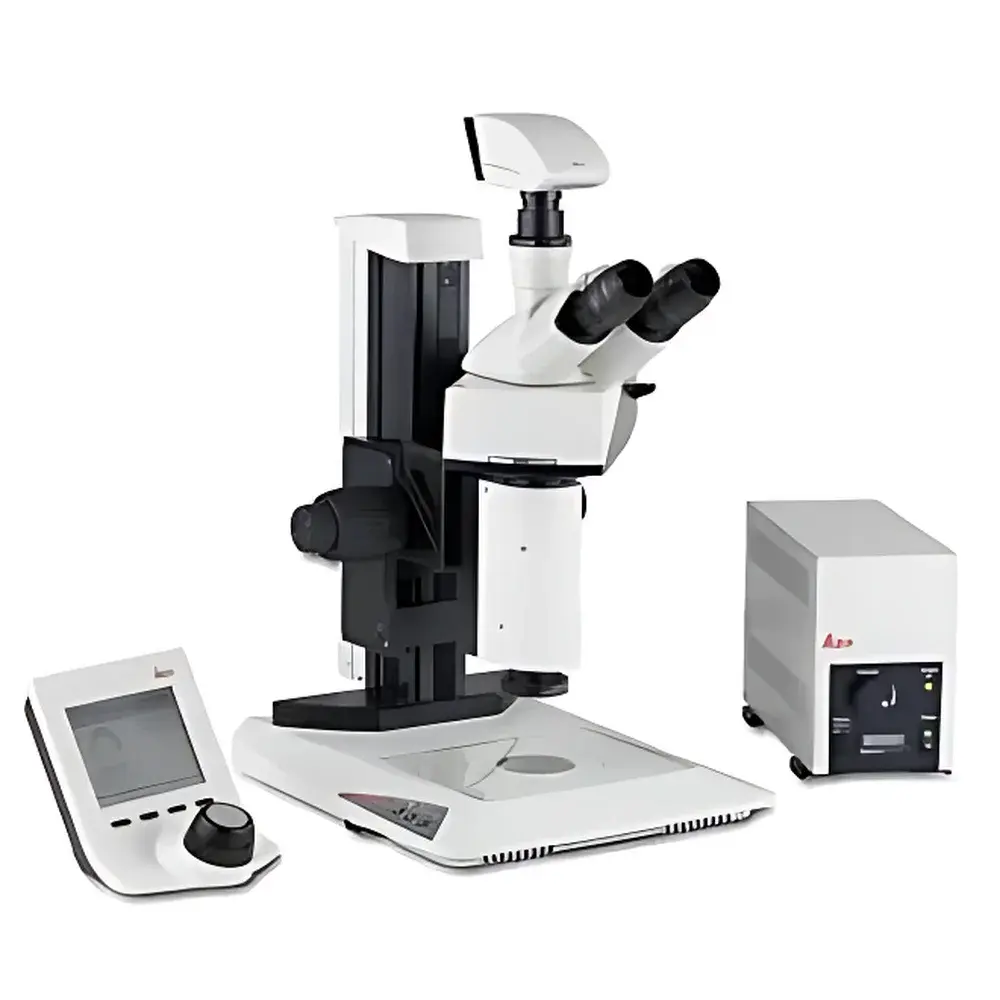
Leica MacroFluo Axial Macro Imaging System
| Brand | Leica |
|---|---|
| Origin | Germany |
| Model | MacroFluo |
| Zoom Optics Options | Leica Z6 APO (6:1) or Leica Z16 APO (16:1) |
| Illumination | Integrated Axial Epi-Fluorescence |
| Working Distance | Long (>40 mm at lowest magnification) |
| Field of View | Wide, Parfocal & Parcentric |
| Focus Stability | Motorized or Manual Precision Column with Vibration-Damping Base |
| Modularity | Fully Configurable with Optional Cameras, Filters, and Light Sources |
| Compliance | Designed for ISO 13528-compliant documentation workflows |
Overview
The Leica MacroFluo Axial Macro Imaging System is a high-precision, research-grade stereo fluorescence macro imaging platform engineered for quantitative biological documentation and multi-scale morphological analysis. Built upon Leica’s proprietary axial optical architecture—distinct from conventional oblique or off-axis illumination designs—the system delivers parfocal, parcentric, and truly parallax-free imaging across its entire zoom range. Its core optical engine integrates either the Leica Z6 APO (6:1 zoom ratio) or Z16 APO (16:1 zoom ratio) apochromatic objective turret, enabling seamless transition from whole-organism overview (e.g., adult zebrafish, Xenopus laevis embryos) to subcellular structural detail without mechanical repositioning or focus recalibration. The axial epi-fluorescence illumination path is coaxially aligned with the imaging axis, eliminating shadowing, illumination gradient artifacts, and excitation non-uniformity commonly observed in lateral or ring-light configurations—critical for reproducible intensity-based quantification in gene expression mapping and reporter assays.
Key Features
- Axial Optical Architecture: Ensures zero parallax and pixel-accurate spatial registration between brightfield, fluorescence, and multi-channel overlay images—essential for longitudinal tracking and morphometric analysis.
- Apochromatic Zoom Optics: Z6 APO (0.7×–4.2×) or Z16 APO (0.7×–11.2×) objectives deliver diffraction-limited resolution, chromatic aberration correction across UV–NIR, and consistent MTF performance across magnification.
- Integrated Axial Epi-Fluorescence: High-efficiency LED or metal-halide light sources coupled via dichroic beam splitters provide uniform excitation intensity (CV < 5% across FOV) even at lowest magnifications—enabling low-background detection of weak GFP/RFP signals in thick, scattering specimens.
- Vibration-Isolated Focusing Column: Precision-ground linear guides and optional motorized Z-drive with sub-micron repeatability (<0.3 µm) ensure stability during time-lapse acquisition and automated Z-stacking.
- Modular Expansion Interface: Standardized Leica L-Mount and C-mount adaptors support integration of sCMOS cameras (e.g., Leica DFC9000 GT), spectral filter wheels, environmental chambers, and motorized stage controllers.
- Ergonomic Workflow Integration: Compatible with Leica Application Suite X (LAS X) software for GLP-compliant metadata tagging, audit-trail-enabled image acquisition, and automated report generation per ISO/IEC 17025 requirements.
Sample Compatibility & Compliance
The MacroFluo system accommodates specimens ranging from intact vertebrate embryos (zebrafish, Xenopus), plant seedlings, soil mesocosms, and histological tissue blocks to microfluidic devices and PCB-level assemblies. Its long working distance (>40 mm at 0.7×) permits unobstructed access for micromanipulation, injection, or concurrent physiological monitoring. All optical components comply with DIN EN ISO 10110 surface quality standards; fluorescence filter sets meet ISO 10110-7 spectral tolerance specifications. The system supports 21 CFR Part 11-compliant user authentication, electronic signatures, and immutable acquisition logs when deployed with LAS X GLP modules—validated for use in academic core facilities, contract research organizations (CROs), and regulated preclinical labs operating under GLP or GMP frameworks.
Software & Data Management
Leica LAS X software provides native support for multi-dimensional acquisition (XYZTλ), batch processing, and quantitative fluorescence intensity profiling with background subtraction, flat-field correction, and region-of-interest (ROI) statistics export (CSV, HDF5). Image metadata—including objective ID, exposure parameters, filter configuration, and calibration timestamps—is embedded in TIFF/OME-TIFF headers. For enterprise deployment, LAS X integrates with laboratory information management systems (LIMS) via RESTful API and supports DICOM-SR export for cross-platform archival. Audit trails record all user actions, parameter changes, and software updates—fully traceable for FDA inspection readiness.
Applications
- Developmental biology: Spatial mapping of transgenic reporter expression in live or fixed embryos.
- Plant phenotyping: Quantitative assessment of chlorophyll fluorescence (Fv/Fm), root architecture, and stress-induced pigment shifts.
- Ecotoxicology: In situ visualization of fluorescent biomarkers (e.g., GFP-tagged biosensors) in soil microcosms or aquatic biofilms.
- Preclinical pathology: Macro-imaging of whole-tissue sections prior to microtome sectioning—enabling ROI-guided serial sectioning.
- Materials science: Fluorescence contrast imaging of polymer phase separation, coating uniformity, or defect localization on large-area substrates.
FAQ
What zoom ratios are available, and how do they affect working distance and field of view?
The system supports two interchangeable zoom optics: Z6 APO (6:1, WD ≥ 40 mm at 0.7×, FOV up to 100 mm) and Z16 APO (16:1, WD ≥ 30 mm at 0.7×, FOV up to 60 mm). Higher zoom ratio enables greater magnification range but reduces maximum FOV and nominal working distance.
Can the MacroFluo be used for quantitative fluorescence intensity measurements?
Yes—when calibrated with NIST-traceable fluorescence standards and operated with LAS X’s intensity normalization module, the system supports relative quantification with inter-session CV ≤ 8% under controlled illumination and exposure conditions.
Is motorized focus standard or optional?
Motorized Z-drive is an optional upgrade; manual precision focus columns are standard. Both configurations include fine-focus vernier scales and locking mechanisms for repeatable positioning.
Which camera interfaces are supported?
Native support for Leica DFC series (USB 3.0, 10 GbE); third-party cameras with GenICam-compliant drivers (e.g., Hamamatsu ORCA-Fusion BT, PCO.edge 4.2) are fully operable via LAS X SDK.
Does the system meet regulatory requirements for GLP-compliant documentation?
Yes—when configured with LAS X GLP Edition and validated hardware firmware, it satisfies audit trail, electronic signature, and data integrity requirements per OECD GLP Principles and FDA 21 CFR Part 11.






