
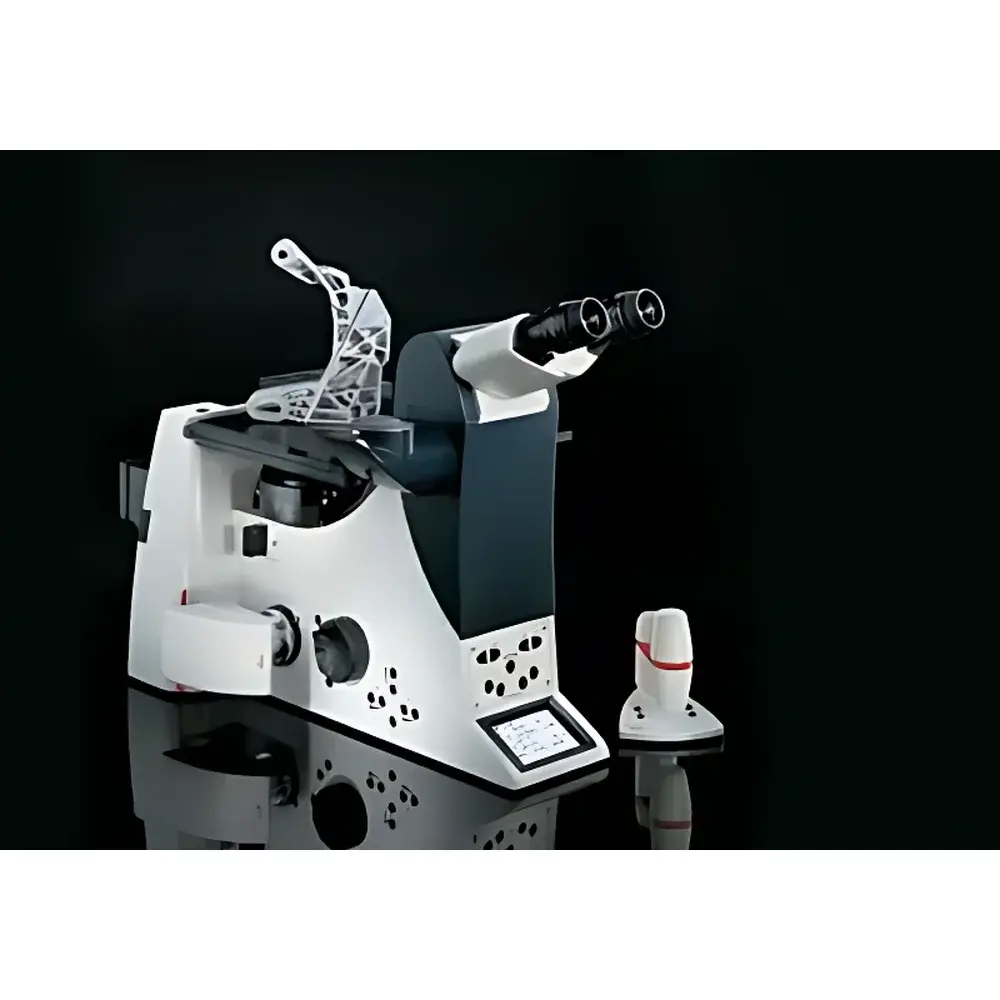
Leica DMI 5000M Intelligent Digital Inverted Metallurgical Microscope
| Brand | Leica |
|---|---|
| Origin | Germany |
| Model | DMI 5000M |
| Optical Design | HC Infinite Correction with Axial & Radial Chromatic Aberration Compensation |
| Eyepieces | 10×, 25 mm Field of View |
| Observation Tube | Tiltable 20–45°, Reversible for Height Reduction (10 cm adjustment) |
| Objectives | Metallurgical 32 mm Diameter |
| Stage | 248 × 204 mm, X–Y Travel 100 × 60 mm, Sample Aperture 5–40 mm |
| Focus Range | 9 mm Vertical Travel, 1 µm Step Resolution |
| Magnification Range | 50×–1000× |
| Objective Turret | 5-Position Motorized or Manual |
| Illumination Control | Motorized Brightfield/Darkfield Switching, Auto-Linked Aperture/Field Diaphragm & Light Intensity Adjustment per Objective |
| LCD Display | 76 × 49 mm, Real-Time Readout of Objective, Z-Position, Illumination Parameters, Zoom Factor |
| Software | Leica Application Suite (LAS) with Programmable User Profiles, Multi-User Management, State Recall, Extended Depth of Field (EDF), Tile Scan, and Quantitative Metallographic Analysis (ASTM E112, E3, E1245, ISO 643, ISO 9042, etc.) |
Overview
The Leica DMI 5000M is a research-grade inverted metallurgical microscope engineered for high-precision microstructural analysis in materials science laboratories. Built upon Leica’s HC (High Contrast) infinite optical system with dual-axis chromatic aberration correction—both axial and radial—the instrument eliminates stray light and optical distortions across the full magnification range (50× to 1000×). Its inverted configuration places the objective lenses beneath the specimen stage, enabling stable imaging of large, heavy, or thermally sensitive samples such as castings, weldments, semiconductor wafers, and coated substrates. The system supports both reflected-light and transmitted-light observation modes, including brightfield, darkfield, polarized light, differential interference contrast (DIC), and fluorescence—making it suitable for comprehensive microstructural characterization in metallurgy, failure analysis, quality assurance, and advanced materials R&D.
Key Features
- Motorized 5-position objective turret with simultaneous manual override—enabling rapid, repeatable switching between magnifications while preserving alignment integrity.
- Ergonomic tilting observation tube (20°–45°) with reversible mounting for height reduction up to 10 cm, conforming to ISO 9241-5 and ANSI/HFES 100 human factors standards for prolonged operator comfort.
- 32 mm diameter metallurgical objectives optimized for high numerical aperture (up to NA 0.90) and long working distances (up to 12.2 mm at 5×), delivering superior light throughput and resolution in both brightfield and darkfield illumination.
- Intelligent illumination management: motorized brightfield/darkfield selection, auto-linked field and aperture diaphragm positioning synchronized with objective change, and real-time LED intensity control—all displayed on the integrated 76 × 49 mm LCD panel.
- Integrated color temperature stabilization system ensures consistent white balance across imaging sessions without manual recalibration—critical for comparative quantitative analysis and regulatory documentation.
- Sub-micron focus precision (1 µm step resolution over 9 mm vertical travel) combined with coaxial coarse/fine focusing controls for accurate Z-axis positioning during layer profiling or roughness assessment.
Sample Compatibility & Compliance
The DMI 5000M accommodates specimens up to 248 × 204 mm on its motorized mechanical stage, with 100 × 60 mm translation range and configurable apertures (5–40 mm) for diverse sample geometries—from bulk metallographic mounts to wafer-scale semiconductor substrates. Its modular design permits integration with external metrology tools, including interferometric step profilers for surface topography quantification (traceable to ISO 25178-601) and large-area CCD/CMOS cameras for automated grain boundary mapping. The system complies with IEC 61000-6-3 (EMC emissions), IEC 61000-6-2 (immunity), and meets essential requirements of the EU Machinery Directive 2006/42/EC. When operated with Leica LAS software under validated configurations, it supports audit-ready workflows compliant with GLP (OECD Principles), GMP (FDA 21 CFR Part 11 electronic records), and ISO/IEC 17025 calibration traceability frameworks.
Software & Data Management
Leica Application Suite (LAS) is provided at no additional cost and serves as the central control and analysis platform. It enables full programmability of acquisition parameters—including illumination settings, objective position, Z-stack depth, tile scan coordinates, and DIC bias—assignable to single-key user profiles. Multi-user management allows role-based parameter locking and secure profile storage, ensuring method consistency across shifts or departments. Each captured image embeds full metadata (objective, magnification, exposure, diaphragm settings, Z-height), and the “State Recall” function restores all hardware states associated with any saved image—facilitating reproducible re-examination. Quantitative analysis modules support ASTM E112 (grain size), E3 (specimen preparation), E1245 (inclusion rating), ISO 643 (steel microstructure), and ISO 9042 (coating thickness)—with automated thresholding, particle classification, phase fraction calculation, and statistical reporting exportable to CSV, PDF, or LIF formats.
Applications
The DMI 5000M is routinely deployed in industrial and academic laboratories for failure root cause analysis (e.g., fatigue crack initiation, intergranular corrosion, weld HAZ evaluation), heat treatment verification (martensite/austenite ratio, decarburization depth), coating adhesion and thickness uniformity assessment, sintered powder metallurgy density analysis, and semiconductor package inspection (wire bond integrity, die attach voiding). Its DIC and polarized light capabilities support crystallographic orientation mapping in non-cubic alloys, while fluorescence compatibility extends utility to oxide scale characterization using thermal barrier coating markers. Integration with motorized stage controllers enables automated serial sectioning alignment for 3D reconstruction of inclusion networks or porosity distributions.
FAQ
Is the DMI 5000M compatible with third-party digital cameras?
Yes—via standardized C-mount or F-mount interfaces; however, optimal performance and full hardware synchronization (e.g., auto-diaphragm linkage, objective ID recognition) require Leica-certified cameras.
Can the system be upgraded to support confocal imaging?
No—the DMI 5000M is not designed for laser scanning or pinhole-based confocal operation; for that functionality, Leica recommends migration to the DMI6000 or DMi8 platforms with optional TCS SP8 confocal modules.
Does the motorized turret support objective identification via RFID or barcode?
Yes—each HC objective contains an embedded RFID tag read automatically upon insertion, enabling LAS to load pre-calibrated settings for magnification, working distance, and illumination parameters.
What level of service and calibration support is available outside the EU?
Leica Microsystems maintains certified service centers in North America, APAC, and EMEA offering on-site preventive maintenance, optical alignment verification (per ISO 10934-1), and traceable calibration reports issued by DAkkS-accredited labs.
Is LAS software compliant with FDA 21 CFR Part 11 for electronic signatures?
Yes—when deployed in “Audit Trail Mode” with user authentication, electronic signature enforcement, and immutable log archiving, LAS meets Part 11 requirements for regulated pharmaceutical and medical device QA/QC environments.



