
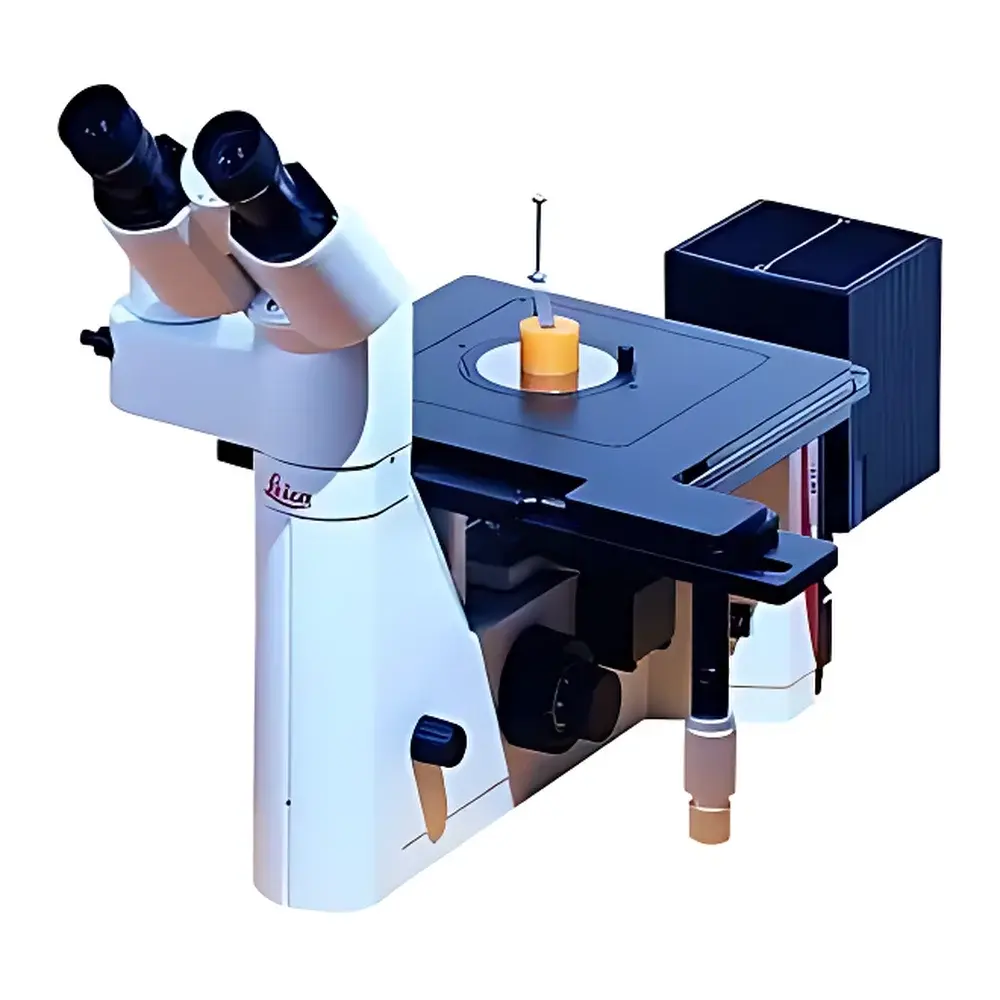
Leica DM ILM Inverted Metallurgical Microscope
| Brand | Leica |
|---|---|
| Origin | Germany |
| Model | DM ILM |
| Configuration | Inverted |
| Image Analysis System | Integrated |
| Total Magnification Range | 10×–100× |
| Eyepiece | 10× |
| Objective Lenses | Up to 100× |
| Illumination | Built-in 6 V / 35 W Halogen Lamp |
| Ergonomic Viewing Angle | Adjustable Ergotube (0°–35°) |
| Modular Turret Options | Six Interchangeable Observation Tubes |
Overview
The Leica DM ILM is a modular, inverted metallurgical microscope engineered for high-precision microstructural analysis of opaque, reflective specimens—particularly metals, alloys, ceramics, and coated materials. Designed around the principles of Köhler illumination and optimized optical path geometry, it delivers diffraction-limited resolution in brightfield reflected light, polarized light, and fluorescence contrast modes. Its inverted configuration positions the objective lenses beneath the specimen stage, enabling unobstructed access to large, heavy, or irregularly shaped industrial samples—including castings, welds, heat-treated components, and semiconductor wafers—without requiring sample sectioning or complex mounting. The system’s rigid mechanical architecture minimizes vibration-induced drift, ensuring measurement stability during extended inspection cycles or automated image acquisition sequences.
Key Features
- Modular observation tube platform supporting six interchangeable configurations—including standard binocular, trinocular, and the ergonomic Leica Ergotube with continuous 0°–35° viewing angle adjustment for operator comfort during prolonged use.
- High-transmission, apochromatically corrected optical train delivering uniform illumination, minimal chromatic aberration, and consistent contrast across the full 10×–100× magnification range (with 10× wide-field eyepieces and 5×, 10×, 20×, 50×, and 100× long-working-distance objectives).
- Integrated 6 V / 35 W halogen illumination system with precision intensity control and built-in field diaphragm, enabling reproducible brightness settings compliant with ASTM E3–22 and ISO 4967 standards for metallographic evaluation.
- Stable, low-profile inverted stand with reinforced stage capable of accommodating specimens up to 200 mm × 200 mm × 80 mm (W × D × H), facilitating rapid sequential examination of production-line samples without repositioning.
- Pre-aligned optical pathways and standardized DIN/ISO 19012-1 mechanical tube length ensure compatibility with third-party digital cameras, motorized focus units, and automated stage controllers.
Sample Compatibility & Compliance
The DM ILM accommodates a broad spectrum of metallurgical and materials science specimens—including as-polished, etched, or anodized metallic surfaces; sintered powders; fracture surfaces; cross-sectioned coatings; and embedded composites. Its long-working-distance objectives permit observation of specimens with surface topography exceeding 1 mm, eliminating the need for oil immersion in routine quality control workflows. The system conforms to ISO/IEC 17025 requirements for testing laboratories and supports GLP-compliant documentation when paired with Leica Application Suite (LAS) X software. All optical components meet RoHS directives, and illumination electronics comply with EN 61000-6-3 (EMC) and EN 61000-6-2 (immunity) standards.
Software & Data Management
The microscope integrates seamlessly with Leica LAS X software—a validated, audit-trail-enabled platform compliant with FDA 21 CFR Part 11 for electronic records and signatures. LAS X provides calibrated image capture, multi-channel fluorescence registration, grain size analysis per ASTM E112, inclusion rating per ASTM E45, and phase fraction quantification using threshold-based segmentation. Raw image metadata—including magnification, exposure time, lamp intensity, and objective ID—is automatically embedded in TIFF and JPEG files. Export formats support CSV, PDF reports, and DICOM-compatible datasets for enterprise-level LIMS integration.
Applications
- Production line QC for automotive castings, aerospace turbine blades, and additive-manufactured metal parts.
- Failure analysis of fatigue cracks, intergranular corrosion, and heat-affected zones in welded joints.
- Research-grade microstructure characterization in university metallurgy labs and national institutes.
- Coating thickness verification and porosity assessment in thermal spray and PVD/CVD applications.
- Standardized metallographic grading per ISO 643, ASTM E3, and EN 10247 for certification and supplier qualification.
FAQ
Is the Leica DM ILM compatible with motorized Z-focus and XY-stage automation?
Yes—via Leica’s optional Motorized Focus Drive (MFD) and Precision Stage Controller (PSC), both controllable through LAS X API or third-party LabVIEW/Python interfaces.
Does the system support quantitative phase analysis out-of-the-box?
Quantitative analysis requires LAS X software with the Materials Science Module, which includes preconfigured templates for ferrite/pearlite ratio, carbide distribution, and austenite grain sizing.
Can the halogen illumination be upgraded to LED?
While the base model uses halogen, Leica offers the optional LED3000 RL module for stable, cool-white illumination with >50,000-hour lifetime and flicker-free operation.
What certifications accompany the instrument for regulated environments?
Each unit ships with a Factory Calibration Certificate traceable to PTB (Physikalisch-Technische Bundesanstalt) and optional IQ/OQ documentation packages aligned with ISO 9001 and GMP Annex 11 requirements.
Is training provided for operators and QA personnel?
Leica Microsystems offers on-site or virtual application training, including method validation workshops and software SOP development support.





