
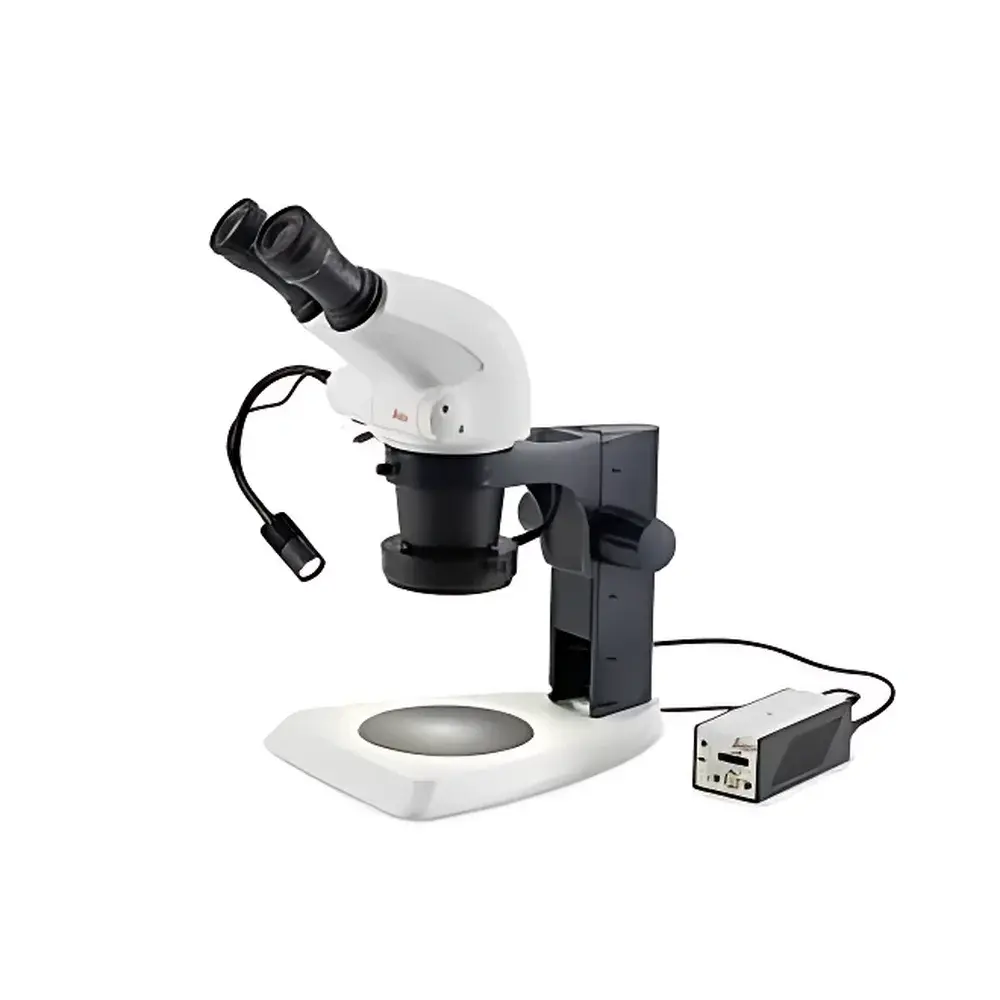
Leica LED1000 Modular LED Illumination System for Stereo Microscopy
| Brand | Leica |
|---|---|
| Origin | Germany |
| Model | LED1000 |
| Light Source | High-Stability White LED Array |
| Rated Lifetime | 4,000 hours |
| Input Voltage | 100–240 V AC, 50/60 Hz |
| Optical Configurations | Ring Light, Spot Light, Transmitted Light Base |
| Polarization Module | Integrated Polarizer/Analyzer Pair |
| Flicker-Free & Ripple-Free Output | Compliant with ISO 9001-certified optical stability requirements |
| Compatibility | Designed exclusively for Leica M-series and Z-series stereo microscopes (e.g., M80, M125, M205, Z6 APO, Z16 APO) |
Overview
The Leica LED1000 Modular LED Illumination System is an engineered optical lighting solution purpose-built for high-fidelity stereo microscopy applications. Operating on the principle of solid-state white LED illumination with precision current regulation, it delivers stable, spectrally consistent output across its full intensity range—eliminating thermal drift, intensity decay, and electromagnetic interference commonly associated with halogen or mercury-based sources. Its core architecture integrates constant-current drivers and passive thermal management to ensure flicker-free (< 0.1% RMS ripple) and ripple-free illumination, a critical requirement for quantitative image acquisition, time-lapse documentation, and digital fluorescence correlation workflows. Designed as a native illumination partner for Leica’s M-series and Z-series stereo microscope platforms, the LED1000 supports seamless mechanical and electrical integration—including auto-detection of attached modules and intensity synchronization via Leica’s proprietary interface protocol.
Key Features
- 4,000-hour rated LED lifetime—reducing maintenance intervals and total cost of ownership without compromising photometric consistency
- Integrated polarization module comprising a motorized polarizer and rotatable analyzer, enabling real-time extinction control for glare suppression on reflective, metallic, or polished samples
- Modular light head architecture supporting three standardized optical configurations: coaxial ring light (for uniform surface illumination), adjustable spot light (with 360° articulation and focusable beam), and transmitted light base (with variable aperture and field diaphragm)
- Universal 100–240 V AC input with active PFC (Power Factor Correction), ensuring stable operation under fluctuating grid conditions common in multi-instrument laboratory environments
- Digital intensity control via rotary encoder or Leica Application Suite (LAS X) software, offering 0–100% linear dimming with < ±0.5% repeatability across 1,000+ on/off cycles
- Compliance with IEC 62471 (Photobiological Safety) and EN 61326-1 (EMC for laboratory equipment), validated per Leica’s internal GLP-aligned test protocol
Sample Compatibility & Compliance
The LED1000 is optimized for routine and advanced stereo microscopy across industrial QA/QC, life science specimen examination, and electronics inspection. Its polarization capability enables high-contrast imaging of birefringent materials (e.g., polymer films, mineral thin sections, collagen scaffolds) and eliminates specular artifacts from solder joints, PCB traces, or machined metal surfaces. The system conforms to ISO 10934-1 (microscopy terminology) and supports traceable calibration workflows when used with NIST-traceable photometric reference standards. For regulated environments, illumination logs—including intensity settings, module configuration, and session timestamps—can be exported in CSV format and archived alongside image metadata in accordance with 21 CFR Part 11-compliant LAS X deployments.
Software & Data Management
When paired with Leica Application Suite (LAS X) v3.7+, the LED1000 enables synchronized hardware control within acquisition protocols. Intensity presets can be saved per user profile or experiment template; polarization angle positions are logged with each image frame. Audit trails record all illumination parameter changes, satisfying GLP/GMP documentation requirements. Firmware updates are delivered via Leica’s secure firmware portal and validated against SHA-256 checksums prior to installation. No local storage or network connectivity is embedded in the illumination unit itself—ensuring air-gapped operation where required.
Applications
- Non-destructive inspection of microelectromechanical systems (MEMS) and semiconductor packaging
- Morphological assessment of botanical specimens, entomological samples, and histological tissue blocks under low-angle oblique lighting
- Quality verification of additive-manufactured metal parts, including porosity analysis and surface finish evaluation
- Educational demonstration of optical anisotropy using calibrated stress models or liquid crystal cells
- Forensic document examination requiring controlled polarization contrast to reveal indented writing or altered ink boundaries
FAQ
Is the LED1000 compatible with non-Leica stereo microscopes?
No—the mechanical mounting interface, power delivery protocol, and communication handshake are proprietary to Leica M/Z-series stands and cannot be retrofitted to third-party systems.
Can the polarization module be used independently of other light heads?
Yes—the polarizer/analyzer pair is integrated into the ring light housing but remains functional when the ring light is detached and mounted on the spot light arm or transmitted base via standard Leica dovetail adapters.
Does the system support TTL triggering for synchronized camera exposure?
No—LED1000 operates in continuous or manually gated mode only; external shutter synchronization requires auxiliary opto-isolated trigger modules sold separately.
What is the spectral output range of the white LED array?
Measured CIE 1931 chromaticity coordinates: x = 0.313, y = 0.329 (D65-equivalent); CCT = 6200 K ± 150 K; CRI (Ra) ≥ 92, verified per DIN 5033-7.
How is thermal management implemented to maintain color stability during extended use?
A passive aluminum heat sink with optimized fin geometry dissipates > 95% of junction heat; internal thermistors monitor LED substrate temperature and dynamically adjust drive current to limit ΔT to < 5°C over 8-hour continuous operation.





