
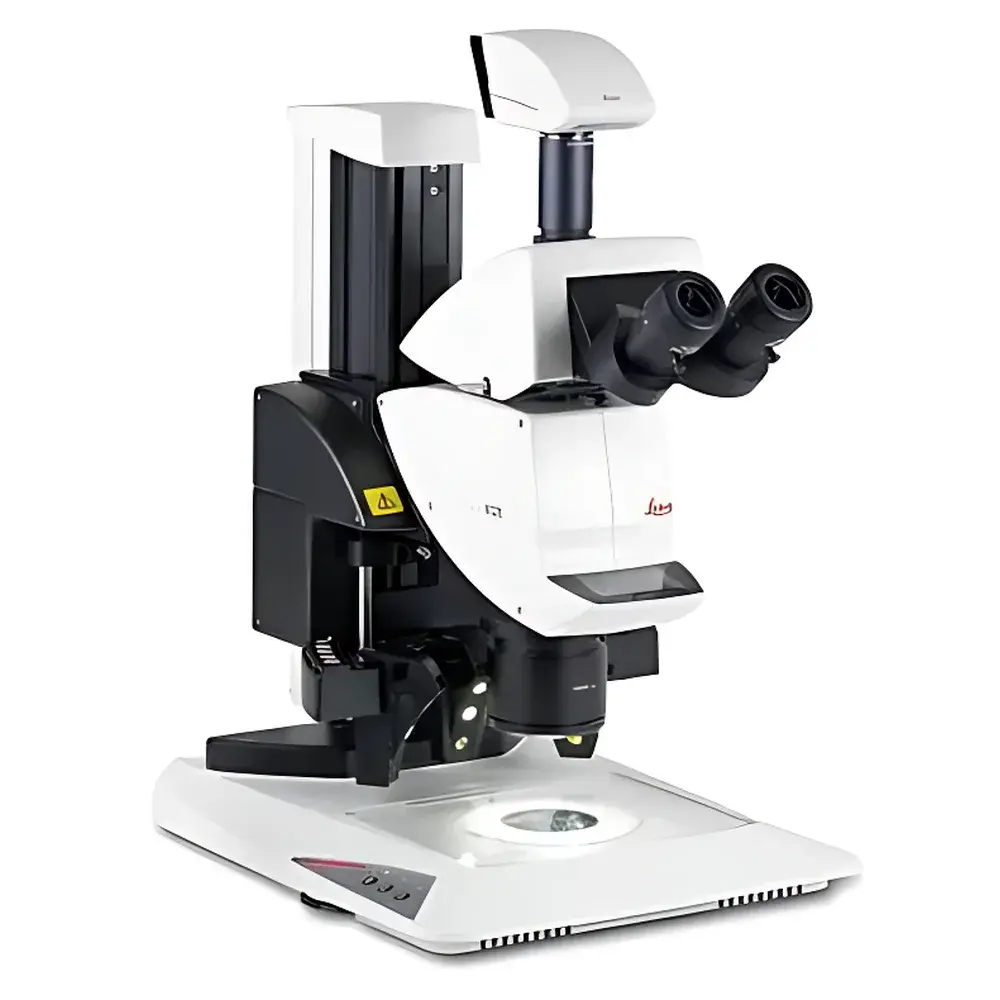
Leica TL5000 Ergo LED Transmitted Light Base with Motorized Aperture
| Brand | Leica |
|---|---|
| Origin | Germany |
| Model | TL5000 Ergo |
| Illumination Type | High-Uniformity White LED |
| Field Diameter | 65 mm |
| Contrast Modes | Optimized Rottermann Contrast, Low-Reflection Darkfield, Uniform Brightfield |
| Automation | Motorized Aperture Synchronized with Zoom Position |
| Software Integration | Fully Encoded & Compatible with Leica LAS / LAS AF |
| Ergonomic Design | Flat, Low-Profile Platform for Fatigue-Free Operation |
| Compliance | Designed for GLP/GMP-Lab Environments, Supports Audit-Trail-Capable Workflow in LAS AF |
Overview
The Leica TL5000 Ergo is a fully encoded, motorized transmitted light base engineered specifically for stereo and macro microscopy applications requiring high-fidelity illumination consistency, ergonomic operator sustainability, and repeatable imaging conditions. Unlike conventional fixed-aperture bases, the TL5000 Ergo employs a precision motorized aperture system that dynamically synchronizes with the zoom position of Leica stereomicroscopes (e.g., M205 FA, M165 FC, Z16 APO), ensuring optimal numerical aperture matching and contrast optimization across the entire magnification range. Its optical architecture leverages advanced white LED arrays calibrated to deliver spectrally neutral (CCT ≈ 5700 K), flicker-free illumination with <±3% intensity variation across the full 65 mm field diameter — a critical requirement for quantitative brightfield documentation, comparative morphological analysis, and multi-session time-series studies. The base operates on the principle of Köhler illumination adapted for reflected-transmitted hybrid configurations, enabling simultaneous use of incident and transmitted light without mechanical reconfiguration.
Key Features
- Motorized aperture control automatically adjusts iris diameter and light centering in real time as zoom or objective position changes — eliminating manual recalibration and preserving consistent contrast and depth-of-field characteristics.
- Rottermann Contrast technology enhances edge definition in low-contrast biological specimens (e.g., unstained embryos, gel matrices, soft tissues) by optimizing diffraction-limited light distribution without introducing halation or glare.
- Low-reflection darkfield mode utilizes precisely angled peripheral LED rings to suppress specular reflection from glossy or metallic samples — ideal for inspecting solder joints, microfluidic channels, or coated surfaces.
- Flat, low-profile mechanical design (height: 42 mm) reduces wrist extension and improves posture during prolonged observation sessions — validated per ISO 9241-5 and EN 614-1 ergonomics guidelines.
- Fully encoded hardware interface enables bidirectional communication with Leica LAS and LAS AF software; all illumination parameters (intensity, aperture size, contrast mode) are logged, recalled, and embedded into image metadata.
- Thermally stabilized LED driver maintains constant color temperature and luminance over extended operation (>8,000 h rated lifetime), with no warm-up delay or output drift.
Sample Compatibility & Compliance
The TL5000 Ergo supports transmission imaging of opaque, translucent, and semi-transparent specimens up to 120 mm in width and 60 mm in height — including Petri dishes, multi-well plates, circuit boards, histological slides mounted in glass or quartz, and whole-mount zebrafish or Drosophila preparations. Its uniform 65 mm field enables single-shot documentation of large-area samples without stitching artifacts. The base complies with IEC 61000-6-3 (EMC emission limits) and IEC 62471 (photobiological safety Class 1), and its encoded operation supports 21 CFR Part 11-compliant audit trails when used with LAS AF v4.13 or later under validated laboratory workflows. It is routinely deployed in QC labs adhering to ISO/IEC 17025 and pharmaceutical environments operating under EU GMP Annex 11 requirements.
Software & Data Management
Integration with Leica Application Suite (LAS) and LAS AF is native and lossless: illumination settings are stored as part of acquisition protocols, enabling full reproducibility across users and instruments. LAS AF’s “Illumination Preset Manager” allows saving combinations of aperture size, brightness level, and contrast mode per sample type (e.g., “Drosophila Larva – Brightfield”, “PCB – Darkfield”). All parameter changes are timestamped and user-attributed within the software’s electronic lab notebook (ELN) module. Exported TIFFs and JPEGs retain EXIF-style metadata tags indicating aperture position (% open), LED drive current (mA), and active contrast profile — facilitating retrospective validation and inter-instrument comparability.
Applications
- Developmental biology: Time-lapse imaging of live zebrafish or C. elegans embryos under stable, non-phototoxic illumination.
- Electronics inspection: Defect identification on PCBs using synchronized darkfield contrast at varying working distances.
- Materials science: Characterization of polymer phase separation, fiber alignment, or composite layer integrity via uniform brightfield transmission.
- Quality control in medical device manufacturing: Visual verification of catheter lumen clarity, stent strut uniformity, or hydrogel transparency.
- Educational laboratories: Standardized teaching setups where consistent illumination eliminates variability between student workstations.
FAQ
Does the TL5000 Ergo require external controllers or drivers?
No — it connects directly to Leica stereomicroscope stands via the proprietary Leica Digital Interface (LDI) port and draws power from the microscope’s main supply. No additional power bricks or USB hubs are needed.
Can the motorized aperture be controlled manually via the base itself?
No — aperture adjustment is exclusively software-driven or synchronized automatically with zoom. Physical dials or buttons are omitted to ensure protocol fidelity and prevent accidental deviation from validated settings.
Is the 65 mm field diameter usable at all magnifications?
Yes — the optical design maintains full field utilization from 6.3× to 160× (with appropriate objectives), though effective illuminated area scales inversely with magnification due to geometric projection; software-based field-of-view calibration compensates for this in LAS AF.
How is thermal management handled during extended imaging sessions?
A passive aluminum heat sink combined with pulse-width-modulated (PWM) LED dimming ensures junction temperatures remain below 65°C even after 12 hours of continuous operation — verified per IEC 60068-2-14 thermal shock testing.





