
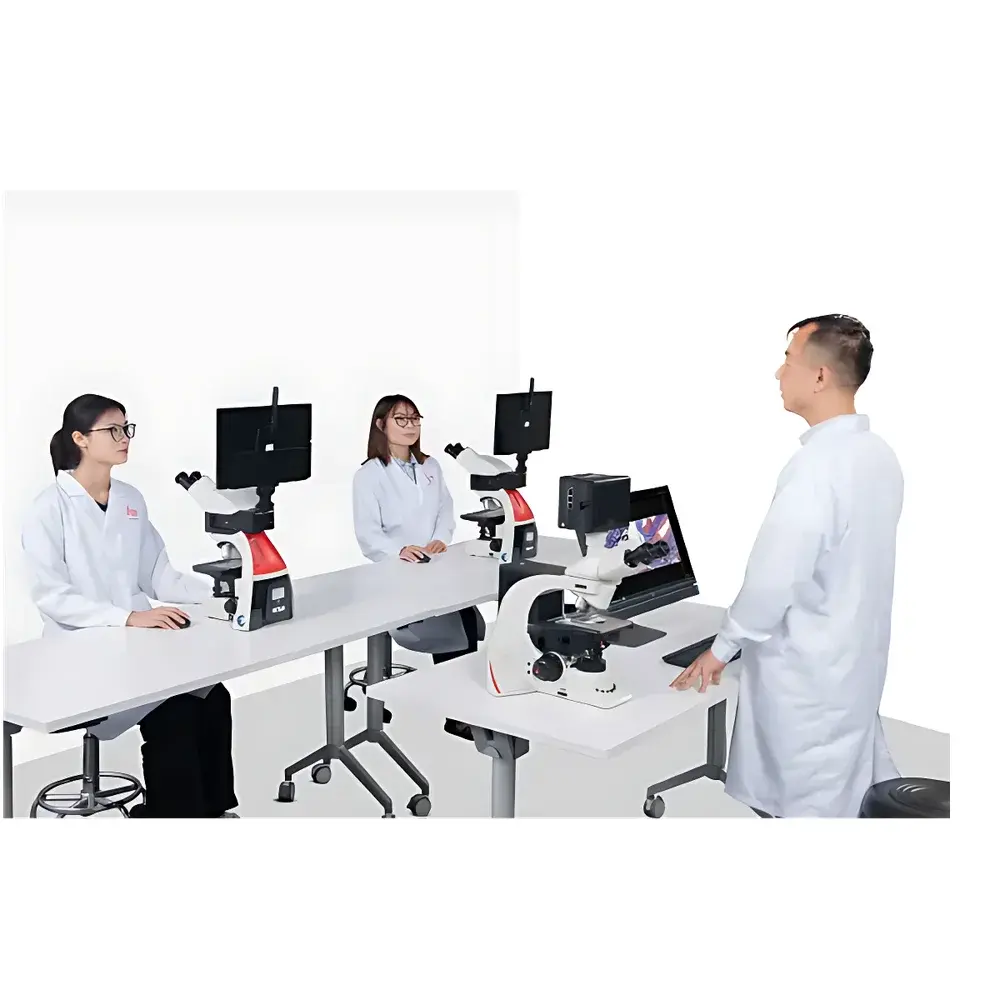
Leica EduTree Interactive Microscopy Teaching System (Domestically Manufactured in Shanghai)
| Brand | Leica |
|---|---|
| Origin | Shanghai, China |
| Manufacturer Type | Authorized Distributor |
| Regional Classification | Domestic (China) |
| Model | EduTree |
| Pricing | Upon Request |
Overview
The Leica EduTree Interactive Microscopy Teaching System is an integrated, wireless educational platform engineered for modern STEM and medical laboratory instruction. Built upon a robust 5G Wi-Fi infrastructure compliant with IEEE 802.11ac standards, EduTree enables real-time, low-latency bidirectional transmission between instructor and student microscopy workstations. Unlike conventional wired classroom systems, EduTree eliminates physical cabling constraints while maintaining sub-400 ms average end-to-end latency—ensuring synchronized visual feedback during live microscopic observation. The system operates on a self-configuring local area network architecture: all client devices (teacher station, student workstations, mobile clients) auto-discover and join the network upon power-up, with automatic device registration, session management, and graceful de-registration upon logout or timeout. Designed specifically for academic environments, EduTree supports Leica widefield upright microscopes, inverted microscopes, and stereomicroscopes—making it suitable for histology labs in medical schools, cell biology courses in life sciences departments, and materials characterization workflows in engineering curricula.
Key Features
- 5G Wi-Fi-based zero-configuration mesh networking supporting up to 120 concurrent student stations per classroom
- Real-time video streaming with adaptive bitrate encoding and hardware-accelerated H.264/H.265 compression
- Integrated depth-fusion imaging algorithm enabling extended depth-of-field (EDF) visualization during manual or motorized focus adjustment
- Dual-mode display control: 9-tile overview mode with tabbed navigation and single-student full-screen mode with remote parameter adjustment
- Teacher-controlled application lockdown: student devices enforce kiosk mode—preventing unauthorized app installation, background task execution, or exit from the EduTree client
- Multi-platform client support: native iOS and Android applications; Windows/macOS desktop clients for teacher station and auxiliary monitors
- Mechanically reinforced all-in-one student workstation chassis rated for >2,000 lid-cycle durability; industrial-grade thermal management for sustained operation
Sample Compatibility & Compliance
EduTree is fully compatible with Leica DM series upright microscopes (e.g., DM2500, DM4000 B), Leica inverted platforms (e.g., DMi1, DMi8), and Leica M series stereomicroscopes. It interfaces seamlessly with standard C-mount and CS-mount digital cameras used across Leica’s educational microscope portfolio. All wireless transmission protocols adhere to China’s MIIT-certified 5G Wi-Fi spectrum allocation (5.725–5.850 GHz) and comply with GB 15629.11-2003 (Chinese national standard equivalent to ISO/IEC 8802-11). The system architecture supports audit-ready logging for GLP-aligned teaching laboratories, with timestamped records of session start/end times, user logins, image capture events, and software configuration changes.
Software & Data Management
The EduTree software suite consists of two core components: the Teacher Console (TC) and Student Client (SC). TC provides four functional modules—Live Monitoring, Synchronized Instruction, Remote Annotation, and Session Archiving. Each captured image or video is embedded with EXIF metadata including microscope model, objective magnification, illumination intensity, timestamp, and operator ID. All media files are stored in DICOM-compliant format with optional integration into institutional LMS platforms via RESTful API. Screen-sharing functionality transmits full desktop content—including PPT slides, third-party analysis software windows, and annotation overlays—with mouse-passthrough capability for seamless file access. Electronic whiteboard tools support vector-based markup, measurement overlays (calibrated in µm), and real-time broadcast to all enrolled students. All session logs and exported data conform to ISO/IEC 27001-aligned storage policies and support export in CSV, TIFF, MP4, and PDF/A-1b formats for long-term archival.
Applications
- Medical education: Histopathology training using hematoxylin-eosin stained tissue sections on upright microscopes
- Life sciences: Live-cell imaging demonstrations with phase contrast or fluorescence on inverted platforms
- Materials science: Grain boundary analysis, inclusion identification, and surface defect mapping on metallurgical microscopes
- Geoscience labs: Thin-section petrography using polarized light on Leica DM2700M systems
- Remote proctoring: Real-time supervision of student microscopy assessments with screen + camera feed correlation
- Cross-classroom collaboration: Inter-room session bridging for multi-instructor workshops or inter-departmental case reviews
FAQ
Does EduTree require external routers or access points?
No—EduTree includes an embedded enterprise-grade Wi-Fi access controller that functions as both DHCP server and network coordinator. No third-party networking hardware is required for standard deployment.
Can student devices connect via Ethernet if Wi-Fi signal is unstable?
The system is designed exclusively for wireless operation; Ethernet ports on student workstations are reserved for service diagnostics and firmware updates—not for primary data transmission.
Is FDA 21 CFR Part 11 compliance supported?
While EduTree is not marketed for regulated clinical diagnostics, its audit trail, electronic signature placeholder fields, and immutable session logs meet foundational requirements for Part 11 readiness in academic GLP environments.
What microscope camera models are officially certified?
Leica DMC2900, DMC5400, and ICC50 HD cameras are fully validated; third-party USB3/UVC-compliant cameras may operate with reduced feature parity.
How is student data privacy protected during transmission?
All video streams and control signals are encrypted end-to-end using AES-256; no unencrypted metadata or raw pixel data leaves the local EduTree network boundary.




