
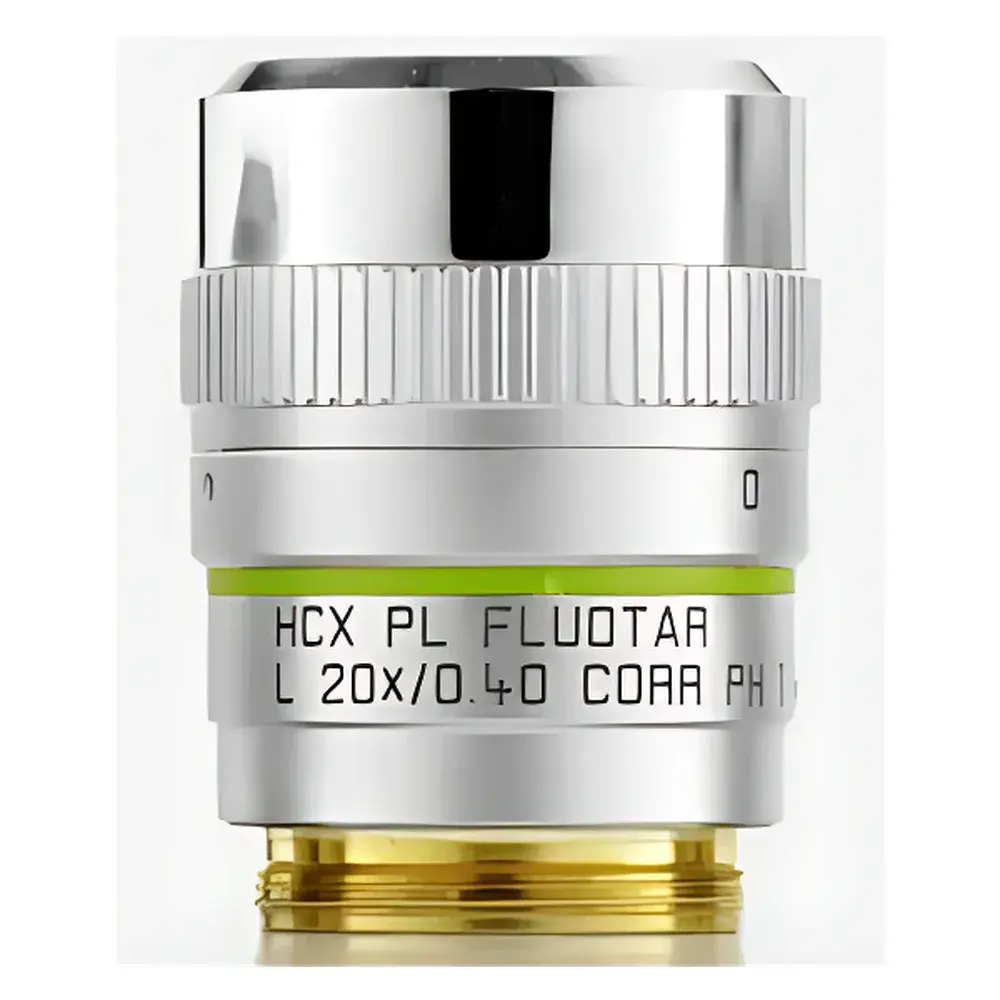
Leica PL FLUOTAR Semi-Apochromat Objective
| Brand | Leica |
|---|---|
| Origin | Shanghai, China |
| Manufacturer Type | Authorized Distributor |
| Product Category | Domestic |
| Model | Semi-Apochromat Objective |
| Component Type | Optical Element |
| Field Flatness | Up to 25 mm |
| Chromatic Correction | Red, Green, and Blue wavelengths (3-band) |
| Axial Focus Deviation | ≤ 2.5× objective depth of field |
| Designation | PL FLUOTAR (PL-FL) |
| Application Domain | High-fidelity visible-spectrum microscopy, fluorescence imaging, live-cell observation |
| Correction Features | Adjustable correction collar (CORR) for coverslip thickness, immersion medium, and thermal drift compensation |
| Optical Material | High-transmission specialty glass |
| Compliance Context | Designed for use in ISO/IEC 17025-accredited labs |
Overview
The Leica PL FLUOTAR Semi-Apochromat Objective is an engineered optical component designed for high-precision visible-light microscopy applications demanding superior chromatic and spherical aberration control. Based on the classical Couder–Abbe design principles and refined through Leica’s decades-long expertise in microscope optics, this objective employs advanced multi-element lens assemblies fabricated from low-fluorescence, high-refractive-index specialty glasses. It corrects for primary and secondary chromatic aberrations across three spectral bands—red (650 nm), green (550 nm), and blue (450 nm)—while maintaining field flatness up to 25 mm. This level of correction bridges the performance gap between standard achromats and full apochromats, making it especially suitable for quantitative fluorescence imaging, multi-channel confocal acquisition, and time-lapse live-cell studies where signal fidelity, photometric linearity, and axial resolution consistency are critical.
Key Features
- PL (Plan) designation ensures field flatness across a 25 mm field number—enabling uniform focus and minimal edge distortion across wide-field imaging and tiled scanning workflows.
- FLUOTAR-grade transmission optimization: anti-reflective coatings and low-autofluorescence glass minimize photon loss and background noise—critical for low-light fluorescence detection and spectral unmixing.
- Integrated correction collar (CORR) allows real-time compensation for variations in coverslip thickness (0.13–0.22 mm), immersion medium refractive index (air, water, glycerol, oil), and ambient temperature shifts—ensuring consistent point spread function (PSF) stability.
- Robust mechanical housing with parfocal alignment (45 mm) and standardized RMS thread (M25 × 0.75) ensures seamless integration into Leica DMi8, DM6 B, and other modular upright/inverted research-grade microscopes.
- Designed for long-term stability under continuous illumination: thermally compensated lens groups mitigate focus drift during extended acquisitions typical in FRAP, FRET, or lattice light-sheet experiments.
Sample Compatibility & Compliance
The PL FLUOTAR Semi-Apochromat supports diverse specimen configurations—including standard 0.17 mm coverslips, thick-section tissue slides, cleared whole-organ samples (e.g., CLARITY, CUBIC), and aqueous live-cell chambers. Its optimized working distance and numerical aperture balance allow compatibility with both conventional epi-fluorescence and modern light-sheet modalities. The objective meets optical performance benchmarks referenced in ISO 8578 (microscope objectives—nomenclature and specifications) and supports audit-ready documentation per FDA 21 CFR Part 11 when used within validated Leica LAS X software environments. It is routinely deployed in laboratories operating under GLP and GMP frameworks where optical calibration traceability, repeatability of magnification, and chromatic fidelity must be demonstrably maintained across instrument lifecycles.
Software & Data Management
When paired with Leica LAS X software, the PL FLUOTAR objective is automatically recognized via encoded turret communication, enabling auto-loading of optimal acquisition parameters—including exposure limits, Z-step intervals, and channel-specific deconvolution kernels. Metadata embedding includes objective ID, correction collar setting, immersion type, and calibration timestamp—supporting FAIR (Findable, Accessible, Interoperable, Reusable) data principles. Exported TIFF stacks retain EXIF-compliant optical metadata, facilitating downstream analysis in ImageJ/Fiji, Huygens, or commercial AI-based segmentation platforms. Audit trails for objective usage, calibration events, and parameter adjustments are retained in accordance with ISO/IEC 17025 clause 7.7 (control of equipment records).
Applications
- Multi-color fluorescence co-localization in fixed and live specimens, including immunofluorescence, FISH, and GFP/RFP/mCherry triple labeling.
- Quantitative phase contrast and differential interference contrast (DIC) combined with fluorescence—leveraging high transmission and minimal wavefront error.
- Long-duration time-lapse imaging of organoids, zebrafish embryos, or neuronal cultures, where thermal and mechanical stability directly impact dataset integrity.
- Preparatory imaging prior to laser microdissection (LMD), where precise cell boundary delineation and chromatic registration across excitation/emission bands are essential for accurate targeting.
- Teaching and core facility deployment—offering apochromat-like performance at reduced cost and complexity compared to full apochromats, without sacrificing critical metrics like Strehl ratio or modulation transfer function (MTF) at Nyquist-limited sampling.
FAQ
What distinguishes a semi-apochromat from a full apochromat objective?
A semi-apochromat corrects chromatic aberration at three wavelengths (typically 450 nm, 550 nm, and 650 nm) and provides improved spherical correction over achromats—but does not achieve the four- or five-wavelength correction of full apochromats. Its residual focus shift remains ≤2.5× the objective’s depth of field, making it suitable for most high-end fluorescence applications without the cost or sensitivity to alignment tolerances of full apochromats.
Can this objective be used with immersion media other than oil?
Yes—the CORR collar enables optimization for air, water, glycerol, and multiple oil formulations (e.g., Type F, Type N). Each immersion mode requires independent collar adjustment to maintain diffraction-limited performance.
Is the PL FLUOTAR series compliant with ISO 10934-1 for objective classification?
Yes—it conforms to the “semi-apochromat” classification defined in ISO 10934-1:2002, satisfying requirements for planarity (PL), chromatic correction (FLUO), and transmission efficiency (T ≥ 85% across 400–700 nm).
How often should the correction collar be recalibrated?
Recalibration is required whenever coverslip thickness deviates by >±0.005 mm, immersion medium changes, or ambient temperature shifts exceed ±2°C. Routine verification is recommended before each experimental session involving quantitative intensity measurements.
Does this objective support super-resolution techniques such as STED or SIM?
While not optimized for stimulated emission depletion (STED) due to its moderate NA relative to dedicated STED objectives, it is fully compatible with structured illumination microscopy (SIM) and deconvolution-based super-resolution methods—provided appropriate laser lines and emission filters are matched to its corrected bandwidth.



