
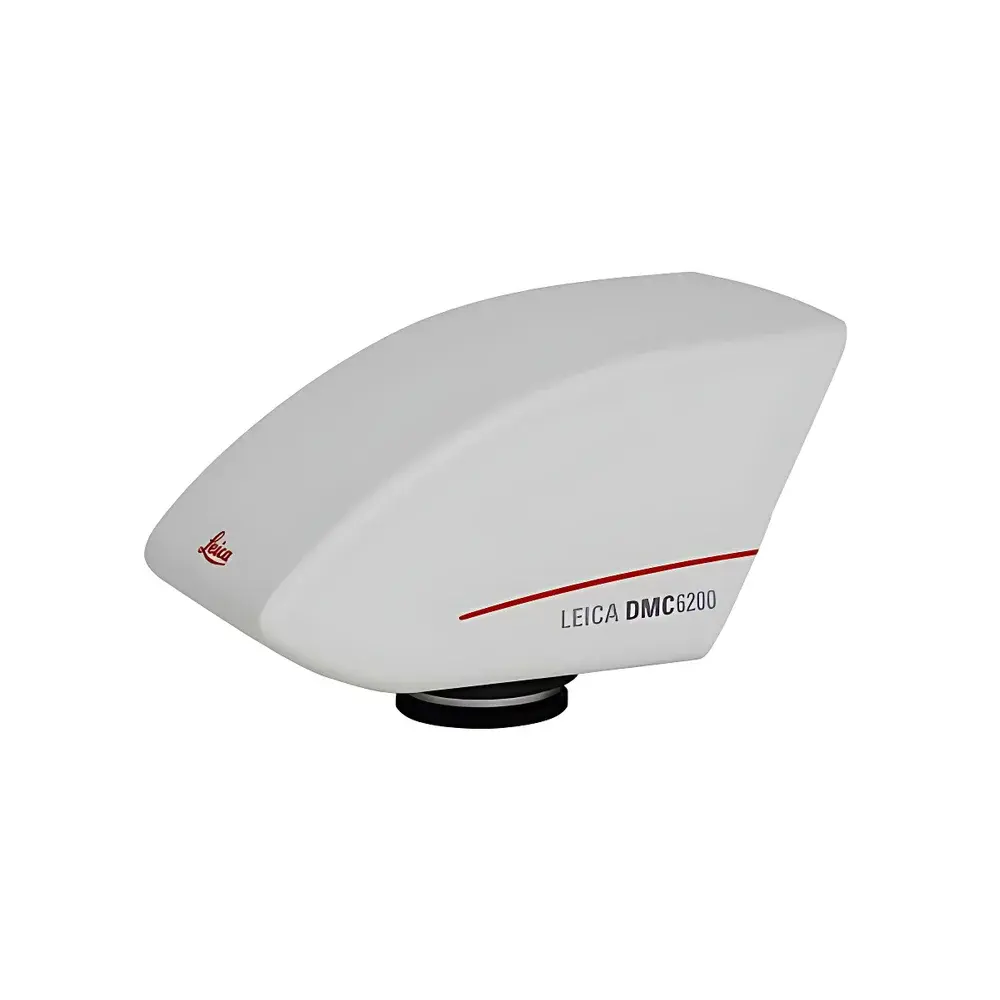
Leica DMC6200 Pixel-Shift Microscopy Camera
| Brand | Leica |
|---|---|
| Origin | Germany |
| Model | DMC6200 |
| Sensor Type | CMOS |
| Effective Resolution (Pixel Shift) | 20.7 MP |
| Native Resolution | 2.3 MP (1920 × 1200) |
| Pixel Size | 5.86 µm |
| Dynamic Range | 73 dB (4000:1) |
| Frame Rate | up to 60 fps |
| Interface | USB 3.0 |
| Color Accuracy | True RGB per pixel, multi-sampling enabled |
| Compliance | CE, RoHS, ISO 13485 (manufacturing), GLP-compatible metadata logging |
Overview
The Leica DMC6200 Pixel-Shift Microscopy Camera is an advanced digital imaging solution engineered for high-fidelity quantitative microscopy across brightfield, darkfield, and fluorescence modalities. Unlike conventional single-shot CMOS cameras, the DMC6200 employs a precision-controlled mechanical pixel-shift mechanism—where the sensor is physically displaced in sub-pixel increments across multiple exposures—to synthesize ultra-high-resolution images without optical interpolation or software-based upscaling. This hardware-level super-resolution technique delivers a native 20.7 megapixel output (5120 × 4000) from a 2.3 MP back-illuminated CMOS sensor (1920 × 1200), preserving spatial fidelity, eliminating aliasing artifacts, and enabling rigorous morphometric analysis. Designed for integration with Leica DM series upright and inverted research microscopes, the DMC6200 operates across the full magnification range—from 1.25× stereo to 100× oil immersion—while maintaining consistent colorimetric accuracy, linearity, and photon capture efficiency.
Key Features
- Precision pixel-shift architecture: 4-frame sensor displacement sequence yielding 20.7 MP synthetic resolution with preserved MTF and Nyquist-limited sampling
- True-color RGB acquisition: Per-pixel spectral response calibrated against CIE 1931 chromaticity coordinates; supports multi-spectral sampling for subtle hue differentiation in stained histology or autofluorescent tissue
- High quantum efficiency sensor: Back-illuminated CMOS with 5.86 µm pixels optimized for low-light sensitivity—enabling robust signal-to-noise ratio (SNR > 38 dB) in weak fluorescence applications such as DAPI or FITC at minimal excitation intensity
- 73 dB dynamic range (4000:1): Captures simultaneous detail in saturated nuclear staining and dim cytoplasmic background without clipping or tone mapping artifacts
- USB 3.0 interface with zero-latency DMA transfer: Sustains 60 fps at full HD (1920 × 1200) and 15 fps at 20.7 MP—ideal for time-lapse cytology, live-cell motility tracking, and real-time focus stacking
- Hardware-triggered synchronization: Compatible with external TTL signals from shutters, filter wheels, or stage controllers for repeatable multi-channel acquisition sequences
Sample Compatibility & Compliance
The DMC6200 supports diverse specimen types including paraffin-embedded tissue sections, live primary cultures, semiconductor wafers, metallurgical cross-sections, and botanical thin sections. Its linear response curve and factory-calibrated gamma profile ensure traceable intensity quantification—critical for comparative immunohistochemistry scoring or grain-size distribution analysis in materials science. The camera complies with ISO/IEC 17025 documentation requirements for measurement uncertainty reporting when used with Leica’s certified calibration slides. Firmware and metadata embed ISO 15189-compliant audit trails (timestamp, exposure, gain, white balance, objective ID), supporting GLP/GMP-regulated environments. While not FDA 510(k)-cleared as a standalone diagnostic device, it meets IEC 61000-6-3 EMC standards and carries CE marking under Directive 2014/30/EU (EMC) and 2011/65/EU (RoHS).
Software & Data Management
The DMC6200 is fully integrated with Leica Application Suite X (LAS X) v3.7+, providing modular workflows for acquisition, annotation, measurement, and report generation. LAS X supports DICOM-SR export for PACS integration, TIFF-64 bit float for quantitative intensity modeling, and HDF5 container format for large-volume time-series datasets. All acquired images retain embedded EXIF-like metadata—including objective magnification, tube lens factor, illumination type, and pixel-shift status—ensuring reproducibility across instrument platforms. Batch processing pipelines support automated flat-field correction, chromatic aberration compensation, and multi-z-stack alignment using fiducial-based registration. Raw data export preserves 12-bit linear intensity values, enabling downstream analysis in MATLAB, Python (via OpenSlide or tifffile), or Imaris for 3D surface rendering.
Applications
- Histopathology: High-resolution digitization of H&E and trichrome-stained slides with artifact-free color fidelity for AI training datasets
- Materials Science: Grain boundary mapping in alloy microstructures and defect detection in photovoltaic silicon wafers at sub-micron scale
- Plant Morphology: Quantitative analysis of stomatal density, vascular bundle patterning, and epidermal cell geometry in cryosectioned leaves
- Electronics Inspection: Solder joint integrity assessment, PCB trace continuity verification, and MEMS device actuation monitoring
- Fluorescence Co-localization: Multi-channel acquisition with <100 nm registration accuracy between DAPI/FITC/TRITC channels using hardware-synced filter wheel control
FAQ
Does the DMC6200 require proprietary hardware for pixel-shift operation?
No—the pixel-shift mechanism is fully embedded within the camera housing and requires no external motorized stage or microscope modification. All motion control and image fusion are handled internally by the FPGA-based imaging engine.
Can the 20.7 MP output be used for regulatory submissions (e.g., FDA, EMA)?
Yes—when operated within validated LAS X workflows and accompanied by system suitability checks (e.g., NIST-traceable resolution targets), the synthetic image dataset satisfies ALCOA+ data integrity principles for regulated preclinical imaging.
Is the sensor sensitive to near-infrared (NIR) wavelengths beyond 700 nm?
The DMC6200’s quantum efficiency drops below 10% at 750 nm; it is optimized for visible light (400–700 nm) and standard fluorophore emission bands (e.g., Cy3, Alexa Fluor 488, Texas Red). For NIR applications, Leica recommends the DFC9000 GT model.
How does the DMC6200 handle vibration during pixel-shift acquisition?
The camera implements real-time motion compensation via on-sensor accelerometer feedback, pausing acquisition if RMS vibration exceeds 0.05 g during shift sequencing—ensuring geometric integrity of the final composite image.
Is firmware update capability available over USB without service intervention?
Yes—firmware updates are delivered via LAS X and applied in situ with automatic rollback protection and SHA-256 signature verification to maintain cybersecurity compliance per IEC 62443-3-3.




