
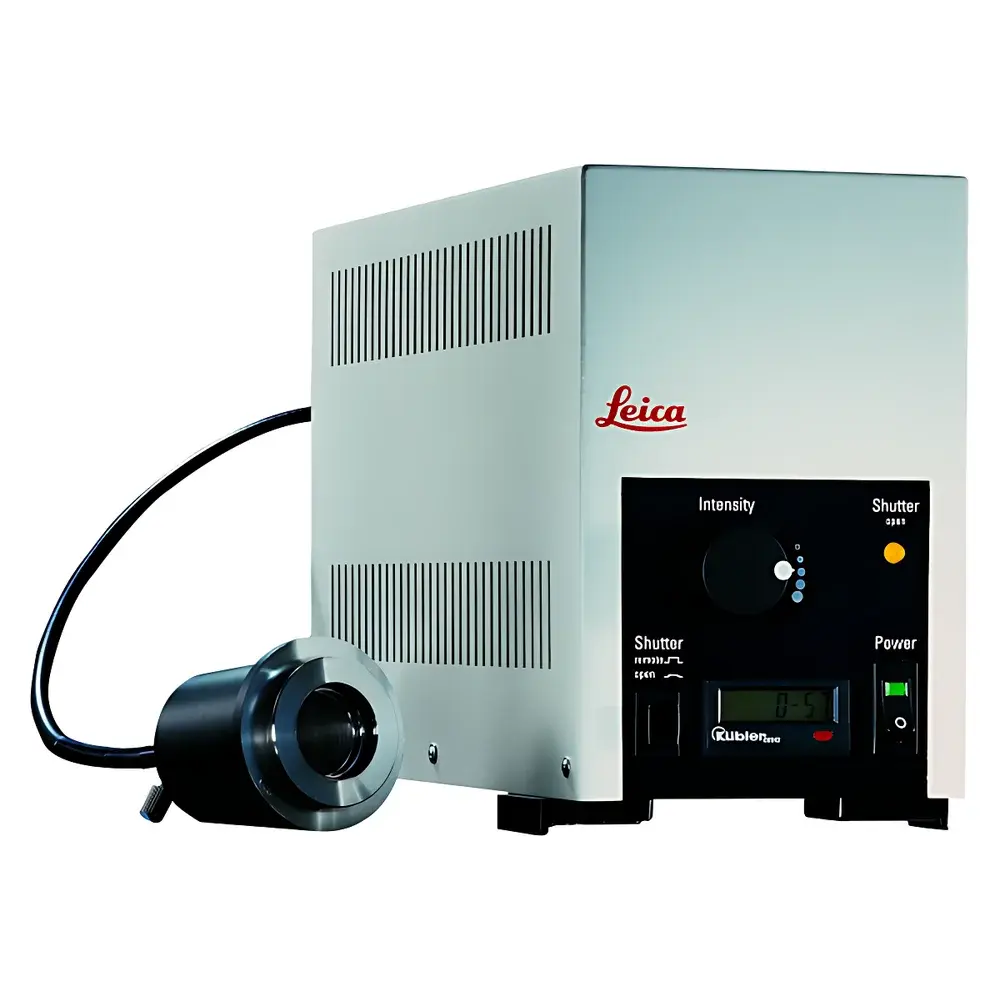
Leica EL6000 External Fluorescence Excitation Light Source
| Brand | Leica |
|---|---|
| Origin | Germany |
| Model | EL6000 |
| Light Source Type | Mercury-Metal Halide Arc Lamp |
| Illumination Mode | Epifluorescence External Illuminator |
| Cooling Method | Air-Cooled |
| Lamp Lifetime | ≥2000 h |
| Shutter Response Time | ≤6 ms |
| Weight (Illuminator Head) | 1.8 kg |
| Compatibility | Leica DM series upright/inverted microscopes, M series stereomicroscopes |
| Software Integration | Full support for Leica LAS X and LAS AF platforms |
| Optical Coupling | Liquid light guide (LLG) interface |
Overview
The Leica EL6000 is a high-stability, externally mounted fluorescence excitation light source engineered for precision epifluorescence microscopy applications. Designed exclusively for integration with Leica Microsystems’ full range of upright, inverted, and stereomicroscopes—including DMi8, DM6 B, DM2500, and M205 FA/M165 FC platforms—the EL6000 employs a mercury-metal halide short-arc lamp to deliver intense, spectrally stable output across UV–visible emission bands (340–650 nm). Unlike conventional internal lamp housings, its external architecture decouples thermal load from the microscope optical path and specimen plane, significantly reducing thermal drift, sample phototoxicity, and stage instability—critical factors in long-term live-cell imaging and quantitative fluorescence assays. The system operates without optical alignment requirements post-installation, ensuring consistent illumination geometry and intensity reproducibility across users and sessions.
Key Features
- Mercury-metal halide arc lamp with ≥2000-hour operational lifetime, eliminating frequent lamp replacement and recalibration cycles
- Integrated high-speed mechanical shutter with ≤6 ms actuation time, enabling precise temporal control of excitation exposure during time-lapse or FRAP experiments
- Dedicated neutral-density attenuation wheel for stepwise reduction of excitation intensity (up to 90% transmission loss), minimizing photobleaching and photodamage in sensitive biological specimens
- Light-weight illuminator head (1.8 kg) optimized for stereomicroscope Z-axis stability—reducing mechanical load on fine-focus mechanisms
- Standard liquid light guide (LLG) coupling interface ensures uniform, low-loss optical transmission to microscope ports while maintaining spatial coherence and minimal divergence
- Air-cooled thermal management system with passive heat-sink design; no external water lines or chillers required
Sample Compatibility & Compliance
The EL6000 supports a broad spectrum of fluorophore classes—including DAPI, FITC, TRITC, Cy3, Cy5, GFP, mCherry, and Hoechst derivatives—enabling multi-channel fluorescence workflows without hardware modification. Its spectral output profile conforms to ISO 10934-1 (Microscopy — Nomenclature for fluorescence microscopy) and meets essential performance criteria outlined in ASTM E2718-20 (Standard Practice for Calibration of Fluorescence Microscopes). When operated within Leica’s validated instrument ecosystem and paired with LAS X software, the EL6000 supports audit-trail-enabled acquisition protocols compliant with GLP and GMP documentation requirements. While not a standalone medical device, its use in preclinical imaging workflows aligns with FDA 21 CFR Part 11 principles when integrated into electronic lab notebook (ELN) environments with appropriate access controls and data integrity safeguards.
Software & Data Management
The EL6000 is natively supported by Leica’s LAS X and LAS AF software suites, enabling synchronized control of shutter activation, ND filter selection, and exposure timing directly from acquisition interfaces. All hardware commands are logged with timestamps and user identifiers in the experiment metadata stream, supporting traceable, repeatable workflows. Software-defined illumination sequences—including programmable on/off cycling, intensity ramping, and conditional triggering via TTL signals—facilitate complex experimental paradigms such as optogenetics stimulation coupled with calcium imaging. Exported datasets retain embedded illumination parameters (e.g., lamp age, cumulative runtime, shutter count), facilitating predictive maintenance scheduling and quality assurance reporting.
Applications
- Live-cell fluorescence time-lapse imaging requiring minimal thermal perturbation and phototoxic stress
- Multi-color co-localization studies demanding stable, repeatable excitation intensity across sequential channels
- Stereomicroscopic fluorescence screening of whole-mount embryos, organoids, or tissue explants
- Quantitative fluorescence intensity measurements where inter-session illumination consistency is critical (e.g., drug response profiling)
- Combined brightfield/fluorescence hybrid imaging on shared-platform systems without cross-modality interference
- Teaching laboratories requiring robust, alignment-free fluorescence illumination with low operational overhead
FAQ
Is the EL6000 compatible with non-Leica microscopes?
No—the EL6000 is mechanically and optically engineered for Leica-specific light guide ports and control bus protocols. Integration with third-party systems would require custom optical coupling and external shutter/ND control, voiding factory calibration and warranty.
Does the EL6000 require periodic lamp alignment or focus adjustment?
No—its fixed-focus optical design and pre-aligned arc lamp eliminate routine alignment procedures. Intensity stability is maintained over lamp lifetime without user intervention.
Can the EL6000 be used for confocal or super-resolution microscopy?
It is not suitable for point-scanning confocal or STED systems due to lack of beam shaping optics and insufficient spatial coherence; however, it serves effectively in widefield deconvolution and structured illumination (SIM) setups when paired with appropriate filter cubes and camera synchronization.
What maintenance is required beyond lamp replacement?
Annual inspection of LLG connector cleanliness and fan filter integrity is recommended. No optical recalibration or thermal recalibration is necessary under normal operating conditions.
How does the EL6000 compare to LED-based fluorescence sources?
Compared to LEDs, the EL6000 offers broader spectral coverage and higher peak irradiance in UV bands—advantageous for UV-excitable dyes—but with higher power consumption and thermal output. LED alternatives provide superior longevity and instant on/off switching but may lack sufficient intensity for certain deep-tissue or low-expression targets.




