
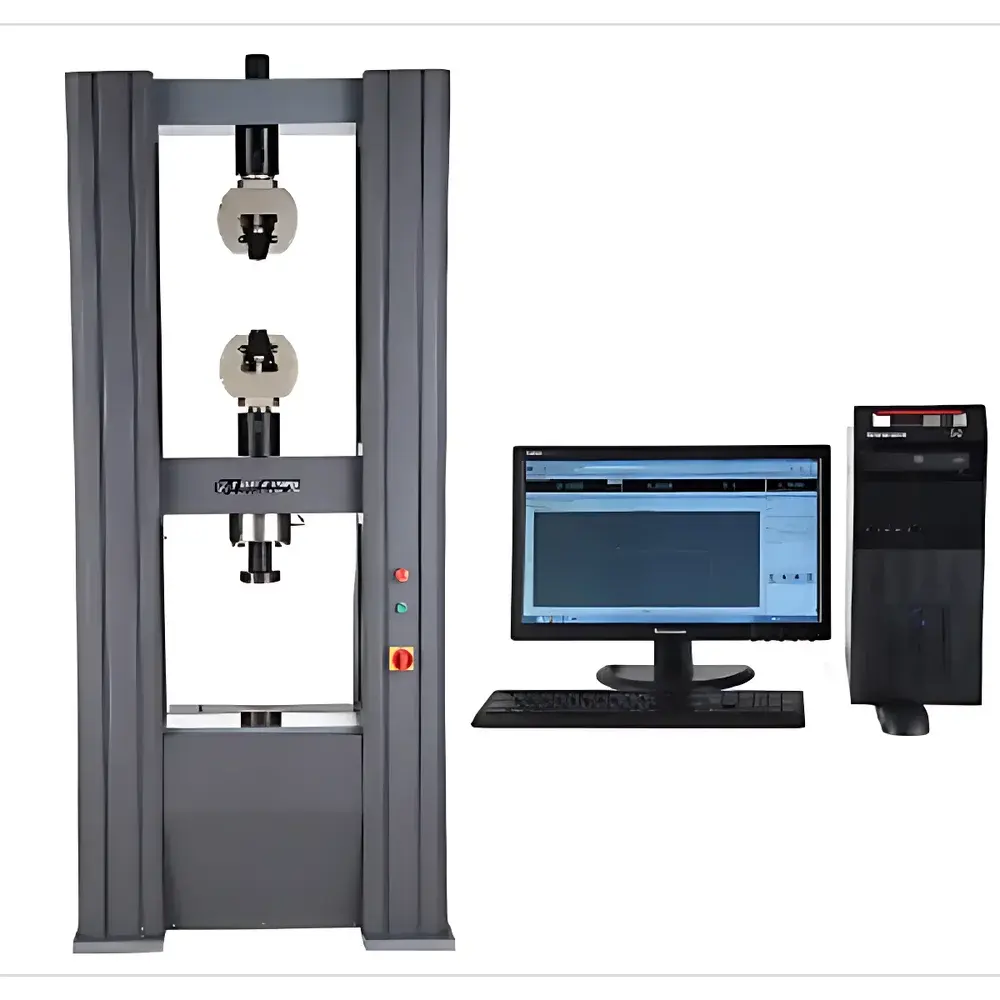
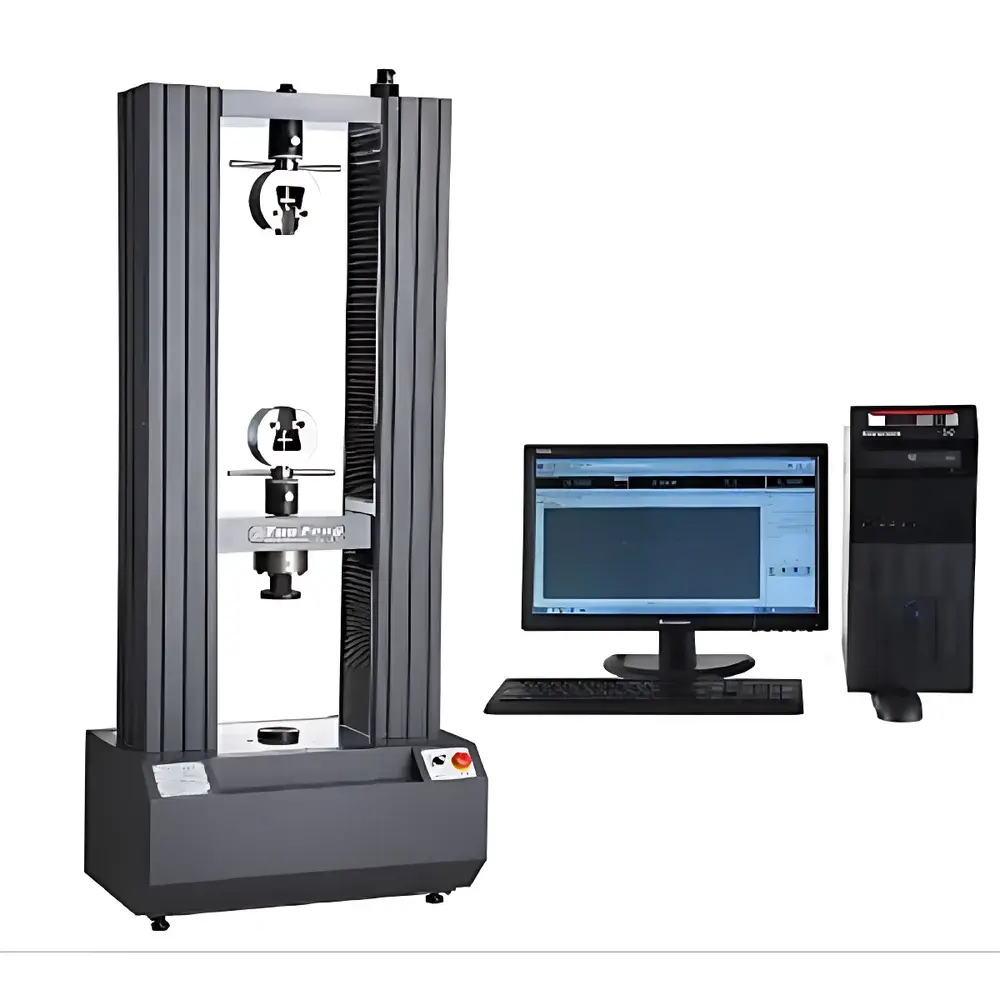
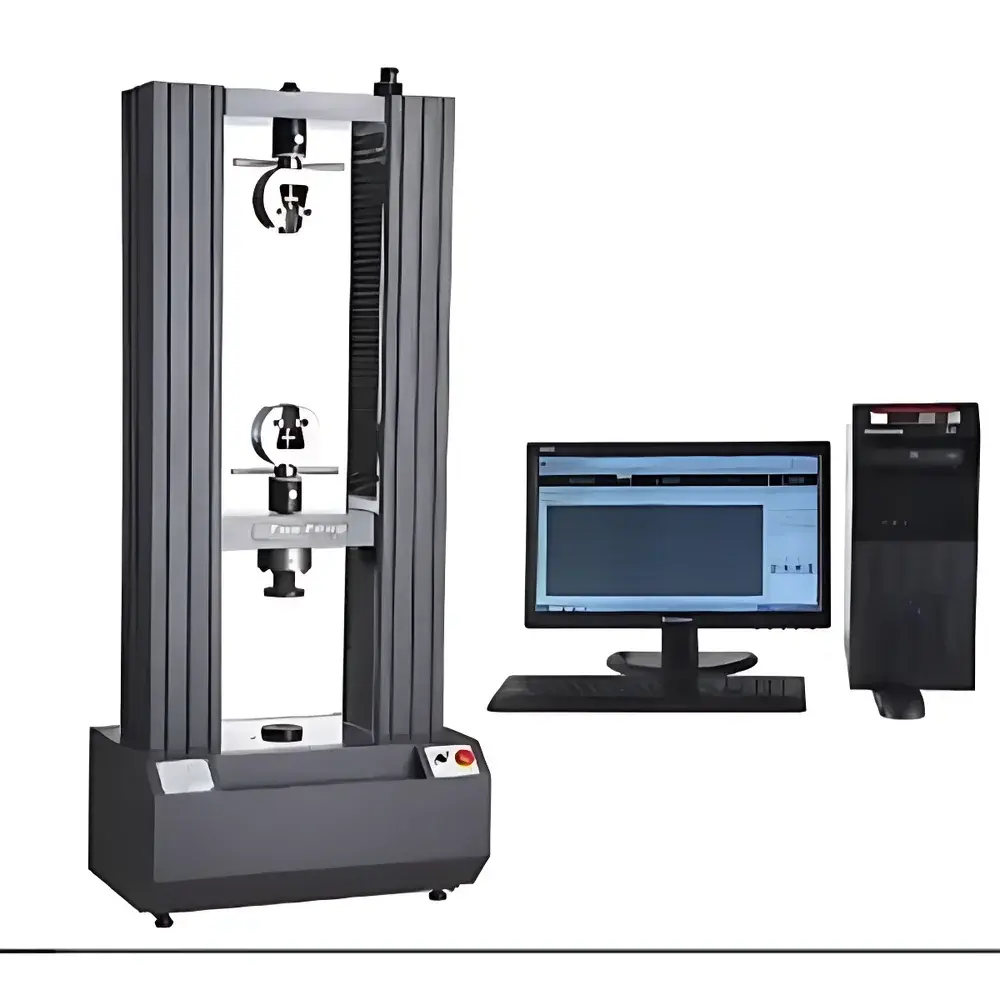
Tuofeng TFW-283 Microcomputer-Controlled Electronic Universal Testing Machine
| Brand | Tuofeng |
|---|---|
| Origin | Shanghai, China |
| Manufacturer Type | Direct Manufacturer |
| Instrument Type | Electromechanical Universal Testing Machine |
| Model | TFW-283 |
| Max Test Load | 200 kN |
| Accuracy Class | 0.5 |
| Effective Force Range | 0.2–100% of Full Scale |
| Force Measurement Accuracy | ±0.005% of Reading |
| Resolution | 1 part in 500,000 full-scale codes (no range switching) |
| Drive System | Imported Servo Motor + Worm Gear Reducer |
| Lead Screw | High-Precision Ball Screw |
| Effective Test Width | 600 mm (customizable) |
| Stroke | 800 mm (extendable) |
| Speed Range | 0.001–500 mm/min (infinitely variable) |
| Displacement Measurement | Optical Encoder |
| Displacement Accuracy | ±0.005% of Reading |
| Strain Measurement | Optional Extensometer or Large-Deformation Sensor |
| Safety Protection | Electronic Limit Switches, Emergency Stop, Overload Protection (10% above capacity) |
| Power Supply | 220 V, 3.0 kW |
| Net Weight | ~1500 kg |
| Compliance | GB/T 16491–2008, JJG 475–2008, ASTM E4, ISO 7500-1, DIN 51221 |
Overview
The Tuofeng TFW-283 Microcomputer-Controlled Electronic Universal Testing Machine is a high-precision electromechanical system engineered for static mechanical property characterization of construction materials—including structural concrete, reinforcing steel, precast elements, cementitious composites, and associated building materials—under uniaxial tensile, compressive, flexural, shear, and splitting tensile loading conditions. Based on closed-loop servo control architecture and calibrated load cell feedback, the system adheres to fundamental principles of force transduction and displacement metrology defined in ISO 7500-1 (static calibration of force-proving instruments) and ASTM E4 (practices for verification of force-measuring instruments). Its modular mechanical design integrates a rigid dual-column frame, high-stiffness ball-screw actuation, and precision-aligned crosshead guidance to minimize parasitic bending moments during compression testing of cylindrical concrete specimens per ASTM C39/C39M and GB/T 50081. The machine operates within a certified accuracy class of 0.5, ensuring traceable measurement uncertainty suitable for third-party certification, quality assurance laboratories, and R&D environments subject to GLP or ISO/IEC 17025 requirements.
Key Features
- Full-range force resolution of 1:500,000 without range switching—enabling high-fidelity capture of low-force phenomena (e.g., microcrack initiation in mortar) alongside ultimate failure loads up to 200 kN.
- Dual-speed motorized crosshead control with programmable jog functionality for precise specimen alignment and rapid return to home position post-test.
- Integrated overload protection set at 110% of rated capacity, coupled with hardware-based emergency stop and electronic travel limits compliant with IEC 60204-1 safety standards.
- Modular extensometry support: compatible with both clip-on axial extensometers (for modulus and yield point determination per ASTM E8/E8M) and large-deformation sensors for ductile or highly nonlinear materials.
- Thermally stable load cell housing and temperature-compensated signal conditioning to maintain repeatability across ambient lab conditions (10–35°C).
- Rigid frame construction (steel base plate, reinforced uprights) minimizing deflection under maximum load—critical for accurate compressive strength evaluation of 150 mm × 300 mm concrete cylinders.
Sample Compatibility & Compliance
The TFW-283 accommodates standard and non-standard specimens used in civil engineering material qualification: cylindrical concrete cores (Ø100–150 mm, height/diameter ratio 2:1), prismatic mortar beams (40×40×160 mm), rebar coupons (up to Ø32 mm), fiber-reinforced polymer (FRP) laminates, geotextiles, and grout specimens. Fixture adaptability includes compression platens with self-aligning spherical seats (per ASTM C39), wedge-grip tensile assemblies for rebars, three-point bend fixtures (ASTM C78), and split-disk tension fixtures (ASTM C496). Software-enforced test protocols ensure automatic adherence to loading rate specifications defined in GB/T 50081 (concrete mechanical properties), ASTM C39 (compressive strength), ASTM C78 (flexural strength), and EN 12390-3. System documentation supports audit readiness for ISO/IEC 17025 accreditation, including calibration certificates traceable to NIM (China National Institute of Metrology) and uncertainty budgets per GUM (JCGM 100).
Software & Data Management
The Windows-based TFW TestSuite software provides deterministic real-time control over force, displacement, and strain channels using PID-regulated servo profiles. It supports multi-step test sequences—including preload stabilization, ramp-to-load, dwell-hold, and cyclic loading—with user-defined trigger conditions (e.g., “hold at 85% of peak load for 60 s”). All raw data (force, displacement, time, extensometer output) are acquired at ≥1 kHz sampling rate and stored in binary .tdf format with embedded metadata (operator ID, sample ID, environmental notes, calibration timestamps). Reporting complies with FDA 21 CFR Part 11 requirements via optional electronic signature module, audit trail logging, and role-based access control. Export options include CSV, PDF, and XML formats; curve overlays enable comparative analysis across batches or curing ages. Data integrity is preserved through automatic checksum validation and version-controlled software updates—backed by lifetime technical support and documented change logs for regulatory submissions.
Applications
- Compressive strength testing of concrete cylinders and cubes per ASTM C39, GB/T 50081, and EN 12390-3.
- Tensile strength evaluation of reinforcing bars (ASTM A615/A615M) and welded wire fabric (ASTM A185).
- Flexural performance assessment of fiber-reinforced concrete beams (ASTM C1018, GB/T 29906).
- Modulus of elasticity and Poisson’s ratio determination using dual-extensometer configurations.
- Splitting tensile strength of concrete (ASTM C496) and bond strength of anchor systems.
- Quality conformance testing for precast concrete elements, grouts, and repair mortars in ISO 9001-certified production facilities.
FAQ
Does the TFW-283 meet ASTM and ISO calibration requirements for accredited testing labs?
Yes—the system is supplied with factory calibration certificates traceable to national standards (NIM), and its 0.5-class accuracy satisfies ISO 7500-1 Class 0.5 and ASTM E4 Verification Level B requirements.
Can the machine perform automated cyclic loading for fatigue pre-characterization of concrete interfaces?
Yes—via programmable step sequences in TestSuite software, including load-controlled or displacement-controlled sinusoidal, triangular, or block-wave profiles with adjustable frequency, amplitude, and dwell periods.
Is strain measurement included as standard equipment?
No—axial extensometers and large-deformation sensors are optional accessories selected based on application-specific resolution and gauge length requirements.
What maintenance intervals are recommended for long-term accuracy retention?
Biannual verification of force and displacement systems is advised; annual recalibration of load cells and encoder systems is required for ISO/IEC 17025 compliance.
Are custom fixture designs supported for nonstandard specimen geometries?
Yes—Tuofeng provides mechanical drawing review and OEM fixture development services aligned with ASTM D638, ISO 527, or client-defined geometry specifications.



