
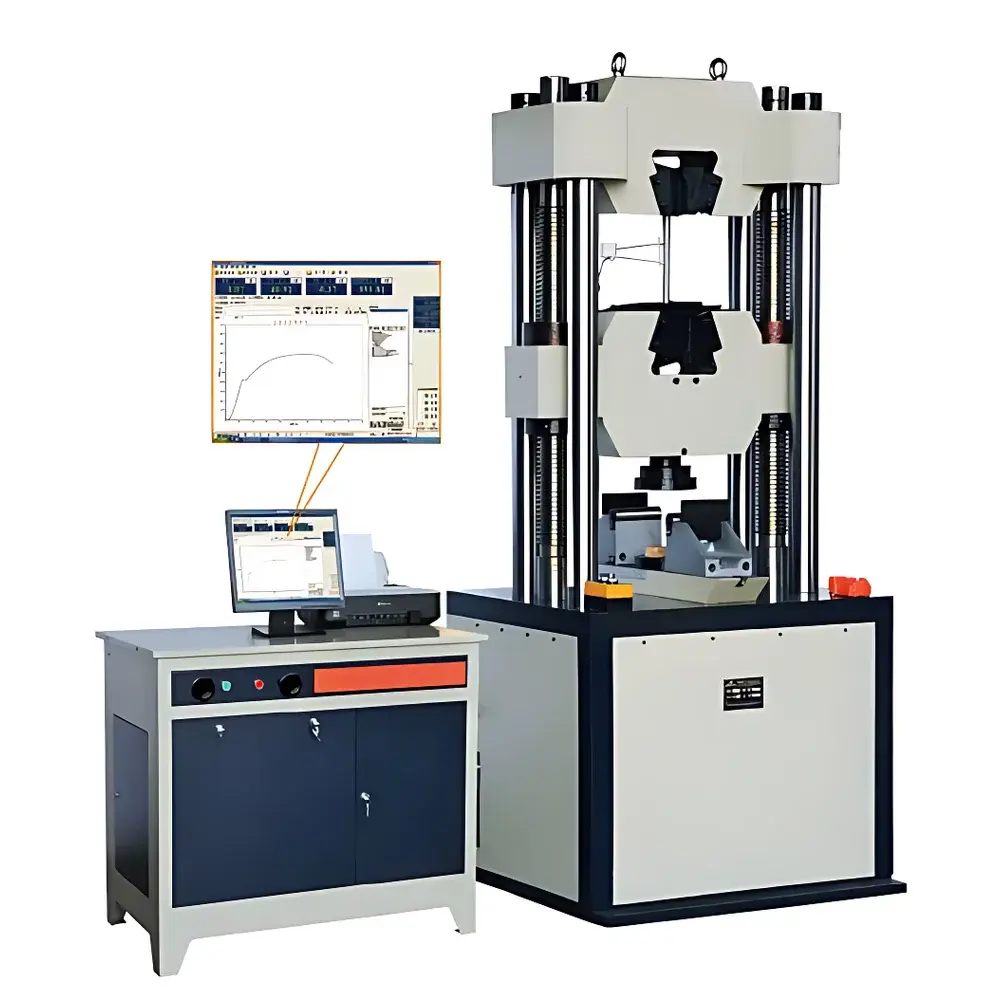
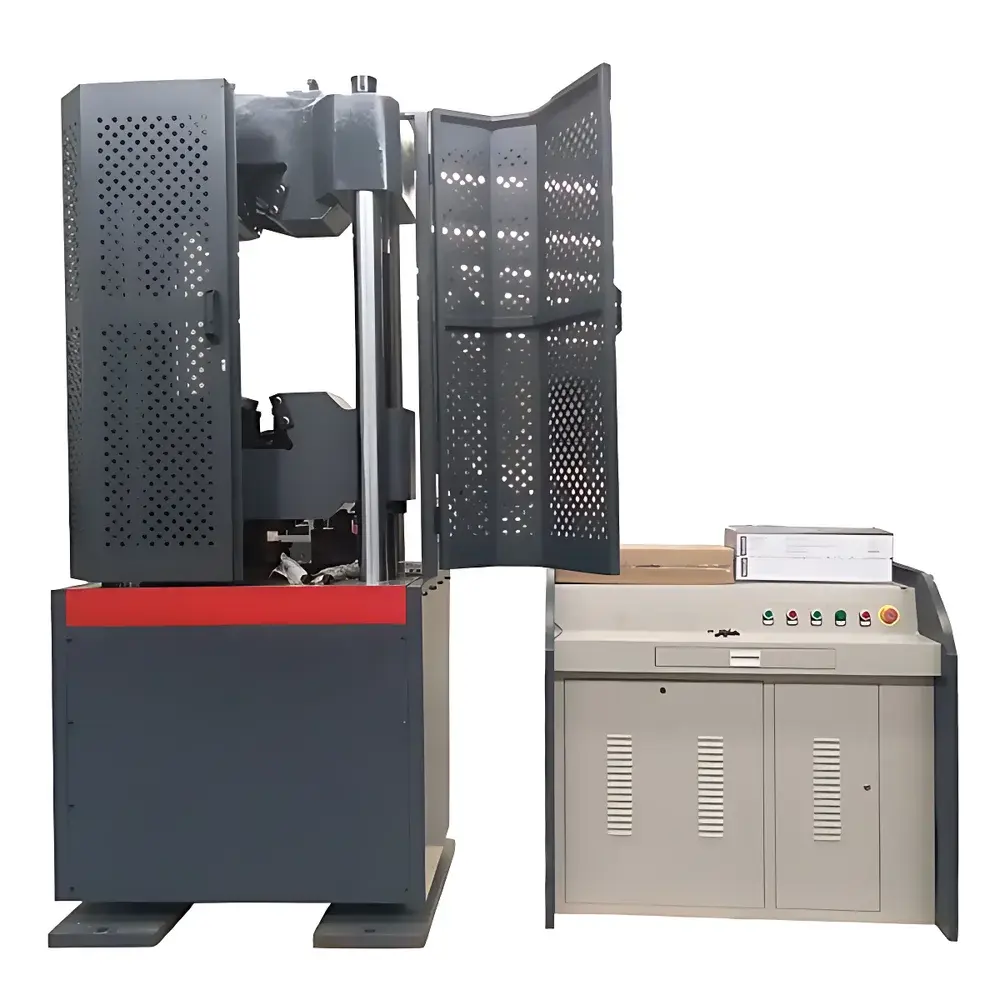
TOFENG WEW-1000B Microcomputer-Controlled Hydraulic Universal Testing Machine
| [Brand | TOFENG |
|---|---|
| Origin | Shanghai, China |
| Manufacturer Type | Direct Manufacturer |
| Equipment Type | Hydraulic Universal Testing Machine |
| Model | WEW-1000B |
| Max. Test Load | 1000 kN |
| Force Measurement Range | 4–100% of Full Scale |
| Force Accuracy | ±1% of Indicated Value |
| Force Resolution | 1/300,000 of Maximum Load |
| Deformation Accuracy | ±1% of Indicated Value |
| Deformation Resolution | 1/300,000 of Maximum Deformation |
| Max. Tensile Space | 600 mm |
| Compression Space | 500 mm |
| Piston Stroke | 200 mm |
| Column Spacing | 585 mm |
| Round Specimen Clamping Range | Φ6–Φ40 mm |
| Flat Specimen Thickness Capacity | 0–30 mm |
| Flat Specimen Width Capacity | 75 mm |
| Compression Platen Diameter | φ160 mm |
| Clamping Method | Hydraulic |
| Overall Dimensions (W×D×H) | 910×710×2300 mm |
| Control Console Dimensions | 1100×750×1000 mm |
| Total Power | 2 kW |
| Weight | 2850 kg] |
Overview
The TOFENG WEW-1000B Microcomputer-Controlled Hydraulic Universal Testing Machine is a high-capacity, oil-pressure-driven mechanical testing system engineered for precision static mechanical property evaluation of metallic and high-strength nonmetallic materials. Its four-column, dual-screw, bottom-mounted hydraulic cylinder architecture provides structural rigidity and long-term load stability essential for high-force tensile, compression, bending, and shear testing up to 1000 kN. The machine operates on classical servo-hydraulic force generation principles: a high-pressure gear pump delivers conditioned oil through precision filtration and flow-regulated valve circuits into the main actuator cylinder; real-time load control is achieved via manual or semi-automated adjustment of the feed-oil valve, enabling precise regulation of loading rate per ASTM E8/E21 and ISO 6892-1 requirements. Force, displacement, and strain signals are acquired independently via high-resolution A/D converters—ensuring traceable, low-noise digital acquisition compliant with ISO 17025 metrological practices.
Key Features
- Four-column, two-screw frame with bottom-mounted hydraulic cylinder—optimized for torsional rigidity and vertical alignment stability during high-load testing.
- Motor-driven crosshead positioning via reducer-chain-screw transmission enables rapid, repeatable adjustment of test space (600 mm tensile / 500 mm compression).
- Hydraulic clamping system with dual-range round specimen grips (Φ6–Φ40 mm) and flat specimen holders (0–30 mm thickness, 75 mm width) ensures uniform stress distribution and minimal slippage.
- Dual-channel high-accuracy transducers: 1000 kN load cell with ±1% indication error and 1/300,000 full-scale resolution; displacement sensor with equivalent metrological performance.
- Integrated safety interlocks—including over-load cutoff (>103% FS), upper/lower mechanical limit switches, and motor shutdown protocols—meet EN ISO 12100 risk reduction requirements.
- Two-tier user management (administrator and operator levels) with password authentication supports GLP-compliant audit trails and role-based access control.
Sample Compatibility & Compliance
The WEW-1000B accommodates standardized metallic specimens per ASTM E8 (tension), ASTM E9 (compression), ASTM E290 (bend), and ISO 6892-1, ISO 7438, ISO 7439. Its 600 mm vertical clearance and φ160 mm compression platen support large-section structural steel coupons, castings, and welded joints. Flat specimen capacity (up to 30 mm thick × 75 mm wide) complies with ASTM A370 geometry constraints for plate and bar testing. All force and deformation measurements adhere to ISO 7500-1 Class 1 verification criteria. System-level compliance includes GB/T 228.1–2021, JJG 139–2014 (China), and harmonized requirements for CE-marked testing infrastructure under Machinery Directive 2006/42/EC.
Software & Data Management
The Windows-native control software (compatible with Windows XP through Windows 10) features a fully localized GUI aligned with Microsoft UI conventions. It supports customizable test method templates—preconfigured for tensile yield point detection (0.2% offset), modulus calculation (ISO 527-1), and fracture energy integration. Data export uses native Excel (.xlsx) formatting, allowing end-users to define column order, units, and statistical summaries without third-party plugins. Audit-ready reporting includes automatic timestamping, operator ID logging, calibration certificate references, and digital signature fields. Raw data files retain binary sensor timestamps and are stored in non-proprietary HDF5 format for long-term archival and third-party analysis interoperability. Software validation documentation aligns with FDA 21 CFR Part 11 expectations for electronic records and signatures in regulated environments.
Applications
This system serves as a primary mechanical characterization platform in metallurgical laboratories, quality assurance departments of heavy equipment manufacturers, and national metrology institutes. Typical use cases include: tensile property verification of API 5L X70 pipeline steel; compressive strength assessment of ASTM A615 Grade 60 rebar; three-point bending evaluation of ASTM A572 structural plates; and shear testing of bolted joint assemblies per ASTM F606. Its 1000 kN capacity and robust frame make it suitable for validating weld integrity in pressure vessel fabrication, fatigue pre-characterization of aerospace alloys, and routine QC testing in foundry and rolling mill environments.
FAQ
What standards does the WEW-1000B comply with for force measurement accuracy?
It meets ISO 7500-1 Class 1 requirements, with force indication error ≤ ±1% of reading across 4–100% of full scale.
Is the software validated for regulated industries such as pharmaceutical or medical device manufacturing?
While not pre-certified for FDA GMP, its audit trail, user access controls, electronic signature support, and raw data export capabilities satisfy foundational 21 CFR Part 11 technical criteria for validation readiness.
Can the system perform closed-loop strain-controlled tests?
No—this is an open-loop hydraulic system with manual flow regulation; it does not support active strain-rate feedback control per ASTM E2309.
What maintenance intervals are recommended for the hydraulic power unit?
Oil filtration and level checks every 500 operating hours; full hydraulic oil replacement and filter cartridge change every 2,000 hours or annually, whichever occurs first.
Are calibration certificates provided with the system at shipment?
Yes—a NIST-traceable force calibration certificate (covering 10%, 20%, 50%, and 100% of 1000 kN) and displacement verification report are included in the delivery package.



