
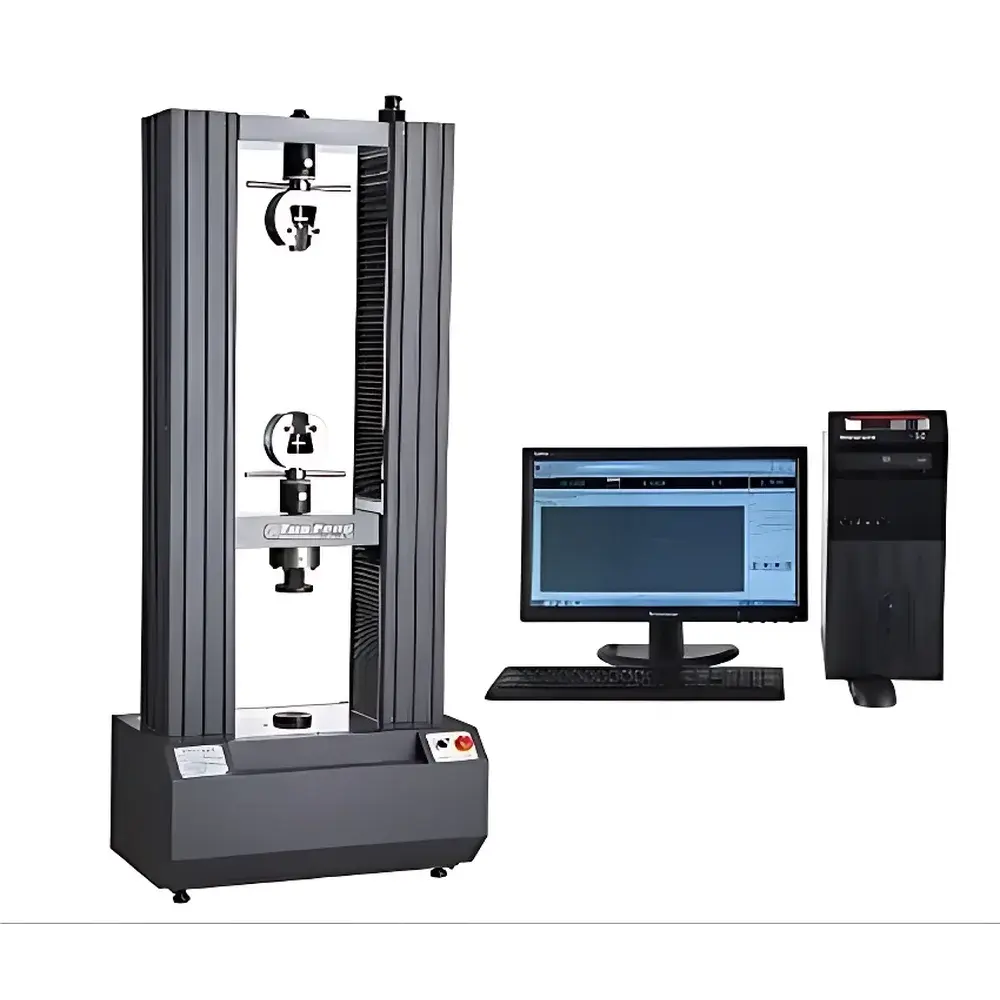
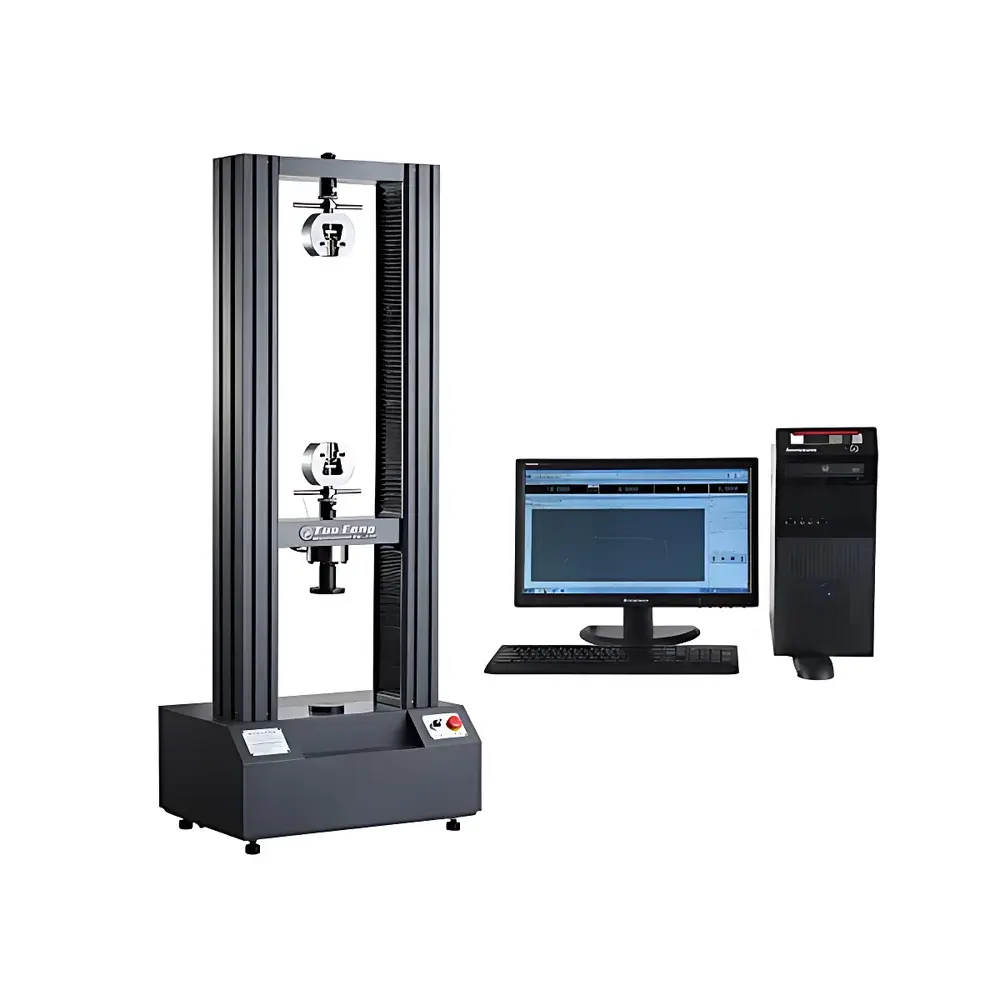
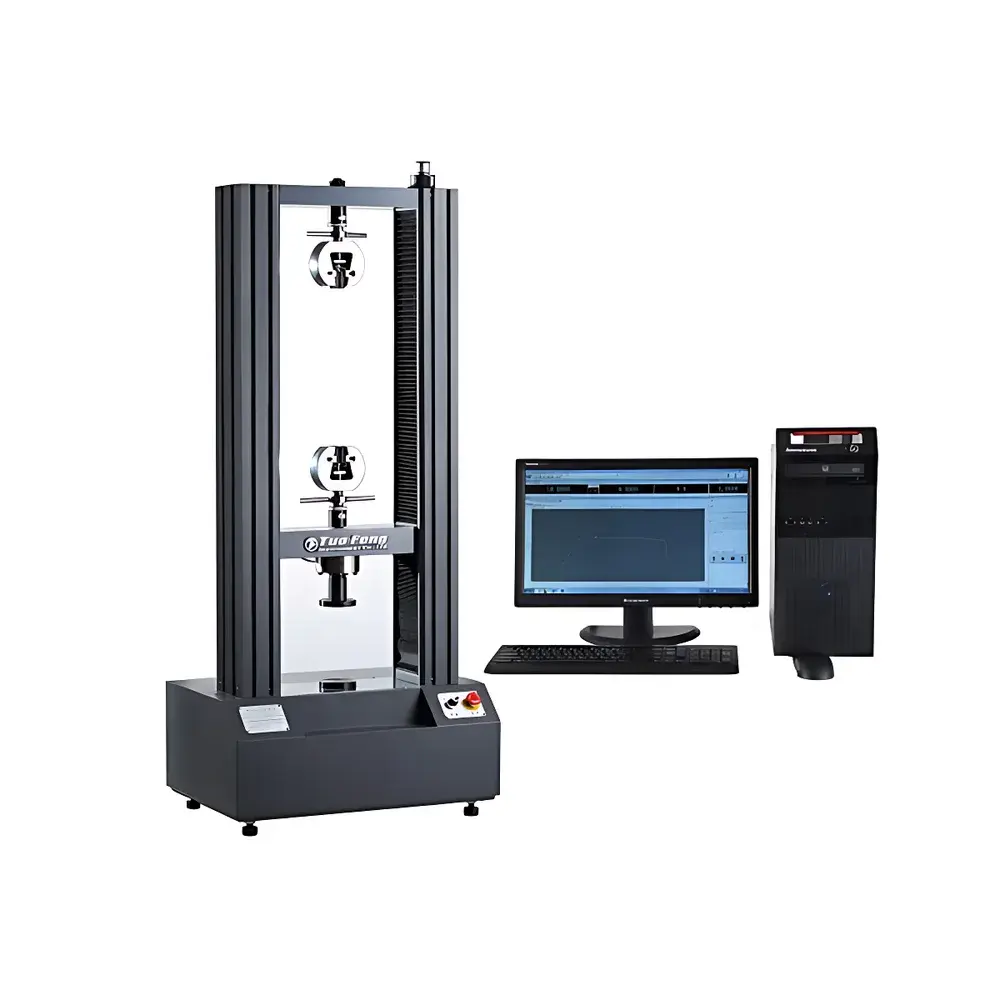
Tuofeng TFW Series Microcomputer-Controlled Electronic Universal Testing Machine
| Brand | Tuofeng |
|---|---|
| Origin | Shanghai, China |
| Manufacturer Type | Direct Manufacturer |
| Model | TFW-100S |
| Max Test Load | 100 kN |
| Force Measurement Range | 1 kg to 100 kN (0.2%–100% FS) |
| Force Accuracy | ±0.5% of reading |
| Crosshead Travel | 1000 mm |
| Displacement Resolution | 0.001 mm |
| Test Speed Range | 0.001–500 mm/min (infinitely variable) |
| Effective Test Width | 400–600 mm (customizable) |
| Position Measurement System | Optical Encoder |
| Position Accuracy | ±0.005% of reading |
| Deformation Measurement | Optional Extensometer or Large-Deformation Sensor |
| Safety Protection | Electronic limit switches, emergency stop, overload protection (10% over capacity), dual-speed motorized crosshead control |
| Power Supply | 220 V, 1.5 kW |
| Machine Weight | ~800 kg |
| Compliance | GB/T 16491–2008, JJG 475–2008, ASTM E4, ASTM E8, ISO 6892-1, DIN 50125, JIS Z 2241, BS EN ISO 6892-1 |
Overview
The Tuofeng TFW Series Microcomputer-Controlled Electronic Universal Testing Machine is an electromechanical static testing system engineered for high-precision mechanical property evaluation of metallic, polymeric, ceramic, composite, and elastomeric materials. Based on closed-loop servo-controlled load application and high-resolution displacement feedback, the system operates under fundamental principles of uniaxial stress–strain mechanics—applying controlled tensile, compressive, flexural, shear, tear, peel, and puncture loads per standardized test protocols. Its modular architecture supports full traceability, repeatable force calibration, and stable thermal-mechanical performance across extended operational cycles—making it suitable for routine quality control laboratories, R&D facilities, and accredited third-party testing centers operating under GLP, GMP, or ISO/IEC 17025 frameworks.
Key Features
- High-stiffness dual-column frame with precision-ground ball-screw drive and imported servo motor for smooth, low-noise actuation and minimal axial runout.
- Full-scale force measurement range from 1 kg to 100 kN (0.2–100% of full scale) with a certified accuracy of ±0.5% of reading—meeting Class 0.5 requirements per GB/T 16491–2008 and ISO 7500-1.
- Displacement resolution of 0.001 mm and position accuracy of ±0.005% of reading, enabled by high-fidelity optical encoder feedback integrated into the crosshead assembly.
- Dual-speed motorized crosshead movement (fast return + fine positioning) with programmable soft-start and deceleration profiles to minimize inertial overshoot during high-speed repositioning.
- Integrated safety architecture including electronic travel limits, hardware-based emergency stop circuitry, and automatic overload cutoff at 110% of rated capacity.
- Modular extensometry support: compatible with clip-on axial extensometers (for modulus and yield determination) and large-deformation sensors (for elongation-at-break in rubber or film applications).
Sample Compatibility & Compliance
The TFW-100S accommodates specimens ranging from thin polymer films (0.01 mm thick) to structural steel coupons (up to 50 mm wide × 25 mm thick), with customizable jaw geometries—including wedge-action, pneumatic, hydraulic, and custom-designed fixtures for ASTM D638, ISO 527, ASTM D790, ISO 178, ASTM D882, ISO 1184, and ASTM D624 compliance. It satisfies metrological verification per JJG 475–2008 and conforms to international standards including ASTM E4 (load verification), ASTM E8/E8M (tension testing of metallic materials), ISO 6892-1 (metallic tensile testing at ambient temperature), and ISO 527-2 (plastics tensile properties). All calibration certificates are NIST-traceable, and software audit trails meet FDA 21 CFR Part 11 requirements when configured with user access control and electronic signature modules.
Software & Data Management
The Windows-based Tuofeng TestSuite v4.x provides fully configurable test method templates aligned with GB, ASTM, ISO, DIN, JIS, and BS standards. It supports multi-mode control—including constant rate of extension (CRE), constant load ramping, hold-to-load, hold-to-strain, and cyclic loading sequences. Real-time visualization includes synchronized plots of load–time, load–displacement, stress–strain, and strain–time; all curves are exportable in CSV, XML, or PDF formats. Data integrity is ensured via timestamped audit logs, role-based user permissions, and automatic backup to network drives or cloud storage. The system enables batch reporting with statistical summaries (mean, SD, min/max), curve superposition for comparative analysis, and direct integration with LIMS platforms via OPC UA or TCP/IP protocols. Firmware and software updates are delivered remotely with version-controlled release notes and validation documentation.
Applications
This universal testing machine serves as a primary mechanical characterization tool across diverse sectors: tensile strength and ductility assessment of aerospace aluminum alloys (per AMS 4027); compression testing of concrete cores and ceramic tiles (ASTM C39, ISO 10545-3); peel adhesion quantification of pressure-sensitive tapes (ASTM D3330); tear propagation resistance in vulcanized rubber (ISO 34-1); flexural modulus determination of fiber-reinforced composites (ASTM D7264); and tensile yield behavior of thermoplastic injection-molded parts (ISO 527-2). It is routinely deployed in QC labs of Tier-1 automotive suppliers, cable manufacturers, medical device OEMs validating polymer sutures or balloon catheters, and national metrology institutes performing interlaboratory comparisons.
FAQ
What standards does the TFW-100S support out-of-the-box?
Preloaded test methods include ASTM D638, ASTM E8, ISO 6892-1, ISO 527-2, GB/T 228.1, and JIS Z 2241—with additional templates available upon request.
Can the system be validated for regulated environments (e.g., pharmaceutical or medical device testing)?
Yes—when equipped with 21 CFR Part 11-compliant software options, electronic signatures, and IQ/OQ documentation packages, it meets FDA and EU MDR audit requirements.
Is remote diagnostics and firmware update supported?
Yes—via secure TLS-encrypted connection, with change logs and version history maintained in the audit trail.
What is the recommended calibration interval?
Annual verification against certified reference standards is advised; internal self-check routines run at startup and after each test sequence.
Are custom fixtures available for non-standard specimen geometries?
Tuofeng offers engineering consultation and turnkey fixture design services, including finite element–validated grip assemblies for high-temperature or cryogenic testing configurations.
Related Products



