
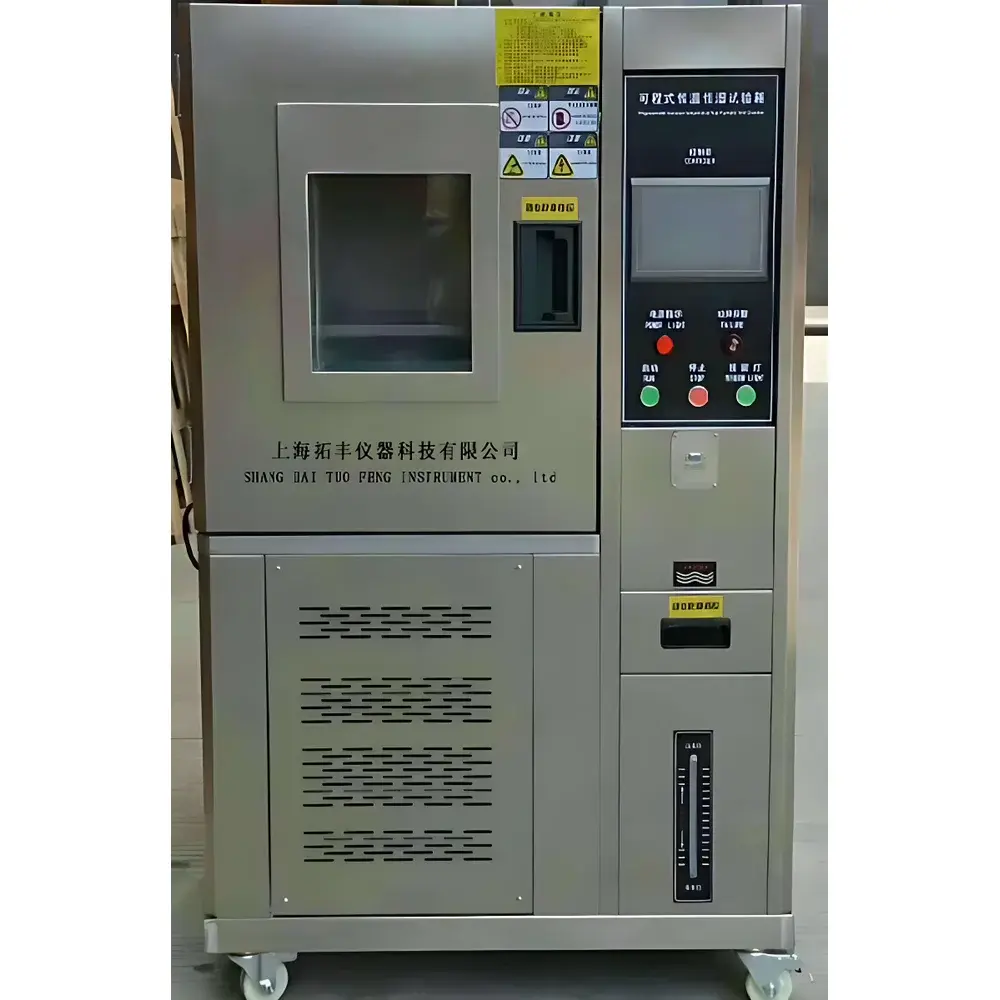
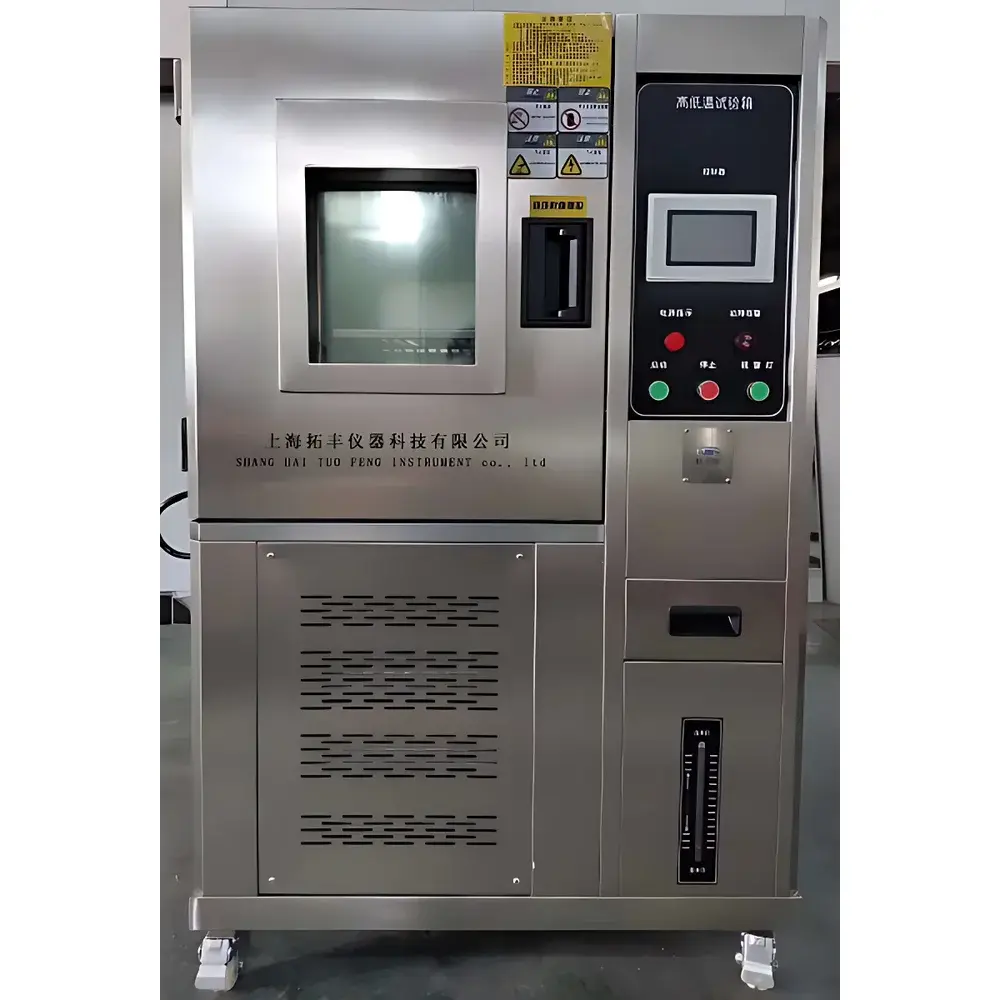
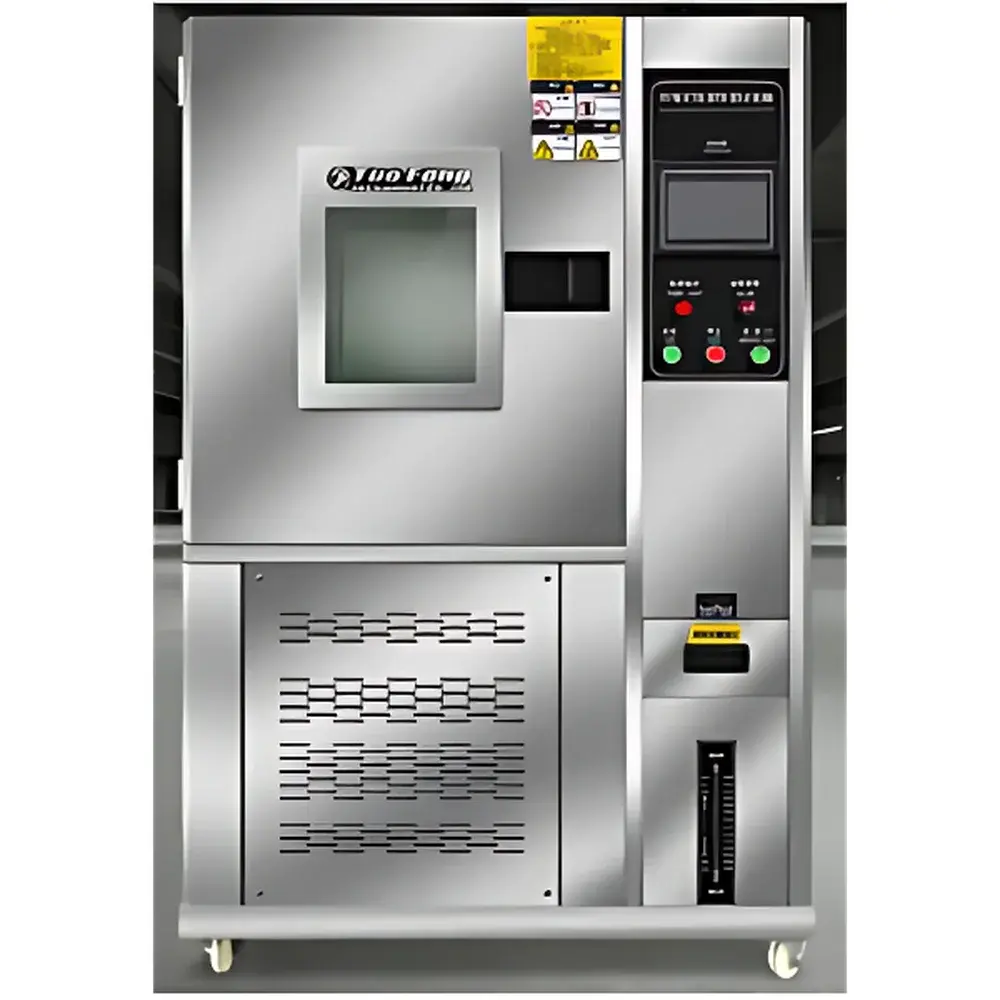
TOFENG TF-320B-80L Temperature and Humidity Controlled Environmental Test Chamber
| Brand | TOFENG |
|---|---|
| Model | TF-320B-80L |
| Chamber Type | Vertical Upright |
| Internal Dimensions (W×H×D) | 500 × 750 × 600 mm |
| Temperature Range | −70 °C to +100 °C (optional +150 °C) |
| Humidity Range | 20–98 % RH |
| Temperature Uniformity | ±0.1 °C |
| Temperature Fluctuation | ±0.5 °C (high temp), ±1.0 °C (low temp) |
| Humidity Uniformity & Fluctuation | ±0.1 % RH |
| Heating Rate | 1.0–3.0 °C/min |
| Cooling System | Air/Water-Cooled Dual-Stage Compressor |
| Controller | TEMI Programmable Touchscreen Interface |
| Construction | SUS304 Stainless Steel Interior & Exterior |
| Insulation | High-Density Polyurethane Foam with Closed-Cell Structure |
| Compliance | GB/T 2423.1–2423.4, GB/T 10586, IEC 60068-2-1 & -2-2, GJB 150.3/4/9 |
Overview
The TOFENG TF-320B-80L Temperature and Humidity Controlled Environmental Test Chamber is an engineered solution for accelerated environmental stress testing of materials, components, and finished products under precisely regulated thermal and hygrothermal conditions. Based on the principle of forced-air convection combined with dual-stage refrigeration and PID-controlled steam humidification, this chamber delivers high reproducibility in temperature and humidity profiles across its full operational range. Designed for laboratory and industrial quality assurance environments, it supports both steady-state conditioning and programmable cyclic profiles—including temperature-only, humidity-only, and combined temperature-humidity ramp-and-soak sequences. Its architecture meets the mechanical and metrological requirements defined in international standards for environmental simulation equipment, enabling traceable, auditable test execution in regulated sectors.
Key Features
- Stable dual-stage compressor cooling system with air/water hybrid condenser options, enabling reliable operation at −70 °C without liquid nitrogen dependency
- High-precision TEMI touchscreen controller with 30 programmable segments, 99 cycles, and real-time graphical display of setpoints vs. actual values
- SUS304 stainless steel construction (interior and exterior) with seamless welding and electropolished finish to prevent corrosion and facilitate cleaning
- High-density polyurethane foam insulation (≥100 mm thickness) with closed-cell structure, minimizing thermal bridging and energy consumption
- Steam-based humidification system with deionized water reservoir and automatic drain function to ensure consistent RH delivery without mineral deposition
- Comprehensive safety architecture including over-temperature/over-humidity cut-off, refrigerant high/low pressure monitoring, compressor overload protection, and non-fuse circuit breakers
- Calibration-ready design with multiple sensor access ports and NIST-traceable reference points for third-party verification
Sample Compatibility & Compliance
The TF-320B-80L accommodates a broad spectrum of sample types—from PCB assemblies and polymer films to pharmaceutical packaging and aerospace fasteners—within its 225 L internal volume (500 × 750 × 600 mm). Adjustable stainless steel shelves (standard configuration: 2 pcs) support uniform airflow distribution and load flexibility. The chamber complies with key national and international environmental testing standards, including GB/T 2423.1 (cold), GB/T 2423.2 (dry heat), GB/T 2423.3 (constant damp heat), GB/T 2423.4 (cyclic damp heat), IEC 60068-2-1 and -2-2, and GJB 150.3/4/9. While not inherently 21 CFR Part 11 compliant, its TEMI controller supports optional audit trail logging and user access control modules required for GLP/GMP-aligned validation protocols.
Software & Data Management
Data acquisition and reporting are supported via RS485/RS232 serial interface or optional Ethernet module, compatible with standard SCADA platforms and LabVIEW drivers. Raw time-series data (temperature, humidity, setpoint, alarm status) can be exported in CSV format for post-processing in MATLAB, Excel, or statistical analysis tools. The controller firmware allows user-defined pass/fail thresholds per test segment, with automatic event logging (e.g., deviation >±0.5 °C for >60 s). For validated environments, optional IQ/OQ documentation packages—including installation checklists, sensor calibration certificates, and performance verification reports—are available upon request.
Applications
- Electronics reliability testing: solder joint fatigue assessment under thermal cycling with humidity bias
- Automotive component qualification: evaluating seal integrity and dimensional stability of plastic housings at 85 °C/85 % RH
- Pharmaceutical packaging validation: monitoring moisture permeation rates through blister foil laminates
- Aerospace material screening: simulating high-altitude low-temperature exposure followed by rapid rehydration
- Building material durability: assessing mold resistance of gypsum board under sustained 30 °C/95 % RH conditions
- Medical device shelf-life studies: accelerated aging of silicone elastomer seals per ISO 11607
FAQ
What is the maximum allowable ambient temperature for continuous operation?
The chamber is rated for uninterrupted use at ambient temperatures between 5 °C and 30 °C, with relative humidity ≤85 % RH (non-condensing). Operation above 30 °C may reduce cooling capacity and extend stabilization times.
Can the TF-320B-80L perform rapid temperature transitions (e.g., thermal shock)?
It is not designed for thermal shock testing. Its heating rate (1.0–3.0 °C/min) and cooling rate (~1.0 °C/min at mid-range) align with standard environmental stress screening (ESS) and qualification testing—not extreme transition profiles requiring dedicated thermal shock chambers.
Is remote monitoring and control supported out-of-the-box?
Basic remote readout is enabled via serial communication; full web-based monitoring requires integration with external SCADA or a custom OPC UA gateway. No built-in Wi-Fi or cloud connectivity is provided.
What maintenance intervals are recommended for long-term accuracy?
Humidity sensor recalibration every 6 months and refrigeration system oil change every 24 months are advised. Full preventive maintenance—including condenser coil cleaning, door gasket inspection, and controller firmware update—should occur annually.
Does the chamber include validation documentation for ISO/IEC 17025 laboratories?
Factory calibration certificates (traceable to CNAS-accredited labs) are included. Full IQ/OQ/PQ documentation, sensor mapping reports, and uncertainty budgets require separate purchase and on-site execution by qualified validation engineers.



