
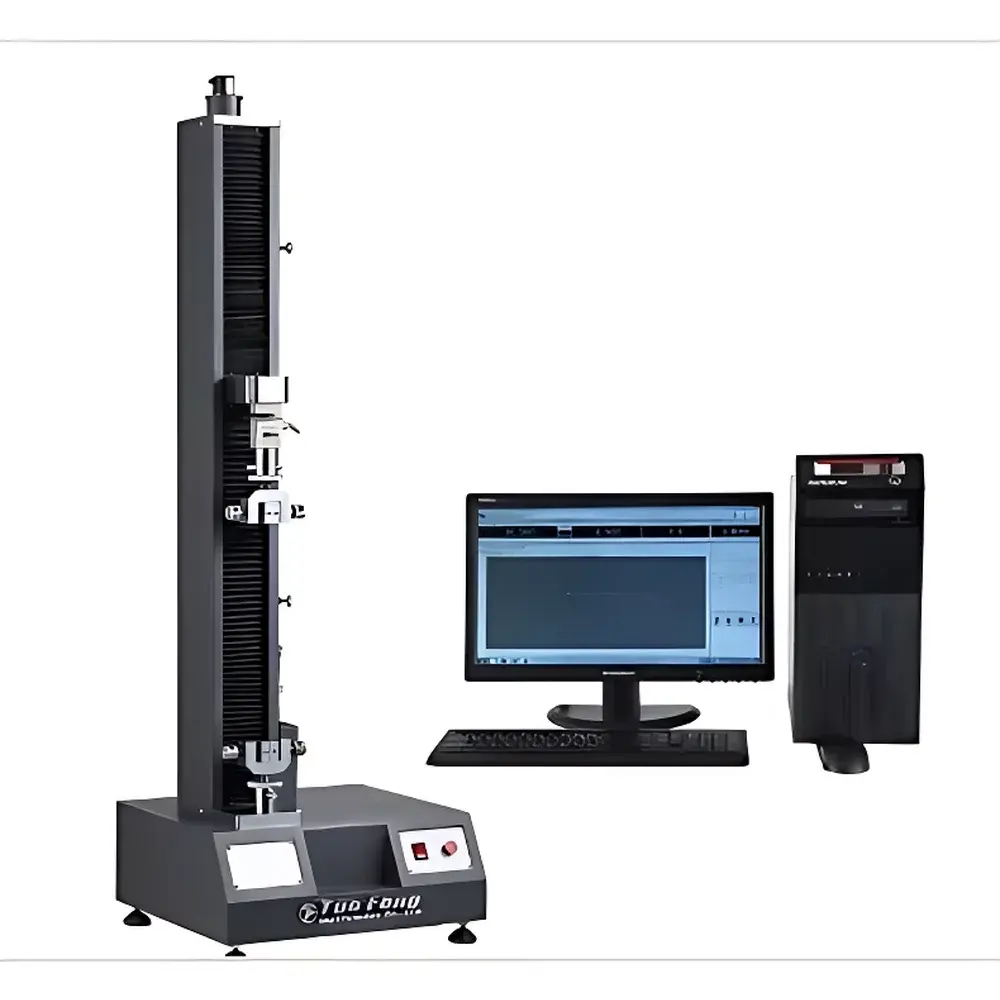
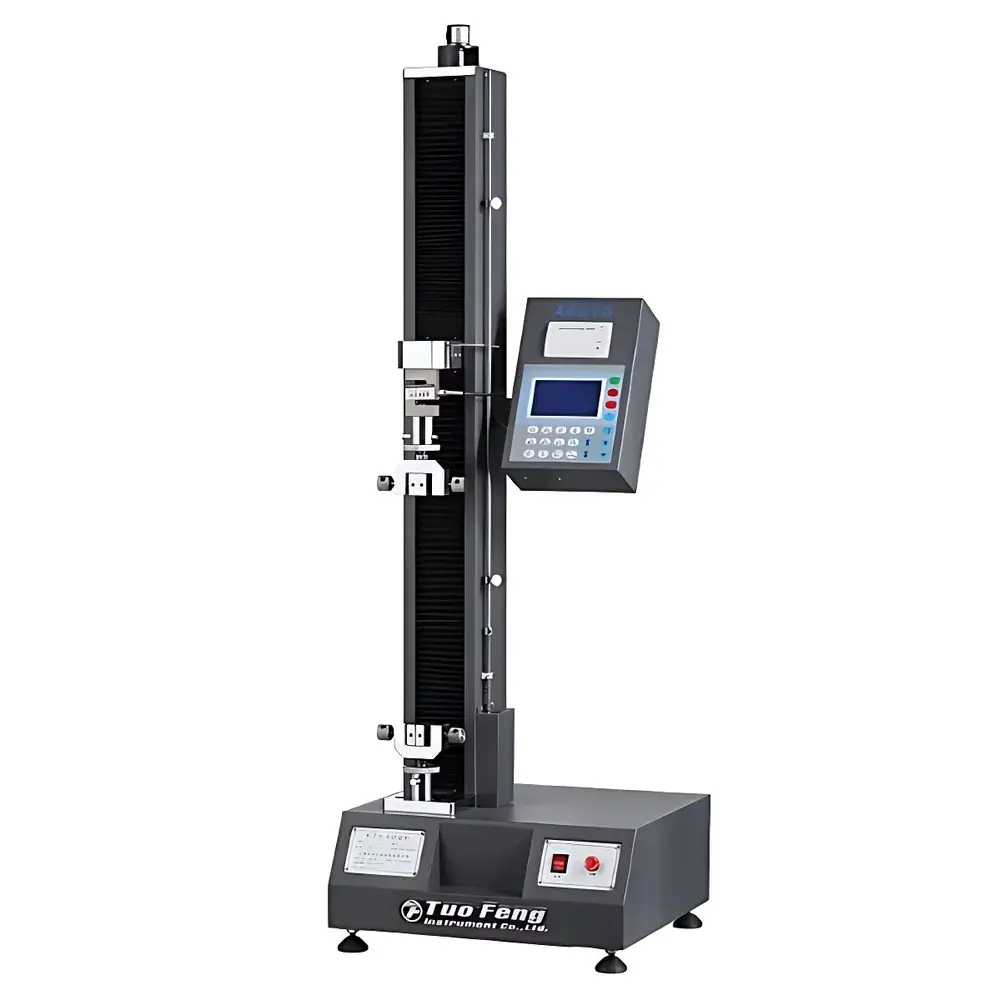
Tuofeng TFL-15 Micro Tensile Testing Machine
| Brand | Tuofeng |
|---|---|
| Origin | Shanghai, China |
| Manufacturer Type | Direct Manufacturer |
| Instrument Type | Electromechanical Tensile Tester |
| Model | TFL-15 |
| Max Test Load | 0.1 kN (100 N) |
| Force Measurement Range | 1–1000 N |
| Force Accuracy | ±0.5% of reading |
| Crosshead Travel | 700 mm |
| Displacement Resolution | 0.0001 mm |
Overview
The Tuofeng TFL-15 Micro Tensile Testing Machine is a precision-engineered, single-column electromechanical testing system designed for high-resolution mechanical characterization of miniature and low-force specimens. Operating on the fundamental principle of controlled uniaxial loading via a servo-motor-driven crosshead, the TFL-15 applies calibrated tensile, peel, tear, and bond strength loads while synchronously measuring force, displacement, and—when equipped with optional extensometry—strain. Its compact architecture and sub-micron displacement resolution make it especially suited for evaluating fine-diameter metallic wires (e.g., <0.5 mm), thin foils (<100 µm), micro-extruded polymer filaments, coated textile fibers, adhesive tapes, laminated packaging substrates, and miniature electronic interconnects. The system complies with core mechanical testing methodologies defined in ISO 6892-1 (metallic materials), ASTM D882 (thin plastic sheeting), ASTM D3330 (adhesive tape peel), ISO 11339 (peel resistance), and GB/T 228.1 (Chinese standard for metallic tensile testing), supporting both routine QC verification and early-stage R&D material screening.
Key Features
- Single-column rigid frame with precision-ground ball-screw drive and high-torque brushless servo motor (400 W, 220 V / 50 Hz)
- Force transducer calibrated to ±0.5% full-scale accuracy across a 1–1000 N range; no internal range switching required
- True 0.0001 mm displacement resolution enabled by high-fidelity optical encoder feedback on the crosshead axis
- Programmable crosshead speed from 0.01 to 500 mm/min (infinitely variable, closed-loop velocity control)
- Integrated electronic limit switches and emergency stop circuitry compliant with IEC 61800-5-2 functional safety requirements
- Three-speed motorized crosshead positioning (fast/medium/slow) with programmable return-to-start functionality
- Modular fixture interface accommodating custom grips—including pneumatic mini-clamps, wedge-action jaws, and peel fixtures—for specimen geometries down to 0.2 mm width
Sample Compatibility & Compliance
The TFL-15 accommodates specimens with gauge lengths from 5 mm to 250 mm and cross-sectional areas ranging from 0.001 mm² (e.g., 40 µm diameter Cu wire) to ~20 mm² (e.g., 2 × 10 mm polymer strip). It supports standardized test configurations per ISO 527-3 (plastics—films), ISO 2062 (yarn tensile), ASTM D882 (thin plastics), ASTM D1445 (carbon filament), and JIS Z 1522 (paperboard tensile). All hardware and firmware are engineered to support GLP-compliant operation: audit trails, user access levels, electronic signatures, and raw data immutability are enforced within the software environment. The system meets electromagnetic compatibility (EMC) requirements per EN 61326-1 and carries CE marking for conformity with EU Machinery Directive 2006/42/EC.
Software & Data Management
The Windows-based TensilePro™ v4.2 software (compatible with Windows 10/11 x64) provides full test method configuration, real-time multi-curve visualization (load–time, load–displacement, stress–strain, displacement–time), and automated parameter derivation—including ultimate tensile strength (UTS), yield strength (Rp0.2), elongation at break (%EB), modulus of elasticity, peel adhesion (N/mm), and tear resistance (kN/m). Units are freely convertible between SI, imperial, and CGS systems. Data export conforms to ASTM E1434 (standard format for mechanical test data) and supports CSV, XML, and PDF report generation with embedded metadata (operator ID, timestamp, calibration certificate ID, environmental conditions). Software architecture includes built-in 21 CFR Part 11 compliance modules—electronic signature capture, change history logging, and role-based permission controls—enabling deployment in regulated pharmaceutical packaging or medical device component validation labs.
Applications
- Tensile evaluation of fine-diameter stainless steel, NiTi, and tungsten micro-wires used in minimally invasive devices
- Peel strength quantification of pressure-sensitive adhesives on flexible electronics substrates (e.g., PET, PI)
- Interlaminar shear and delamination resistance testing of multilayer food packaging films (e.g., AlOx-coated PET/PE laminates)
- Mechanical reliability assessment of solder joint interconnections on flex PCBs under thermal cycling preconditioning
- Quality control of ultrathin aluminum foil (≤12 µm) for lithium-ion battery anode current collectors
- Adhesion strength measurement of plasma-treated textile fibers prior to dyeing or coating processes
FAQ
What is the minimum specimen thickness the TFL-15 can reliably test?
The system routinely handles specimens as thin as 5 µm (e.g., evaporated metal films on Si wafers) when paired with vacuum chucks and non-contact laser extensometry.
Does the TFL-15 support ASTM E8/E8M for metallic tensile testing?
Yes—when configured with appropriate extensometer options and calibrated grips, it satisfies all procedural and metrological requirements of ASTM E8/E8M for specimens meeting Type A or B geometry specifications.
Can test methods be exported and shared across multiple TFL-15 units in a lab network?
Test method files (.tmt) are fully portable and interoperable across all TFL-series instruments running identical software revision levels.
Is third-party calibration certification included with delivery?
Each unit ships with a factory-issued ISO/IEC 17025-accredited calibration certificate traceable to NIM (China National Institute of Metrology), covering force, displacement, and velocity channels.
What maintenance intervals are recommended for long-term accuracy retention?
Biannual verification of force transducer linearity and encoder resolution is advised; annual recalibration is recommended for GLP/GMP environments.



