
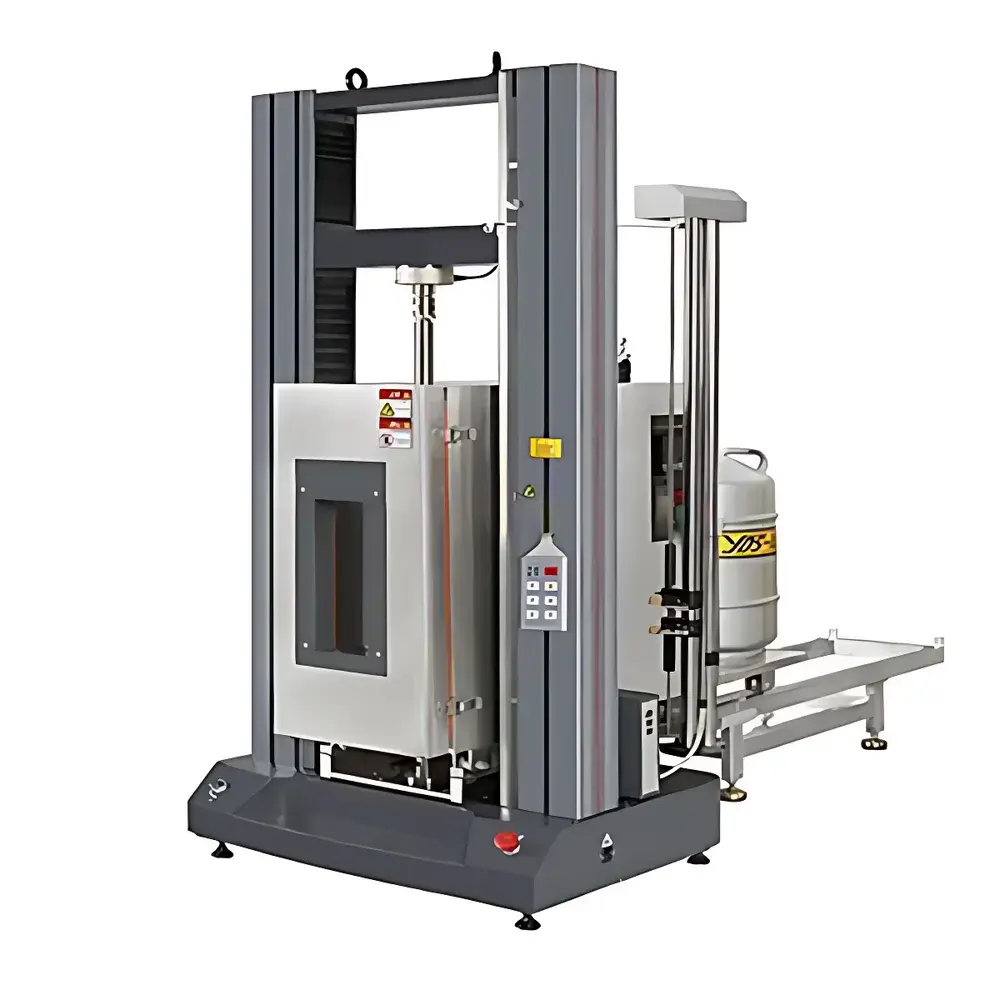
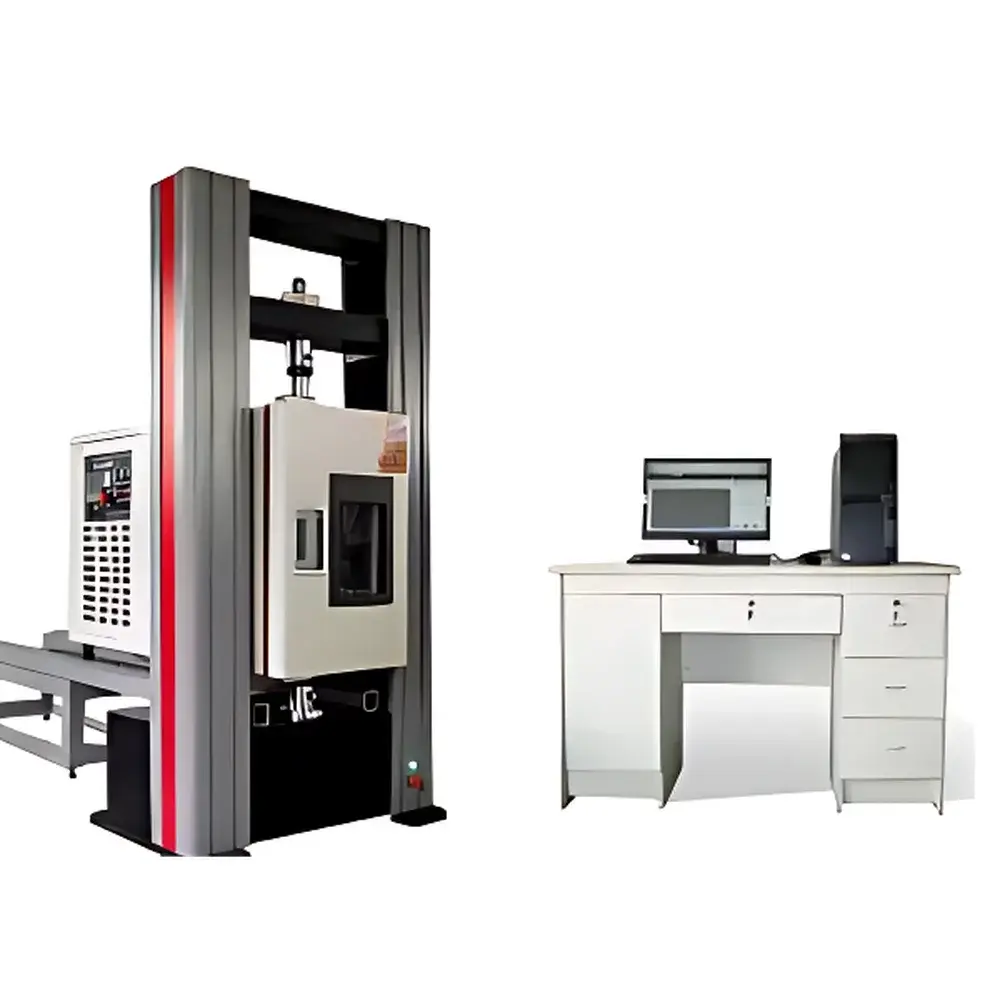
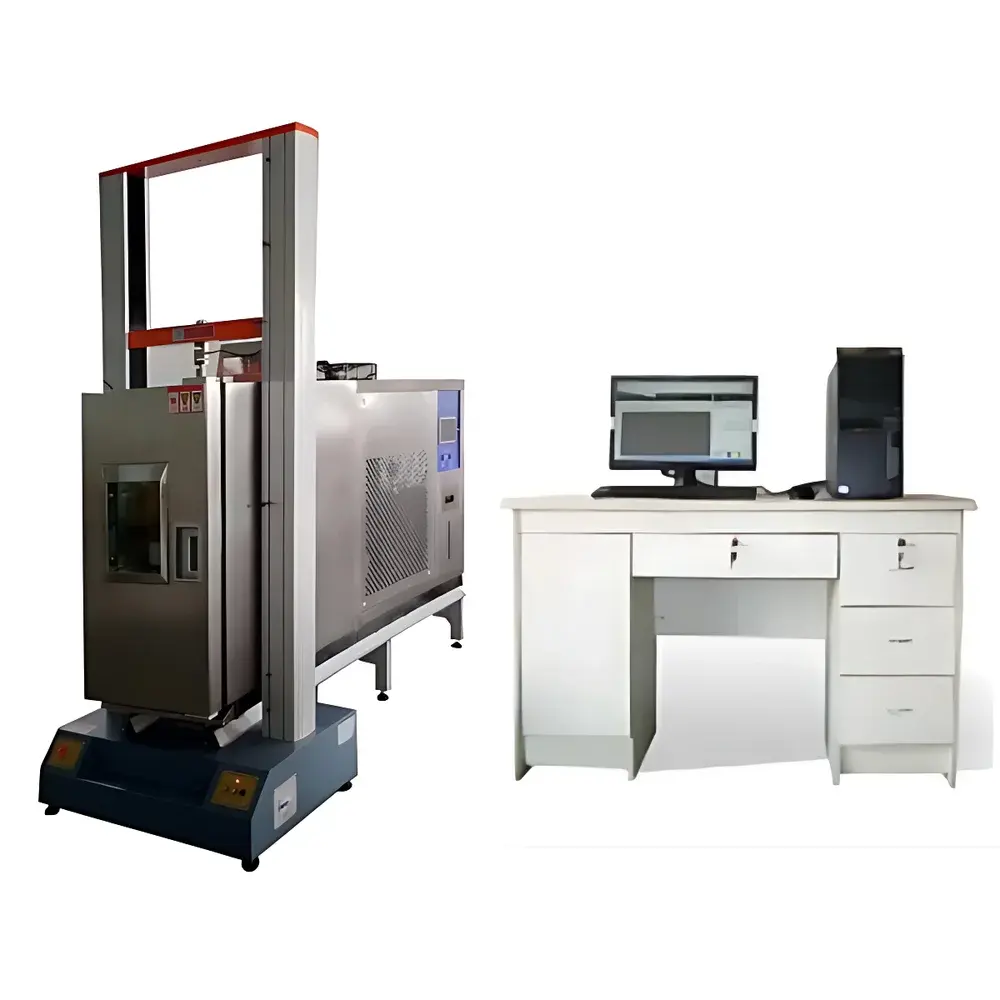
Tuofeng TFW-170 High-Low Temperature Universal Testing Machine
| Brand | Tuofeng |
|---|---|
| Origin | Shanghai, China |
| Manufacturer Type | Direct Manufacturer |
| Instrument Type | Electromechanical Universal Testing Machine |
| Max Test Load | 5–100 kN (configurable) |
| Accuracy Class | 0.5 |
| Force Measurement Range | 0.4–100% FS |
| Force Resolution | 1/500,000 of Full Scale |
| Deformation Measurement Range | 0.2–100% FS |
| Deformation Resolution | up to 1/300,000 |
| Displacement Error | ±0.5% of reading |
| Column Inner Width | 840 mm |
| Crosshead Travel (standard) | 1000 mm |
| Host Dimensions | 1250 × 560 × 2400 mm |
| Power Supply | AC 220 V / 50 Hz ±10%, 750 W |
| Host Weight | ~380 kg |
| Environmental Chamber Temp Range | –40 °C to +100 °C |
| Chamber Heating Power | 1.5 kW |
| Chamber Internal Dimensions | 360 × 300 × 500 mm (W×D×H) |
| Temperature Uniformity | ±2 °C over 100 mm vertical zone |
| Temp Ramp Rate | ≤30 min to +100 °C from ambient |
| Thermal Equilibration Time | ≤5 min (both above/below 0 °C) |
| Chamber Control | Programmable PID with Pt100 sensors |
| Safety Features | Leakage protection, overcurrent circuit breaker |
| Compliance | GB/T 228.1, ISO 6892-1, ASTM E8/E21, ASTM D638/D790/D1621, JIS Z2241, DIN 50125 |
Overview
The Tuofeng TFW-170 High-Low Temperature Universal Testing Machine is an electromechanical static testing system engineered for precise mechanical characterization of metallic and non-metallic materials across a wide thermal spectrum—from –40 °C to +100 °C. It integrates a high-stiffness dual-column load frame with a programmable environmental chamber, enabling standardized uniaxial tensile, compression, flexural, shear, peel, and tear testing under thermally controlled conditions. The system operates on the principle of servo-controlled displacement actuation, where a precision ball-screw-driven crosshead applies controlled loading while synchronized multi-channel transducers—load cell, extensometer (optional), and linear variable differential transformer (LVDT)—capture force, deformation, and displacement data in real time. Its modular architecture supports both ambient and conditioned testing without hardware reconfiguration, making it suitable for R&D labs, quality control departments, and third-party certification facilities requiring traceable, repeatable mechanical property evaluation per international standards.
Key Features
- High-accuracy load measurement system compliant with ISO 7500-1 Class 0.5, featuring a resolution of 1 part in 500,000 of full scale and linearity error ≤ ±0.5% of reading.
- Full-range, auto-ranging force sensor with no manual range switching—ensures consistent resolution across the entire 5 kN to 100 kN capacity options.
- Integrated environmental chamber constructed from 304 stainless steel exterior and 316 mirror-finish interior, insulated with high-density alumina-silica fiber for thermal stability and low heat leakage.
- Programmable temperature controller with dual Pt100 sensors, capable of ramping from –40 °C to +100 °C in under 30 minutes and maintaining uniformity within ±2 °C over a 100 mm axial zone.
- Optimized chamber geometry with 50 mm-diameter top/bottom access ports and retractable ceramic insulation blocks to minimize thermal bridging during specimen loading.
- Robust load frame with 840 mm column spacing and 1000 mm crosshead travel, accommodating large specimens and custom fixtures—including ASTM-compliant grips, bending jigs, and compression platens.
- Dual safety architecture: independent electronic overload cutoff and hardware-level circuit protection (leakage current detection + thermal-magnetic circuit breaker).
Sample Compatibility & Compliance
The TFW-170 accommodates flat, round, tubular, and irregular specimens—including metals (steel, aluminum, titanium alloys), polymers (thermoplastics, elastomers, composites), ceramics, adhesives, foams, and thin films—within dimensional limits defined by the chamber’s internal volume (360 × 300 × 500 mm) and grip clearance. Specimen mounting utilizes standard wedge-action or pneumatic grips with interchangeable jaw faces (serrated, rubber-coated, or smooth). The system meets mechanical testing requirements specified in GB/T 228.1–2021 (tensile), ISO 6892-1:2019, ASTM E8/E21 (metals), ASTM D638/D790/D1621 (plastics), JIS Z2241, and DIN 50125. All test sequences—including temperature ramping, dwell, and mechanical loading—are fully scriptable and auditable, supporting GLP/GMP-aligned workflows where regulatory traceability is required.
Software & Data Management
The Windows-based test control software provides real-time visualization of force–displacement, stress–strain, and temperature–time curves. It automatically calculates and reports key parameters—including ultimate tensile strength, yield strength (0.2% offset), modulus of elasticity, elongation at break, compressive strength, flexural modulus, peel adhesion, and tear resistance—according to user-selected standards. Raw data is stored in ASCII-compatible .csv and proprietary binary formats with embedded metadata (operator ID, timestamp, calibration ID, environmental log). Audit trail functionality records all user actions, parameter changes, and calibration events in compliance with FDA 21 CFR Part 11 requirements when configured with digital signature and role-based access controls. Export modules support direct integration with LIMS platforms and generate PDF/Excel reports with customizable headers, logos, and statistical summaries (mean, SD, CV%).
Applications
This system serves as a primary mechanical characterization tool in sectors where material behavior under thermal stress is critical: aerospace component validation (e.g., polymer matrix composites at sub-zero service temperatures), automotive NVH material screening (elastomer hysteresis vs. temperature), battery separator tensile integrity at elevated temperatures, biomedical polymer sterilization cycle survivability, cryogenic sealant performance, and high-temperature ceramic joint reliability. Universities use it for fundamental viscoelastic modeling (time–temperature superposition), while QC labs deploy it for incoming raw material verification against supplier specifications and batch-to-batch consistency monitoring. Its ability to replicate service-condition mechanical loading makes it indispensable for failure analysis and accelerated life testing protocols.
FAQ
What temperature ranges can the environmental chamber achieve, and how quickly?
The chamber operates from –40 °C to +100 °C, with a maximum heating rate of +100 °C in ≤30 minutes from ambient and thermal equilibration time ≤5 minutes across the test zone.
Is the system compatible with ASTM and ISO standard test methods?
Yes—the TFW-170 is preconfigured to execute tests per ASTM E8, D638, D790, D1621; ISO 6892-1, 527-1, 178; GB/T 228.1; and JIS Z2241, with method templates and reporting logic embedded in the software.
Can I use my own extensometer or video extensometer with this machine?
Yes—the system provides analog and digital input channels compliant with ASTM E83 and ISO 9513 for third-party extensometers, including contact and non-contact types, with synchronization to load and temperature data streams.
What level of calibration documentation is provided?
Each unit ships with NIST-traceable calibration certificates for load cell, displacement encoder, and temperature sensors, valid for 12 months, plus a full calibration procedure manual and uncertainty budget report.
Does the software support multi-user environments with permission levels?
Yes—administrator, operator, and viewer roles are configurable, with password-protected access to calibration functions, method editing, and report generation, satisfying internal audit and regulatory review requirements.



