
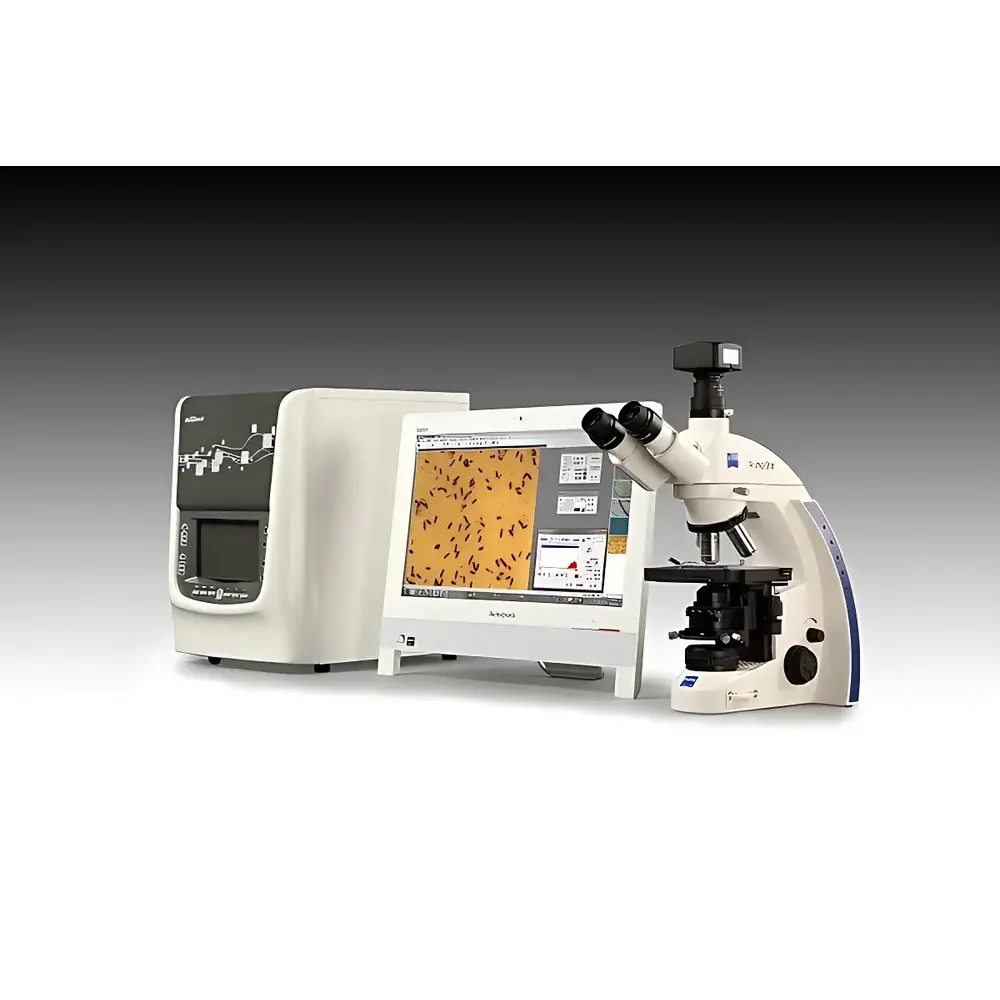
Xunsu MF6 Colony Counter & Microscopic Image Analysis Multifunctional Integrated System
| Brand | Xunsu |
|---|---|
| Origin | Zhejiang, China |
| Manufacturer Type | OEM Manufacturer |
| Instrument Type | Fully Automated Colony Counter |
| Counting Speed | <1 second for up to 500 colonies |
| Microscope | Zeiss PrimoStar |
| Camera | SONY 2/3″ Color CCD (5.2 MP for colony imaging |
| Lens | 10-MP fixed-focus lens (200 lp/mm resolution) |
| Illumination | Adjustable white-light LED (3500–8500 K), UV (254 nm), dual-sided (top diffuse + bottom dark-field) |
| Software Modules | Colony counting, zone-of-inhibition analysis, antibiotic potency calculation (ChP 2015 compliant), β-lactamase detection, microscopic particle analysis, GLP/GMP-ready audit trail |
Overview
The Xunsu MF6 Colony Counter & Microscopic Image Analysis Multifunctional Integrated System is an engineered platform designed for rigorous microbiological quality control, antimicrobial efficacy testing, and cellular morphometric analysis in regulated laboratory environments. It integrates two independent high-fidelity optical pathways—dedicated colony imaging and Zeiss PrimoStar-based microscopic imaging—within a single, unified hardware architecture. Colony quantification relies on calibrated visible-light imaging under controlled illumination conditions, employing advanced image segmentation algorithms rooted in level-set active contour modeling. Microscopic analysis leverages thermoelectrically cooled SONY CCD technology to suppress thermal noise, enabling high signal-to-noise ratio acquisition under low-light conditions. The system complies with ISO 11133:2014 (microbiological culture media preparation), USP and , and Chinese Pharmacopoeia 2015 Edition requirements for microbial enumeration and inhibition zone measurement. Its dual-path design eliminates cross-contamination risks between macro-scale colony assessment and micro-scale cellular observation, supporting parallel workflows in pharmaceutical QC, food safety labs, and academic microbiology research.
Key Features
- Two independent optical subsystems: high-resolution colony imaging (10-MP SONY CCD + f/1.4 fixed lens, 200 lp/mm resolution) and Zeiss PrimoStar microscope coupled with a 1.4-MP thermoelectrically cooled CCD for low-noise cellular imaging.
- Adaptive dual-illumination system: top-mounted 360° flexible mixed-color LED array (3500–8500 K adjustable color temperature) for surface texture and chromatic fidelity; bottom-mounted suspended dark-field illumination for enhanced edge contrast and subsurface colony detection in agar.
- Fourth-generation image segmentation engine based on RGB-constrained multi-phase level-set active contour models, enabling robust separation of overlapping, irregular, or low-contrast colonies—even in heterogeneous backgrounds or mixed-species cultures.
- Comprehensive regulatory compliance toolkit: built-in audit trail with timestamped, immutable records of all user actions (image acquisition, parameter selection, manual corrections); electronic signatures; watermark-stamped final reports; and full test environment reconstruction for reviewer verification.
- Integrated antibiotic potency analysis module conforming to ChP 2015 two-dose and three-dose assay protocols, with automated zone diameter extraction via Szone multi-mode edge detection (auto-detection, circle-fitting approximation, and manual three-point definition).
- Dedicated β-lactamase screening workflow per national dairy safety standards, including water blank validation, triplicate sample processing, and algorithmic positivity/negativity classification based on differential inhibition zone metrics.
Sample Compatibility & Compliance
The MF6 supports standard and non-standard microbiological sample formats including pour plates, spread plates, membrane filters, spiral plates (FDA-compliant modes), 3M Petrifilm™ products (aerobic count, Staphylococcus aureus, coliform/E. coli), and multi-well assay plates. For fungal and actinomycete analysis, the “one-click mycelial measurement” function computes area, perimeter, major/minor axes, and circularity without user-defined thresholds. All software modules adhere to data integrity principles outlined in FDA 21 CFR Part 11, EU Annex 11, and WHO TRS 992 Annex 6. The four-tier user permission model (System Administrator, Data Manager, Operator, Reviewer) enforces role-based access control, while database-level immutability ensures raw images, metadata, dilution factors, and correction logs remain unalterable post-acquisition. Calibration is traceable to NIST-traceable stage micrometers and certified reference plates.
Software & Data Management
The proprietary MF6 software suite operates on Windows OS and implements a relational SQL database backend for structured storage of images, quantitative results, instrument settings, and procedural metadata. Each test record includes: original image file (lossless TIFF), applied segmentation parameters, operator ID, review timestamp, electronic signature, and full revision history—including pre- and post-correction colony counts. Reports export to PDF (with embedded digital watermark and dual-user e-signature) or Excel (for statistical process control integration). Audit trail entries capture not only “what was measured” but also “how it was measured”: exact illumination settings, lens focus position, ROI coordinates, and even mouse-click sequences during manual editing. Data archiving supports encrypted backup to network drives or external SSDs, with optional integration into LIMS via standardized CSV or XML interfaces.
Applications
The MF6 serves as a validated platform across multiple regulated domains: pharmaceutical sterility testing (USP ), antimicrobial susceptibility profiling (CLSI M07/M100), probiotic strain enumeration (ISO 15214), food and beverage shelf-life modeling, clinical microbiology (OPKA/SBA assays), enzyme activity screening (clear-zone hydrolysis), and mold growth inhibition studies. Its microscopic module enables morphometric analysis of yeast budding patterns, bacterial chain formation, spore dimensions, and filamentous fungal hyphal branching angles—quantified using calibrated pixel-to-micron conversion. In R&D settings, the system supports comparative morphology studies across culture conditions, enabling objective correlation between colony phenotype and genomic or metabolic traits.
FAQ
Does the MF6 comply with FDA 21 CFR Part 11 requirements for electronic records and signatures?
Yes—the system implements role-based authentication, tamper-evident audit trails, electronic signatures with time/date stamping, and immutable storage of raw data and processing history.
Can the MF6 distinguish colonies of different species in mixed cultures?
Yes—using RGB-constrained level-set clustering, it classifies colonies by color, size, texture, and contour morphology, supporting up to 24 distinct color clusters or user-defined target hues.
Is calibration traceable to international standards?
Yes—system calibration uses NIST-traceable stage micrometers and certified reference plates; software includes both automated and manual recalibration functions with version-controlled parameter logging.
What is the maximum throughput for plate analysis?
Up to 60 standard Petri dishes per hour when operating in batch mode with pre-configured templates and minimal manual intervention.
How does the system handle plates with condensation, scratches, or marker pen annotations?
The background repair tool applies adaptive inpainting and morphological filtering to reconstruct pristine plate backgrounds prior to segmentation, significantly improving recognition accuracy in real-world lab conditions.




