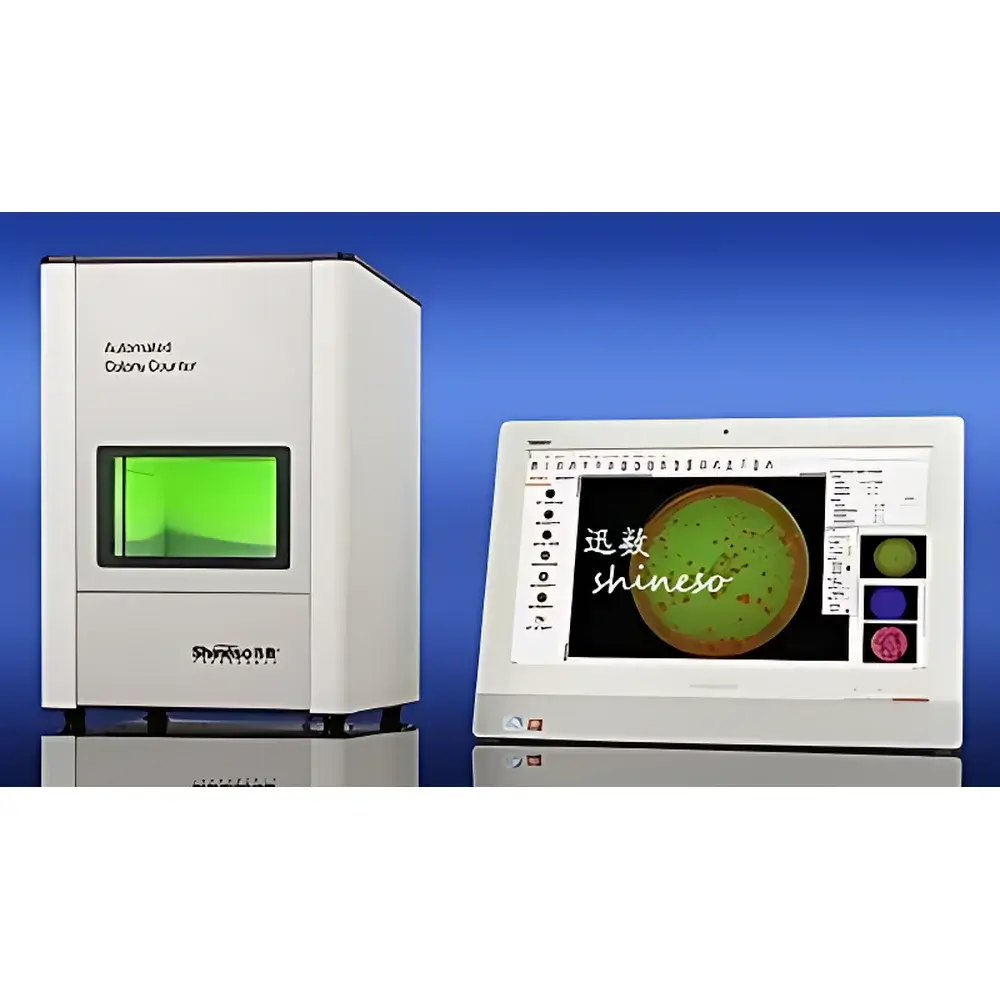
Xunso HD5000(AI) Multispectral Super-Resolution Colony Imaging System
| Brand | Xunso |
|---|---|
| Origin | Zhejiang, China |
| Manufacturer Type | OEM Manufacturer |
| Instrument Type | Fully Automated Colony Counter |
| Sample Types | Liquid media, solid media (pour plate, spread plate, membrane filtration, spiral plate, 3M Petrifilm™) |
| Petri Dish Capacity | 35–150 mm diameter |
| Counting Speed | 20,000 colonies/sec |
| Counting Accuracy | ≥98% for standard reference strains |
| Imaging Performance | 4/3-inch large-format SONY color CMOS sensor (21 MP, 4.54 × 4.54 µm pixel size), 4/3-inch ultra-high-resolution fixed-focus lens (180 lp/mm resolution) |
| Software Suite | AI Colony Counting Software, Classical Colony Analysis Software, Automatic Zone-of-Inhibition Measurement Software, Antibiotic Potency Assay Software, Disk Diffusion Antimicrobial Susceptibility Testing (AST) Software |
Overview
The Xunso HD5000(AI) Multispectral Super-Resolution Colony Imaging System is a high-precision, fully automated digital imaging platform engineered for quantitative microbiological analysis in regulated and research-intensive environments. It integrates multispectral illumination physics—including Rheinberg illumination, suspended dark-field, pseudo-infrared thin-film interference, and tunable diffuse backlighting—with a 21-megapixel 4/3-inch SONY CMOS sensor and an optically corrected 180 lp/mm fixed-focus lens. This architecture enables sub-millimeter spatial resolution, exceptional contrast fidelity, and robust segmentation of morphologically heterogeneous colonies across diverse culture substrates. The system operates on a dual-principle imaging paradigm: (1) optical contrast enhancement via wavelength-selective, angle-controlled illumination to maximize feature discriminability without chemical staining; and (2) AI-driven pixel-level semantic segmentation trained on a curated, multi-industry dataset of >10⁶ annotated colony images—spanning pharmaceutical QC, food safety, environmental monitoring, clinical microbiology, and academic research. Designed to meet the analytical rigor required by ISO 7218, USP /, EP 2.6.12, and CLSI M07/M100 standards, the HD5000(AI) delivers traceable, audit-ready outputs compliant with GLP and GMP data integrity requirements.
Key Features
- Multispectral illumination engine with 132 programmable lighting combinations: 11-channel visible-wavelength Rheinberg excitation + 11-color trans-illumination backgrounds, enabling non-invasive optical “color labeling” of colonies based on intrinsic spectral reflectance and scattering properties.
- Suspended dark-field illumination: Uniform white LED contour lighting against black background yields >30 dB contrast for transparent zones (e.g., phage plaques, hemolysis) and low-contrast colonies on opaque or pigmented media.
- Pseudo-infrared thin-film interference optics (HD5000M variant): Specifically optimized for membrane filtration assays—converts white cellulose acetate or polycarbonate filter backgrounds into uniform chromatic fields, rendering near-white microcolonies as high-contrast red-toned features for reliable detection down to 20 µm.
- AI-powered colony segmentation engine: Trained on 20 years of real-world user data, supporting one-click batch analysis of 200 plates in ≤180 s; handles challenging cases including semi-transparent colonies, edge-adherent growth, label/text interference, overlapping colonies, and mixed-species morphologies (e.g., actinomycetes/bacteria co-cultures).
- Quantitative morphometric analysis: Automated measurement of colony area, perimeter, major/minor axis, circularity, and grayscale texture descriptors—enabling strain-level phenotypic profiling per ISO/IEC 17025 method validation guidelines.
- FDA-compliant spiral plate analysis: Supports exponential, slow-exponential, uniform, proportional, and lawn modes; compatible with SBI and IUL spiral platers per FDA BAM Chapter 3 protocols.
Sample Compatibility & Compliance
The HD5000(AI) accommodates all standard microbiological sample formats: pour plates, spread plates, membrane filters (including 3M Petrifilm™ and Oxoid Translucent), contact plates, and multiwell plates (6–96-well). Its illumination versatility ensures reproducible imaging across agar types (TSA, PCA, VRBA, MAC, CHROMagar™), liquid overlays (soft agar for phage assays), and stained preparations (crystal violet for clonogenicity, neutral red for viral cytopathic effect). Regulatory alignment includes full support for USP microbial enumeration, objectionable organisms testing, EP 2.6.12 enumeration methods, ISO 4833-1:2013 and ISO 7218:2017 colony counting protocols, and CLSI M100 Ed. 33 antimicrobial susceptibility interpretation criteria. All software modules enforce ALCOA+ principles: attributable, legible, contemporaneous, original, accurate, complete, consistent, enduring, and available—via built-in electronic signatures, immutable audit trails, and 21 CFR Part 11–compliant role-based access control (system administrator, data manager, operator, reviewer).
Software & Data Management
The integrated software suite comprises five validated modules: (1) AI Colony Counting (ISO/IEC 17025–validated algorithm), (2) Classical Image Analysis (multi-threshold dynamic adjustment, level-set segmentation), (3) SZone Zone-of-Inhibition Measurement (auto-detect, circle-fit, three-point manual mode), (4) Antibiotic Potency Assay (USP monograph–compliant one-dose method; ChP 2025–aligned two/three-dose bioassay), and (5) Disk Diffusion AST (CLSI M100 database–driven S/SDD/I/R classification). Data governance follows a four-tier permission model: operators perform acquisition and preliminary analysis; reviewers verify results against raw images and processing logs; data managers archive encrypted .RAW + .CSV + PDF report bundles; system administrators manage user lifecycle and cryptographic key rotation. All operations generate timestamped, user-attributed metadata stored in a tamper-evident SQLite3 database with SHA-256 hashing. Export options include PDF/A-2b (with embedded watermarked e-signatures), Excel (.xlsx), and image stacks (.tiff) meeting NIH/FDA submission requirements.
Applications
The HD5000(AI) serves as a core platform for: pharmaceutical sterility assurance (USP ), bioburden monitoring (ISO 11737-1), food pathogen screening (ISO 6579, ISO 16649), environmental microbiology (EPA Method 1681), antibiotic discovery (zone-of-inhibition quantification, MIC/MBC derivation), antifungal efficacy testing (ISO 16000-10), viral titer determination (plaque assay, TCID₅₀), stem cell clonogenicity (colony-forming unit–fibroblast, CFU-F), immunological functional assays (OPKA, SBA), and CRISPR screening (spot assay quantification). Its dual-mode imaging supports both regulatory release testing and exploratory research—e.g., high-content phenotypic profiling of mutant libraries under stress conditions, or longitudinal tracking of biofilm colony dynamics during antimicrobial challenge.
FAQ
Does the HD5000(AI) comply with 21 CFR Part 11 for electronic records and signatures?
Yes. The system implements role-based authentication, audit-trail logging (immutable, time-stamped, user-attributed), electronic signatures with cryptographic binding, and secure data export—all validated per Annex 11 and Part 11 guidance.
Can it analyze membranes from different manufacturers (e.g., Millipore, Pall, Sartorius)?
Yes. The pseudo-infrared thin-film interference module (HD5000M) is substrate-agnostic and calibrated for cellulose ester, polyethersulfone, and polycarbonate filters across pore sizes 0.22–0.45 µm.
Is the AI model retrainable with proprietary strain libraries?
No. The deployed neural network is a closed, pre-validated inference engine. Custom training requires separate validation per ISO/IEC 17025 clause 5.4.2 and must be documented as a method modification.
What is the maximum plate throughput per hour under continuous operation?
At 180 seconds for 200 plates, sustained throughput is ~4,000 plates/hour—limited only by operator loading/unloading cycle time and ambient temperature stability.
Does the system support integration with LIMS or ELN platforms?
Yes. RESTful API endpoints enable bidirectional data exchange (JSON/XML) for sample metadata ingestion, result push, and instrument status polling—compatible with LabVantage, Thermo Fisher SampleManager, and Benchling.