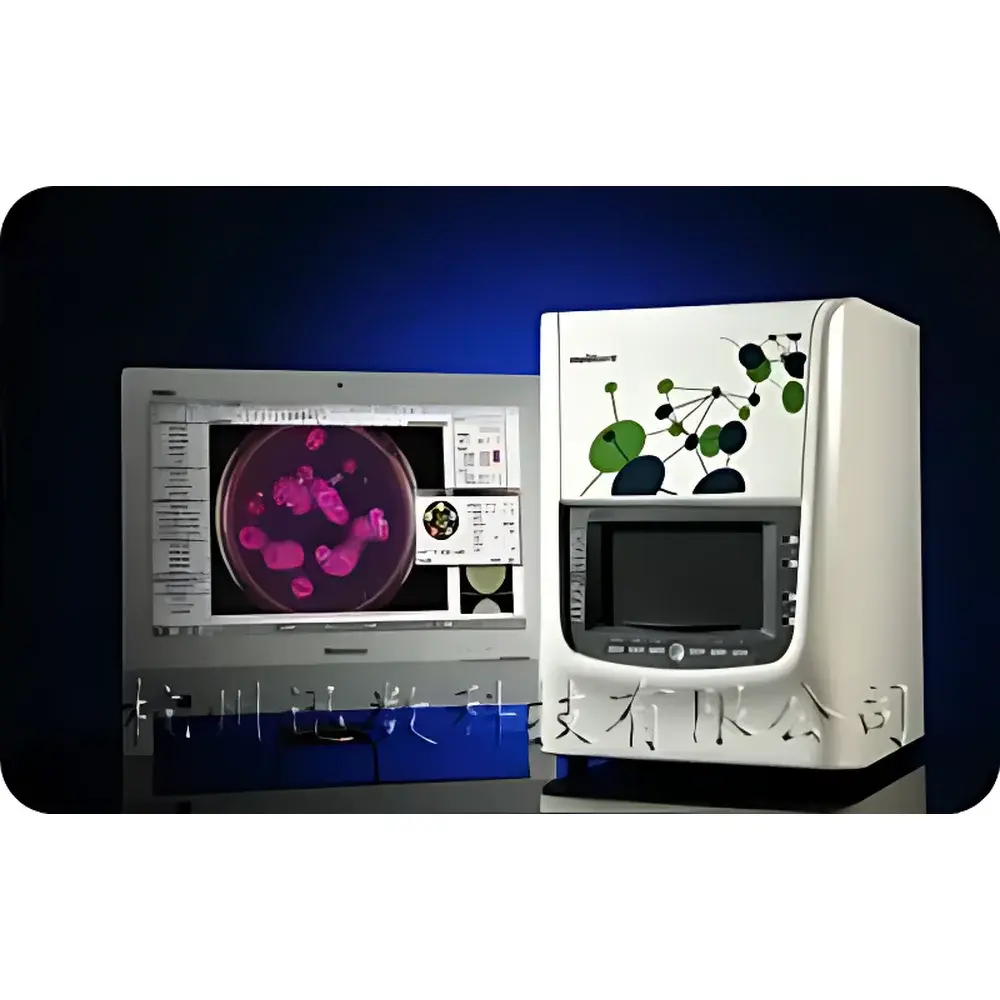
Xunsu Czone7D Automated Antibiotic Zone-of-Inhibition Measurement and Colony Counter
| Brand | Xunsu |
|---|---|
| Origin | Zhejiang, China |
| Manufacturer Type | Direct Manufacturer |
| Instrument Type | Fully Automated Colony Counter & Zone-of-Inhibition Analyzer |
| Counting Speed | <1 second for up to 500 colonies |
| Model | Czone7D |
| Price Range | USD 7,000–11,200 (FOB) |
Overview
The Xunsu Czone7D is a fourth-generation, fully automated colony counter and antibiotic zone-of-inhibition measurement system engineered specifically for pharmaceutical microbiology laboratories conducting microbial limit testing, antimicrobial potency assays, and regulatory-compliant enumeration of bacteria, yeasts, and molds. It operates on high-fidelity digital imaging combined with advanced computer vision algorithms—primarily level-set active contour modeling and multi-modal edge detection—to deliver precise, reproducible, and audit-ready results. The instrument integrates dual optical pathways (top diffuse illumination and bottom suspended dark-field illumination), triple-wavelength LED lighting (RGB), and dual-band UV excitation (254 nm for chamber sterilization and 366 nm for fluorescent colony detection), enabling robust performance across diverse sample types—including turbid media, herbal residue-contaminated plates, membrane filters, spiral plating, and 3M Petrifilm™ formats. Its design adheres to the optical and procedural requirements outlined in USP , , , and Chinese Pharmacopoeia 2020 Edition Volume IV (General Chapters 1105, 1106, and 9202), supporting GLP/GMP-aligned workflows.
Key Features
- Fully enclosed dark chamber with ergonomic porthole door eliminates ambient light interference and suppresses stray-light artifacts (e.g., halos or glare from Petri dish refraction).
- Dual illumination architecture: top-mounted 360° flexible mixed-light module for enhanced surface texture contrast; bottom-mounted suspended dark-field illumination for improved colony-background differentiation.
- Triple-color (RGB) LED structural lighting ensures accurate color fidelity and eliminates blue-shift bias common in standard white LEDs—critical for morphological classification and differential colony identification.
- Switchable background modes (black dark-field and white reflective) optimize contrast for both light- and dark-colored colonies, especially in complex matrices such as traditional Chinese medicine extracts.
- Integrated dual-wavelength UV system: 254 nm lamp for internal chamber decontamination and UV mutagenesis; dual-side 366 nm lamps for fluorescence excitation of Escherichia coli, coliforms, and GFP-expressing strains.
- Six一键 (one-click) intelligent counting modules tailored for倾注, spread, membrane filtration, spiral plating, and 3M™ test plates—each applying context-aware segmentation logic.
- Proprietary Szone multi-mode zone measurement engine supports automatic edge detection, circle-fitting approximation (for irregular or fragmented zones), and manual three-point circle definition—ensuring traceable, operator-independent measurements.
Sample Compatibility & Compliance
The Czone7D accommodates standard 90 mm and 150 mm Petri dishes, membrane filters (including black-grid nitrocellulose), 3M™ Petrifilm™ products (Aerobic Count, Staphylococcus aureus, Coliform, and E. coli/Coliform), and FDA-compliant spiral plating patterns (compatible with SBI and IUL inoculators). It meets method validation requirements for microbial limit tests per USP , EP 2.6.12, and ChP 2020 Section 1105. For antimicrobial potency determination, it implements two-dose and three-dose assay protocols compliant with ChP 2010/2020 Annex 9202 and supports parallel-line analysis with built-in statistical validation. All measurement data—including raw images, annotated overlays, calibration logs, and user actions—are timestamped and stored with full audit trail capability, satisfying FDA 21 CFR Part 11 electronic record integrity requirements when deployed with appropriate administrative controls.
Software & Data Management
The integrated software suite includes three core modules: Colony Analysis, Zone-of-Inhibition Measurement, and Antibiotic Potency Calculation. It features role-based access control with three-tier password protection (operator login, database access, and administrator privileges) to safeguard data integrity. Statistical outputs—including total counts, size-classified distributions, morphology descriptors (circularity, aspect ratio, perimeter-to-area ratio), and zone diameters—are exportable to Excel without loss of metadata. The system supports automated calculation of CFU/mL based on plate diameter and dilution factor inputs. For regulatory submissions, reports can be customized using open-format templates and include embedded calibration certificates, user-defined annotations, and image watermarks. All image processing parameters are logged per session, enabling full reprocessing traceability during audits.
Applications
- Pharmaceutical microbial limit testing (bacteria, yeast, mold enumeration per ChP/USP)
- Antibiotic potency assays (penicillins, cephalosporins, aminoglycosides) using cylinder-plate or agar diffusion methods
- Culture medium suitability verification per ChP 1106 and USP
- Controlled microorganism identification support via standardized morphological feature extraction (colony elevation, margin, opacity, pigmentation)
- Fluorescent colony enumeration (E. coli O157:H7, GFP-tagged strains) under 366 nm excitation
- Herbal product microbiological testing with effective particulate interference suppression
- Spiral plate enumeration aligned with AOAC 977.27 and SN/T 0770-1999
FAQ
Does the Czone7D comply with pharmacopoeial standards for antibiotic potency testing?
Yes—it implements two-dose and three-dose assay algorithms validated against Chinese Pharmacopoeia 2020 Annex 9202 and supports parallel-line analysis with precision metrics meeting ChP repeatability criteria (relative error ≤0.01% for intra-assay reproducibility).
Can the system distinguish colonies from herbal residue or filter paper grids?
Yes—its suspended dark-field illumination enhances contrast for translucent or low-pigment colonies, while background switching and morphology-constrained level-set segmentation enable reliable separation of colonies from dark particulates or black-grid membranes.
Is raw image data retained alongside processed results?
Yes—every analysis session stores unprocessed TIFF images, overlay masks, measurement coordinates, and parameter settings in a relational database with immutable timestamps, supporting full forensic reconstruction.
What UV safety features are included?
The unit incorporates interlocked UV shielding: 254 nm and 366 nm lamps automatically deactivate upon door opening, and exposure time is software-limited to prevent accidental overexposure.
How is software validation supported for regulated environments?
The software provides IQ/OQ documentation templates, configurable electronic signatures, audit trail export (CSV/Excel), and change control logs—facilitating compliance with GAMP5, FDA 21 CFR Part 11, and EU Annex 11 requirements.