
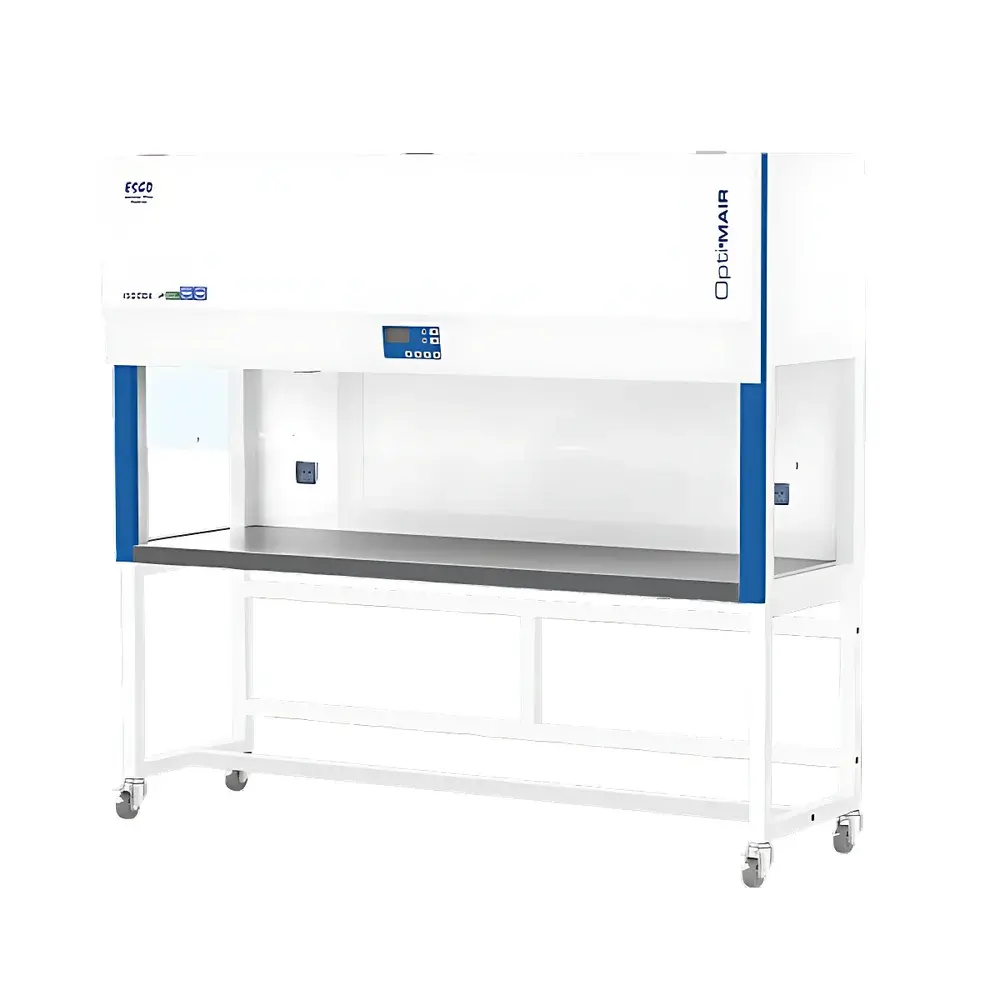
Esco OptiMair Vertical Laminar Flow Clean Bench
| Brand | Esco |
|---|---|
| Origin | Shanghai, China |
| Manufacturer Type | Direct Manufacturer |
| Country of Origin | China |
| Instrument Category | Vertical Laminar Flow Clean Bench |
| Compliance | ISO 14644-1 Class 5 (equivalent to Fed. Std. 209E Class 100) |
| Adjustable Air Velocity | 0.3–0.45 m/s |
| Standard Surface Material | 304 Stainless Steel |
| Standard Lighting | UV Lamp with Timer & Remote Control Options |
| Standard Coating | Esco ISOCIDE® Antimicrobial Coating |
| Structural Panel | Anti-glare Coated Steel Back Panel |
| Side Panels | UV-Resistant Tempered Glass |
| Fan Type | High-Efficiency Low-Noise EC Motor |
| Optional Upgrade | HEPA Filter Configurable for ISO Class 4 (Fed. Std. 209E Class 10) |
Overview
The Esco OptiMair Vertical Laminar Flow Clean Bench is an ISO 14644-1 Class 5 certified local air purification system engineered for unidirectional downward airflow across the work surface. It operates on the principle of vertical laminar flow—where pre-filtered and HEPA-filtered air is delivered uniformly from the top plenum through a diffuser plate, creating a particle-free, low-turbulence environment over the work area. This airflow architecture minimizes cross-contamination between operator and sample, offering superior product protection compared to horizontal-flow configurations in applications where personnel exposure must be minimized. Designed and manufactured by Esco—a global leader in cleanroom and biosafety technology since 1978—the OptiMair series complies with international performance and safety benchmarks including ISO 14644-1, YY/T 1539–2017 (Medical Clean Benches), and JG/T 292–2010 (Clean Bench General Technical Conditions). Its structural integrity, aerodynamic efficiency, and materials selection support long-term operational reliability in regulated environments.
Key Features
- Adjustable laminar airflow velocity (0.3–0.45 m/s) with real-time digital display on a tactile control panel for precise process alignment
- Standard ISOCIDE® antimicrobial coating applied to all interior metal surfaces—including side panels and back wall—to inhibit microbial colonization and support routine decontamination protocols
- UV germicidal lamp with programmable timer function; optional infrared remote or radio-frequency module enables hands-free activation/deactivation, reducing physical contact and enhancing workflow continuity
- Work surface fabricated from electropolished 304 stainless steel—corrosion-resistant, non-porous, and compatible with common laboratory disinfectants including 70% ethanol and sodium hypochlorite solutions
- UV-transmissive tempered glass side panels improve ambient light transmission while maintaining operator visibility and ergonomic posture during extended procedures
- Anti-reflective coated steel rear panel eliminates glare-induced visual fatigue, supporting compliance with human factors guidelines in GLP and GMP-aligned laboratories
- EC (electronically commutated) blower system delivers stable, low-vibration airflow with noise levels ≤55 dB(A) at 1 m distance and energy consumption optimized for continuous operation
Sample Compatibility & Compliance
The OptiMair Clean Bench is validated for use with non-hazardous biological samples, sterile media preparation, aseptic cell culture handling, pharmaceutical compounding, optical component assembly, and plant tissue culture inoculation. It is not designed for containment of biohazards or volatile chemicals. Its certification to ISO 14644-1 Class 5 (≤3,520 particles ≥0.5 µm/m³) ensures suitability for processes requiring 100-level cleanliness per Fed. Std. 209E. Optional HEPA filter upgrades allow configuration to ISO Class 4 (10-level equivalent), subject to third-party validation. The unit meets electromagnetic compatibility (EMC) requirements per IEC 61326-1 and electrical safety standards per IEC 61010-1. Documentation packages include factory calibration reports, filter integrity test records, and airflow uniformity verification data—supporting audit readiness under FDA 21 CFR Part 11, EU Annex 1, and WHO TRS 961 frameworks.
Software & Data Management
While the OptiMair operates via embedded microcontroller-based hardware without cloud connectivity, its control interface supports full traceability in regulated settings. All UV lamp activation events—including scheduled start/stop times and manual overrides—are logged with timestamps and stored locally in non-volatile memory for up to 12 months. The system includes audit trail functionality compliant with ALCOA+ principles (Attributable, Legible, Contemporaneous, Original, Accurate, Complete, Consistent, Enduring, Available). Data export is available via USB port for integration into laboratory information management systems (LIMS) or electronic lab notebooks (ELN). No proprietary software installation is required; configuration parameters are accessible via intuitive menu navigation and password-protected administrative access.
Applications
- Aseptic preparation of microbiological growth media and reagents in clinical and research microbiology labs
- Cell line maintenance, transfection, and passaging in academic and biotech cell culture facilities
- Pharmaceutical sterile filtration validation and small-batch vial filling under ISO 5 conditions
- Optical lens and sensor assembly in precision manufacturing environments sensitive to particulate contamination
- Plant meristem isolation and explant transfer in tissue culture laboratories adhering to phytosanitary standards
- Quality control testing of food-grade packaging materials and environmental swab processing in food safety labs
FAQ
Is the OptiMair Clean Bench suitable for handling pathogenic organisms?
No. This unit provides product protection only and does not protect the operator or environment from hazardous agents. For biohazardous work, a Class II Biological Safety Cabinet is required.
What is the recommended HEPA filter replacement interval?
Under typical usage (8 hours/day, ISO Class 5 environment), filter life is 3–5 years. Actual service life depends on ambient particulate load and must be verified annually via DOP/PAO challenge testing.
Can the airflow velocity be calibrated onsite?
Yes. The integrated anemometer is field-calibratable using NIST-traceable handheld probes; calibration certificates are provided with each unit.
Does the unit comply with FDA 21 CFR Part 11 requirements?
It supports Part 11 compliance through secure user authentication, electronic audit trails, and immutable event logging—but requires integration with a validated LIMS or ELN for full electronic signature capability.
Is installation qualification (IQ) documentation available?
Yes. Esco provides IQ/OQ templates aligned with ASTM E2500 and ISO/IEC 17025, including site-specific airflow mapping, filter leak testing, and vibration analysis protocols.



