
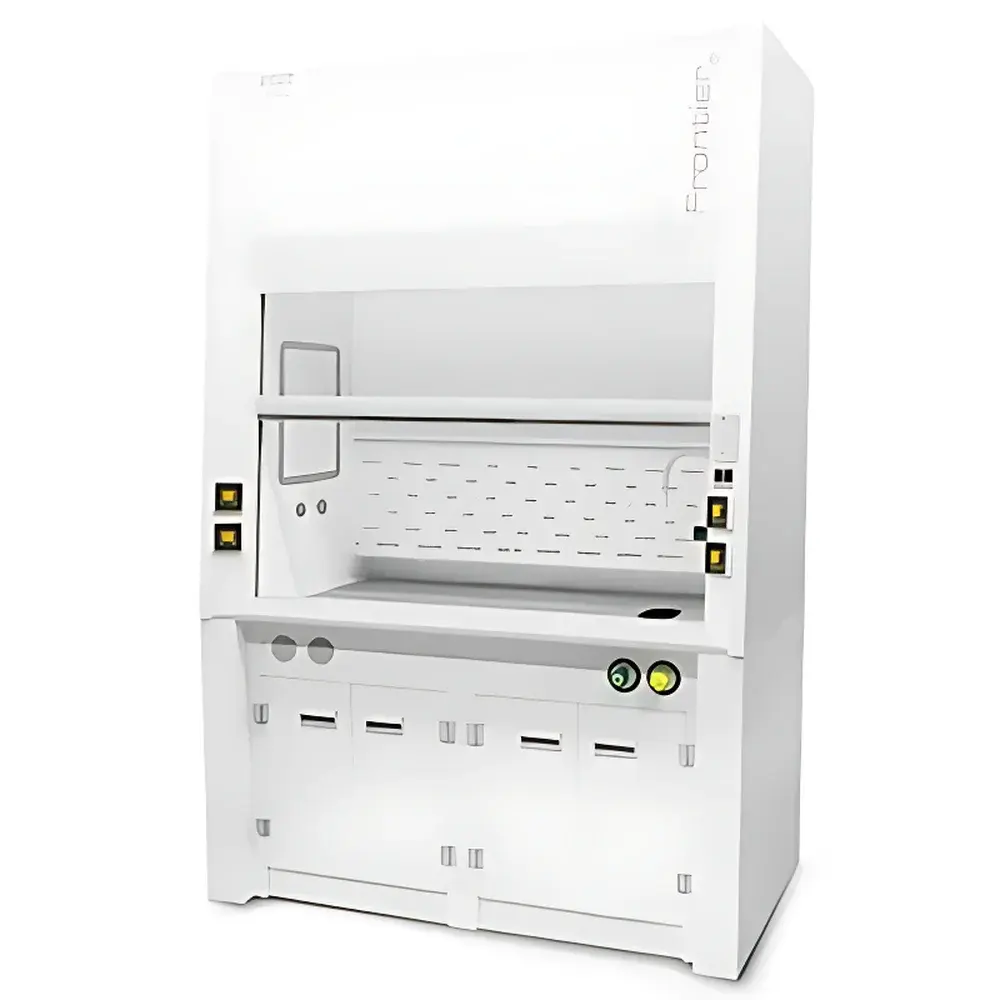
Esco Frontier PPH Polypropylene Fume Hood
| Brand | Esco |
|---|---|
| Origin | Singapore |
| Manufacturer Type | Original Equipment Manufacturer (OEM) |
| Product Category | Imported Laboratory Equipment |
| Model | PPH-4UDPVW-8 / PPH-5UDPVW-8 / PPH-6UDPVW-8 / PPH-8UDPVW-8 |
| Construction Material | Full Polypropylene (PP), Metal-Free |
| Configuration | Single-Sided Front Access Fume Hood |
| External Width Options | 1200 mm, 1525 mm, 1830 mm, 2440 mm |
| Internal Depth | 665 mm |
| Internal Height | 1200 mm |
| Work Surface | Acid/Alkali-Resistant PP |
| Sash Type | Vertical or Combined Vertical-Horizontal |
| Sash Material | Tempered Polycarbonate |
| Sash Opening Angle | 5° Forward Tilt |
| Face Velocity | 0.5 m/s (meets ASHRAE 110 & EN 14175 requirements) |
| Power Supply | 220–240 VAC, 50/60 Hz |
| Optional | Sentinel XL Airflow Monitoring System with Digital Display and Audiovisual Alarms |
Overview
The Esco Frontier PPH Polypropylene Fume Hood is an engineered solution for laboratories requiring rigorous chemical containment in highly corrosive or metal-sensitive environments. Designed around a monolithic polypropylene architecture—free of all metallic components—the hood eliminates risks of catalytic interference, ion leaching, or galvanic corrosion during trace metal analysis, semiconductor processing, or aggressive acid/base handling. Its operational principle relies on laminar, low-velocity airflow (0.5 m/s face velocity) guided by aerodynamically optimized internal geometry—including multi-perforated baffle plates, streamlined winglet inlet vents, and a conical PP exhaust canopy—to achieve high-efficiency contaminant capture without energy-intensive variable-air-volume (VAV) infrastructure. Certified to ASHRAE 110-2016 and EN 14175-3:2021 performance standards, the PPH series delivers reproducible containment across full sash travel (including fully open position), validated via tracer gas testing under worst-case thermal and dynamic load conditions.
Key Features
- Metal-free construction: Entire enclosure—including chassis, liner, work surface, baffles, and ducting interface—is fabricated from stress-relieved, UV-stabilized polypropylene, ensuring compatibility with HF, aqua regia, fuming nitric acid, and other ultra-corrosive reagents.
- Energy-efficient containment: Maintains ≥99.9% containment efficiency at 0.5 m/s face velocity—even with sash fully raised—eliminating need for complex VAV systems while reducing HVAC load by up to 40% versus conventional stainless steel hoods.
- Perfect Pitch Profile: 5° forward-tilt sash design improves operator ergonomics, enhances visual field depth, and minimizes parallax error during precision manipulations.
- Multi-perforated baffle system: Strategically distributed apertures direct airflow into a single, unified exhaust path—reducing turbulence and increasing capture velocity uniformity across the work plane.
- Streamlined winglet inlet vents: Optimized curvature prevents vortex formation at the hood perimeter, stabilizing inflow dynamics and suppressing eddy-driven recirculation zones.
- Tempered polycarbonate sash: Impact-resistant, optically clear vertical or combined vertical-horizontal configuration with smooth linear actuation; maximum open height: 790 mm (31.1″).
- Modular service integration: One pair of external utility valves (gas/liquid) pre-installed; up to four additional service ports configurable at factory or on-site.
- Tool-free service access: Removable baffle panels, side liners, and rear backing plates enable rapid decontamination, maintenance, or reconfiguration without specialized tools.
Sample Compatibility & Compliance
The PPH series is validated for use with volatile organic compounds (VOCs), halogenated solvents, strong mineral acids (e.g., HCl, HNO₃, H₂SO₄, HF), alkalis (e.g., NaOH, KOH), and reactive hydrides. Its non-conductive, non-catalytic surface prevents electrochemical interference in ICP-MS, AAS, and trace elemental analysis workflows. All models comply with ISO 15195:2018 (laboratory accreditation for analytical testing), meet GLP/GMP environmental control requirements, and support FDA 21 CFR Part 11-compliant audit trails when integrated with Sentinel XL monitoring data logs. Structural integrity is certified per ASTM D5947-19 (dimensional stability) and ISO 178 (flexural modulus ≥1,200 MPa).
Software & Data Management
When equipped with the optional Sentinel XL Airflow Safety Monitoring System, the PPH hood provides real-time digital readout of face velocity, sash position, and alarm status via a front-panel LCD. The system records timestamped airflow events (±0.01 m/s resolution) with automatic export to CSV or XML formats. Data logging supports 30-day local storage and integrates with enterprise LIMS platforms via Modbus RTU or Ethernet/IP protocols. Audit trail functionality complies with 21 CFR Part 11 Annex 11 requirements, including user authentication, electronic signatures, and immutable event history.
Applications
- Trace metal analysis laboratories performing EPA Method 200.7, ISO 17294-2, or ASTM D5673 where metallic contamination must be below detection limits (e.g., <0.1 ng/L).
- Pharmaceutical QC labs handling cytotoxic agents or potent APIs requiring ISO Class 5–7 background air quality.
- Electroplating R&D facilities using cyanide-based baths or fluoroboric acid electrolytes.
- University teaching labs conducting undergraduate chemistry experiments with concentrated acids or solvent distillations.
- Microelectronics fabrication cleanrooms requiring acid-resistant enclosures for wafer etching stations.
FAQ
Does the PPH hood require a dedicated VAV system to maintain safe face velocity?
No. The hood is engineered to meet ASHRAE 110 containment criteria at a constant 0.5 m/s face velocity across its full sash range—including fully open—without VAV control.
Can the work surface withstand exposure to hydrofluoric acid?
Yes. The stress-relieved polypropylene work surface exhibits no visible degradation after continuous 72-hour immersion in 48% HF at 25°C, per ASTM D543-20 testing.
Is the Sentinel XL system compatible with existing building management systems (BMS)?
Yes. Sentinel XL supports BACnet MS/TP, Modbus TCP, and OPC UA protocols for seamless integration into third-party BMS or SCADA environments.
What is the expected service life of the polycarbonate sash under normal laboratory use?
Under ISO 4892-2 UV exposure cycling and ASTM D1003 haze testing, the sash maintains >90% optical clarity and impact resistance for ≥10 years with routine cleaning using isopropanol and soft lint-free cloths.
Are replacement baffles and liners available as spare parts?
Yes. All internal modular components—including baffles, side liners, rear panels, and exhaust canopy—are cataloged as field-replaceable units (FRUs) with standardized part numbers and 48-hour global logistics support.



