
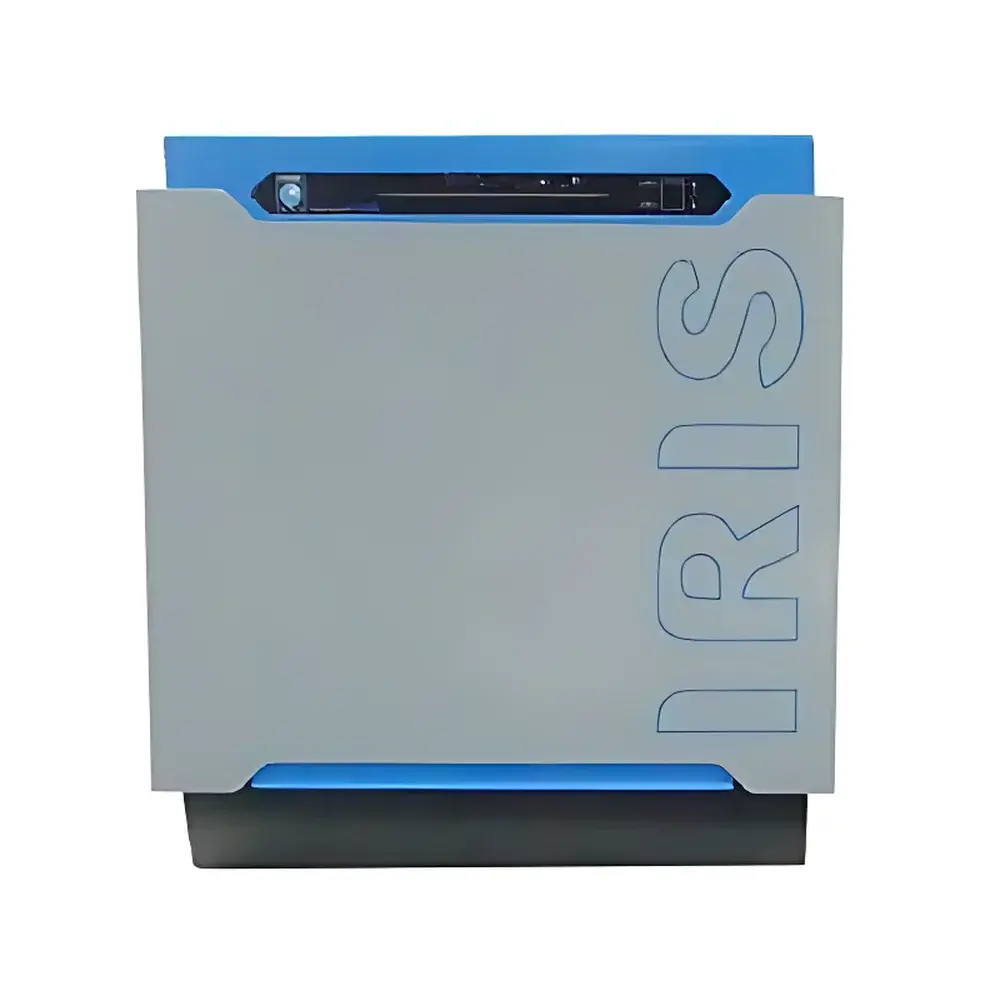
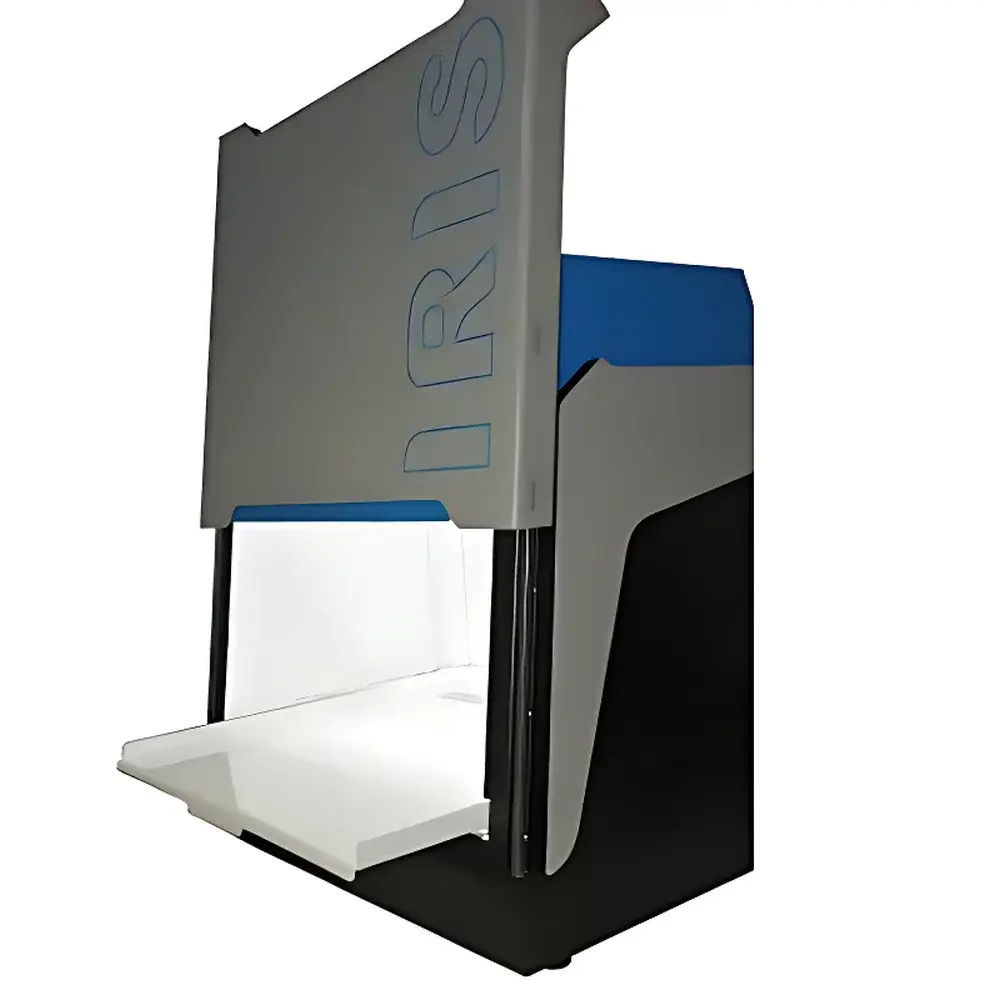
Alpha MOS IRIS Vision Analyzer for Color and Shape Analysis
| Brand | Alpha MOS |
|---|---|
| Origin | France |
| Model | IRIS |
| Type | Benchtop Color & Shape Analyzer |
| Optical Geometry | d/8° Integrating Sphere |
| Product Category | Color Difference Meter |
| Compliance | Designed for ISO 11664, CIE No. 15, ASTM E308, and GLP/GMP-aligned workflows |
| Software Platform | Unisensory Suite v5.x (FDA 21 CFR Part 11 compliant audit trail, electronic signatures, data integrity controls) |
Overview
The Alpha MOS IRIS Vision Analyzer is a benchtop optical measurement instrument engineered for objective, quantitative assessment of color and geometric attributes in consumer products, foodstuffs, pharmaceuticals, and industrial materials. Unlike conventional colorimeters or spectrophotometers that report single-point or averaged chromatic values, the IRIS employs a high-resolution digital imaging system housed within a light-tight enclosure with precisely calibrated d/8° integrating sphere illumination. This architecture ensures uniform, geometry-independent irradiance across heterogeneous surfaces—critical for reproducible evaluation of textured, granular, or irregularly shaped samples. The system captures full-field spatial data in CIE L*a*b*, RGB, and grayscale domains, enabling pixel-level analysis of chromatic heterogeneity, surface topology, and morphological features without physical contact or sample preparation.
Key Features
- Full-field imaging-based metrology: Simultaneous acquisition of color distribution, shape descriptors (area, perimeter, circularity, aspect ratio, convexity), and surface texture metrics across the entire sample field-of-view.
- d/8° integrating sphere illumination: Complies with ISO 11664-4 and CIE Publication 15:2018, minimizing directional bias and ensuring robustness against gloss, surface roughness, and orientation variability.
- No-sample-prep operation: Enables rapid, non-destructive analysis of intact, unaltered specimens—including powders, tablets, confectionery, fresh produce, and composite packaging—without grinding, dilution, or mounting.
- Multi-sample throughput mode: Supports sequential placement of up to six discrete samples per measurement cycle via programmable stage positioning and auto-focus calibration.
- Traceable data architecture: Each image and derived parameter set is time-stamped, user-logged, and stored with full metadata (illuminant, observer angle, white reference, exposure settings) in accordance with ALCOA+ principles.
Sample Compatibility & Compliance
The IRIS accommodates flat, convex, or mildly curved samples up to Ø150 mm × 50 mm height, with no minimum mass or homogeneity requirements. It is routinely deployed in quality control laboratories operating under ISO/IEC 17025, FDA 21 CFR Part 11, and EU GMP Annex 11 frameworks. Its measurement traceability is anchored to NIST-traceable ceramic tile standards (e.g., BCRA Series II) and validated per ASTM D2244 (color difference), ASTM E1708 (imaging colorimetry), and ISO 13655 (spectral measurement geometry). All firmware and software updates undergo formal change control and version-locking to support regulatory audits.
Software & Data Management
Controlled by Unisensory Suite v5.x, the IRIS provides a secure, role-based interface supporting method templates, statistical process control (SPC) charting, batch trending, and comparative benchmarking against internal standards or competitor references. Raw TIFF images and processed CSV/Excel exports retain full bit-depth (12-bit per channel) and spatial resolution (≥3.2 MP). Audit trails log every user action—including parameter modification, result deletion, and report generation—with immutable timestamps and digital signature capture. Data encryption at rest and in transit meets HIPAA and GDPR technical safeguards.
Applications
- Color stability monitoring across shelf life (e.g., oxidation-induced browning in snacks, photodegradation in coatings).
- Batch-to-batch consistency verification for tablets, capsules, and lyophilized vials per USP <1092>.
- Defect detection: Cracks, discoloration zones, foreign particulates, or coating non-uniformity in real-time QC lines.
- Particle size and shape distribution analysis in dry blends, catalysts, or excipients without sieving or sedimentation.
- Consumer perception correlation studies linking instrumental color/shape metrics to sensory panel scores.
- Process validation: Quantifying visual impact of drying temperature, extrusion speed, or mixing time on final product appearance.
FAQ
Does the IRIS require annual recalibration?
Yes—recommended annually using certified reference tiles and documented per ISO/IEC 17025 Clause 6.5. Calibration certificates include uncertainty budgets per ISO/IEC 17025:2017 Annex A.
Can it analyze transparent or translucent samples?
Yes, with optional backlit illumination module (sold separately); standard configuration uses front-diffuse illumination optimized for opaque and semi-opaque surfaces.
Is remote access supported for multi-site deployments?
Unisensory Suite supports secure HTTPS-based remote monitoring and method synchronization across geographically distributed labs, with TLS 1.2+ encryption and configurable firewall policies.
How is compliance with 21 CFR Part 11 enforced?
Through mandatory electronic signatures for critical actions, automatic audit trail generation, and system-generated reports verifying data integrity, user authentication logs, and change history—all exportable in PDF/A-2b format.
What file formats are natively supported for export?
TIFF (raw image), CSV (quantitative metrics), XLSX (summary reports), XML (LIMS integration), and PDF/A-2b (validated reports).



