
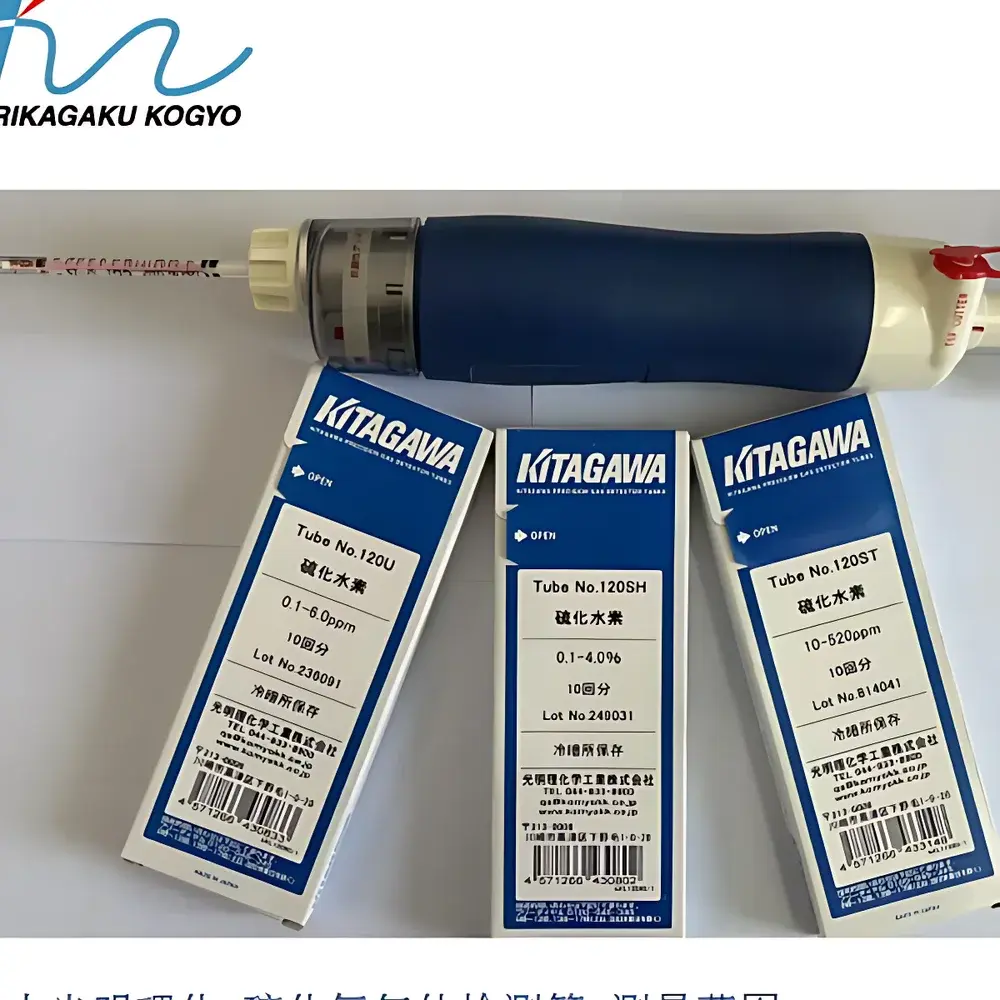
Kitaoka K-120 Series Hydrogen Sulfide (H₂S) Colorimetric Gas Detection Tubes
| Brand | Meiko Rikka |
|---|---|
| Origin | Japan |
| Manufacturer Type | Authorized Distributor |
| Origin Category | Imported |
| Models | 120SB, 120SC, 120SD, 120SE, 120U, 120SH, 120SM, 120SF, 120ST, 120UT, 120UH |
| Detection Range | 0.1–3.0 ppm to 5–40% v/v (model-dependent) |
| Tube Format | 10 tubes/box (standard), 2 tubes/box (R.SH dual-range) |
| Measurement Principle | Colorimetric reaction with pre-impregnated reagent |
| Required Accessory | AP-20 manual piston pump |
Overview
The Kitaoka K-120 Series Hydrogen Sulfide (H₂S) Colorimetric Gas Detection Tubes are precision-engineered, single-use analytical devices designed for rapid, on-site quantification of hydrogen sulfide in ambient air, industrial exhaust streams, confined spaces, and emergency response scenarios. Based on the well-established colorimetric diffusion principle—where H₂S gas diffuses through a calibrated glass tube and reacts stoichiometrically with immobilized reagents (typically lead acetate or cadmium sulfate derivatives)—the resulting color front advances proportionally to concentration and sampling volume. The measurement is read directly from the graduated scale etched on the tube wall, eliminating dependence on electronics, power sources, or calibration gases. Each tube is factory-sealed under inert atmosphere to ensure shelf stability and batch-to-batch reproducibility. Designed in strict accordance with JIS K 0804 (Japanese Industrial Standard for Gas Detection Tubes) and compatible with ISO 8573-1 Annex B methodology for qualitative/semi-quantitative gas screening, the K-120 series serves as a primary field verification tool prior to confirmatory laboratory analysis (e.g., GC-PID or ion chromatography).
Key Features
- Multi-range coverage: 11 distinct models enable seamless selection across six orders of magnitude—from ultra-trace (0.1 ppm) to high-concentration (40% v/v) H₂S detection.
- Interchangeable compatibility: All K-120 tubes are mechanically and volumetrically standardized for use with the AP-20 dual-stroke manual pump (100 mL per stroke), ensuring consistent draw volume and minimizing operator-induced variability.
- No external power or consumables required: Fully passive operation eliminates battery dependency, explosion risk, or need for zero gas—critical for Class I Division 1 hazardous locations.
- GLP-aligned documentation: Each box includes lot-specific certificate of analysis referencing raw material traceability, expiration date (typically 24 months from manufacture), and reference method validation data per JIS Z 8015.
- Robust physical design: Borosilicate glass construction with fused silica frits ensures mechanical integrity during field handling and prevents reagent migration or channeling.
Sample Compatibility & Compliance
The K-120 tubes are validated for use in clean, dry air matrices at temperatures between 5–40 °C and relative humidity ≤85% RH (non-condensing). Cross-sensitivity studies confirm minimal interference from common co-contaminants including CO, CO₂, SO₂ (≤50 ppm), NH₃ (≤10 ppm), and hydrocarbons below LEL thresholds. For applications involving high humidity, particulate-laden, or acidic gas streams, optional pre-filters (e.g., Kitaoka PF-1 moisture trap or PF-3 acid scrubber) are available. Regulatory alignment includes compliance with OSHA 29 CFR 1910.120 (HAZWOPER) for initial hazard assessment, NIOSH Manual of Analytical Methods (NMAM) Method 6013 for H₂S screening, and EU Directive 2017/164/EU establishing indicative occupational exposure limit values (IOELVs). Data generated meets ALARP (As Low As Reasonably Practicable) justification requirements for risk-based decision making under ISO 45001.
Software & Data Management
As a manual, analog measurement system, the K-120 series does not incorporate embedded firmware or digital output. However, quantitative results are fully compatible with electronic lab notebook (ELN) integration via structured manual entry or barcode-assisted logging using companion mobile applications (e.g., Kitaoka TubeScan™ iOS/Android). Each tube lot number is traceable to production batch records archived for ≥10 years per JIS Q 9001:2015 clause 8.5.2. Audit trails—including user ID, sampling location (GPS-tagged via mobile device), date/time stamp, and observed color front position—are exportable in CSV or PDF format to support FDA 21 CFR Part 11–compliant environments when paired with validated ELN platforms.
Applications
- Confined space entry pre-testing (sewers, tanks, digesters) per OSHA 1926.1207.
- Routine stack monitoring in biogas upgrading facilities and pulp/paper mills.
- Emergency response triage during H₂S leaks in oil & gas upstream operations.
- Verification of scavenger efficiency in amine treatment units.
- Educational demonstrations of gas diffusion kinetics and stoichiometric reaction fronts.
- QA/QC spot checks in wastewater treatment plant headworks and lift stations.
FAQ
What is the shelf life of unopened K-120 tubes?
Unopened tubes retain accuracy for 24 months from the date of manufacture when stored at 15–25 °C in original packaging, away from direct sunlight and organic solvent vapors.
Can K-120 tubes be reused after partial aspiration?
No. Each tube is a single-use, quantitative endpoint device; re-use invalidates calibration and introduces carryover risk. Discard immediately after reading.
How does temperature affect measurement accuracy?
Readings taken outside 5–40 °C require correction per JIS K 0804 Annex D. A ±10% deviation in indicated concentration occurs per 10 °C deviation from 25 °C baseline.
Is training required for compliant use?
Yes. Users must complete competency-based instruction covering pump technique, endpoint interpretation, environmental correction, and record-keeping per ISO/IEC 17025:2017 clause 6.2.3. Certificate of training is recommended for audit readiness.







