
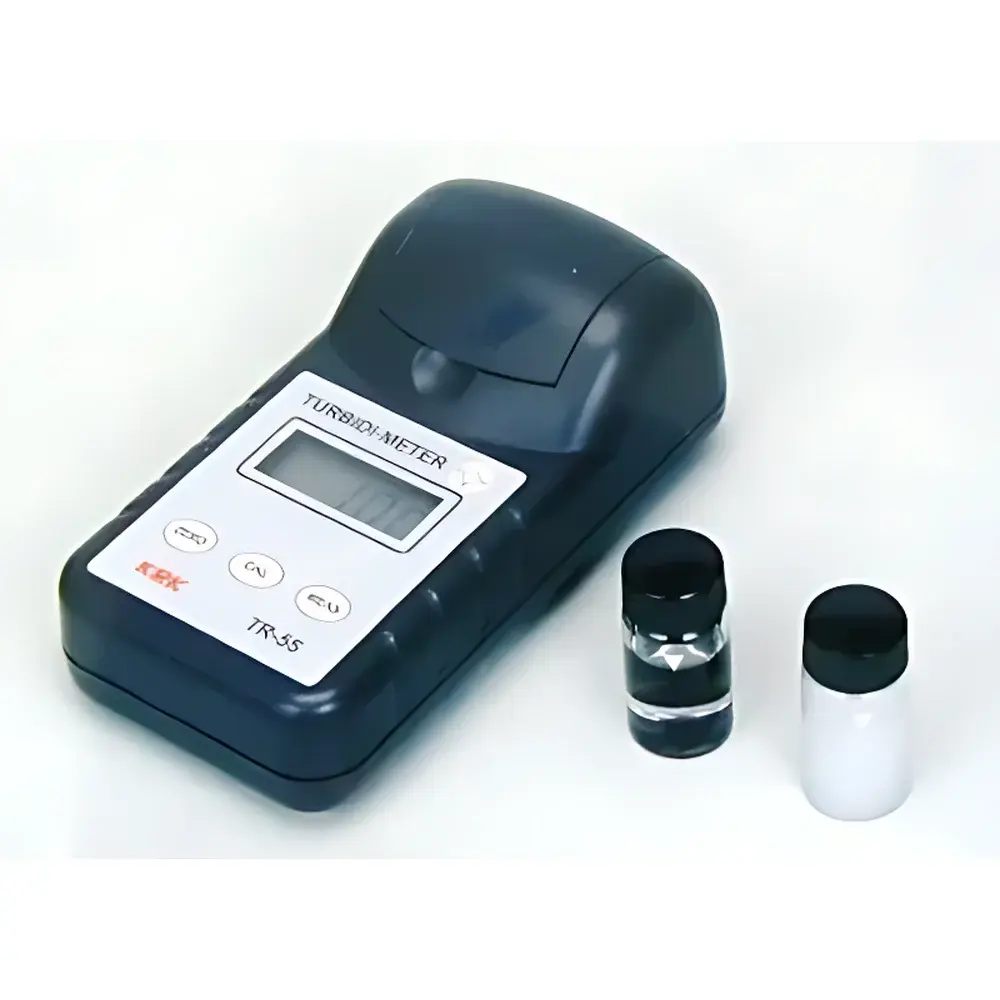
CLCU-55 Portable Chloride Ion Photometer for Copper Plating Bath Analysis
| Brand | Rikari Chemical |
|---|---|
| Origin | Japan |
| Model | CLCU-55 |
| Instrument Type | Portable |
| Measurement Principle | 90° Scattering Photometry |
| Detection Range | 0.0–199.9 mg/L Cl⁻ |
| Resolution | 0.1 mg/L |
| Accuracy | ±2% of reading |
| Repeatability | ≤±5% FS |
| Response Time | <5 s (after power-on), measurement cycle ≈3 min |
| Display | LCD with 0.1 mg/L resolution |
| Power Supply | 4× AA alkaline batteries (DC 6 V) |
| Dimensions | 88(W)×174(D)×65(H) mm |
| Weight | ~310 g |
| Calibration | Zero calibration standard + span calibration using CLCU-RC/CLCU-RA reagents |
| Self-Diagnostic Functions | Battery voltage monitoring, LED degradation warning, calibration error detection |
Overview
The CLCU-55 Portable Chloride Ion Photometer is an engineered solution for rapid, field-deployable quantification of chloride ion (Cl⁻) concentration in acidic copper electroplating baths—specifically sulfate-based electrolytes used in PCB manufacturing and semiconductor interconnect plating processes. Unlike classical titration or ion-selective electrode (ISE) methods, the CLCU-55 employs a fixed-angle (90°) scattering photometric principle optimized for turbidimetric chloride determination in high-conductivity, low-pH environments. The instrument measures light scatter intensity generated by the formation of silver chloride (AgCl) colloidal precipitates upon reaction between sample chloride and standardized silver nitrate–reagent complexes (CLCU-RA/CLCU-RC). This optical endpoint detection eliminates subjective endpoint interpretation, operator-dependent technique variability, and time-consuming volumetric calculations—enabling consistent, technician-level execution without laboratory-grade training.
Key Features
- True portable architecture: Compact form factor (88 × 174 × 65 mm), lightweight design (~310 g), and battery-powered operation (4× AA, DC 6 V) support in-line process monitoring at plating tanks, bath replenishment stations, or QC checkpoints.
- Dedicated photometric optics: Fixed 90° scattering geometry minimizes interference from suspended solids, bath additives (e.g., brighteners, levelers), and Cu²⁺ background absorption—critical for stability in real-world plating solutions.
- High-resolution digital display: 0.1 mg/L resolution across full 0.0–199.9 mg/L range ensures precise tracking of critical Cl⁻ thresholds (typically 30–100 mg/L in acid copper baths) where deviations directly impact deposit ductility, throwing power, and micro-throwing power.
- Automated operational safeguards: Built-in self-diagnostic routines continuously monitor LED emitter output stability, battery voltage decay, and calibration integrity—flagging out-of-spec conditions before data acquisition begins.
- Minimal calibration burden: Requires only zero-point calibration (reagent blank) and optional span calibration using supplied CLCU-RC (5 g) and CLCU-RA (100 mL) reagent kit—eliminating need for multi-point standard curves or external calibration standards.
- Robust environmental tolerance: Sealed optical chamber and corrosion-resistant housing ensure reliable performance in humid, chemically aggressive electroplating shop environments.
Sample Compatibility & Compliance
The CLCU-55 is validated for direct analysis of clarified or filtered samples from sulfuric acid–copper sulfate plating baths (pH 0.5–2.0, Cu²⁺ ≤ 250 g/L, H₂SO₄ ≤ 220 g/L). It is not intended for raw wastewater, seawater, or high-chloride industrial effluents outside its specified matrix. While not certified to ISO/IEC 17025, the methodology aligns with ASTM D512-20 (Standard Test Method for Chloride Ion in Water) principles for turbidimetric chloride determination. Instrument firmware supports GLP-compliant recordkeeping when paired with optional external data loggers; audit trails for calibration events and measurement timestamps comply with internal QC documentation requirements under IATF 16949 and IPC-4552A Annex B for electroplated copper verification.
Software & Data Management
The CLCU-55 operates as a standalone, embedded-system photometer with no onboard data storage or USB/Bluetooth connectivity. All measurements are displayed in real time on the integrated LCD and retained in memory for up to 5 seconds post-readout. For traceable data capture, users integrate the device into existing LIMS or MES workflows via manual entry or barcode-scanned reagent lot tracking (CLCU-RA/CLCU-RC vials include serialized batch identifiers). Reagent shelf-life and calibration validity periods are documented per manufacturer’s CoA, supporting FDA 21 CFR Part 11–aligned procedural controls when deployed in regulated production environments.
Applications
- Real-time monitoring of chloride concentration in acid copper plating baths to maintain optimal Cl⁻ levels (typically 40–80 mg/L) for uniform grain refinement and reduced nodulation.
- Troubleshooting bath contamination events—e.g., accidental chloride ingress from rinses, anode bag leakage, or impure copper sulfate additions.
- Verification of bath maintenance protocols including carbon treatment efficacy and drag-out loss compensation.
- Supporting IPC-4552A Clause 7.3.2 requirements for periodic chloride verification in high-reliability PCB fabrication lines.
- On-site validation of supplier-provided copper sulfate purity specifications prior to tank make-up.
FAQ
What sample preparation is required before measurement?
Samples must be filtered through a 0.45 µm membrane filter to remove particulates that could interfere with turbidity-based scatter detection. No dilution or pH adjustment is needed for standard acid copper baths.
Can the CLCU-55 measure chloride in nickel or chromium plating baths?
No. The optical algorithm and reagent chemistry are specifically calibrated for sulfate-copper matrices. Interference from Ni²⁺, Cr⁶⁺, or complexing agents invalidates results in non-copper systems.
How often should span calibration be performed?
Span calibration is recommended daily for high-volume production use or after every 20 measurements under GMP-aligned QC protocols; zero calibration is required before each measurement session.
Is the CLCU-55 compliant with RoHS or REACH regulations?
Yes. All electronic components, housing materials, and reagents (CLCU-RA/CLCU-RC) meet EU RoHS Directive 2011/65/EU and REACH SVHC screening criteria, with full declarations available upon request.
What is the expected lifetime of the LED light source?
The high-stability 625 nm LED emitter is rated for ≥10,000 hours of operational life under typical intermittent usage, with built-in diagnostics to alert users of luminous decay exceeding ±5% tolerance.
Related Products







