
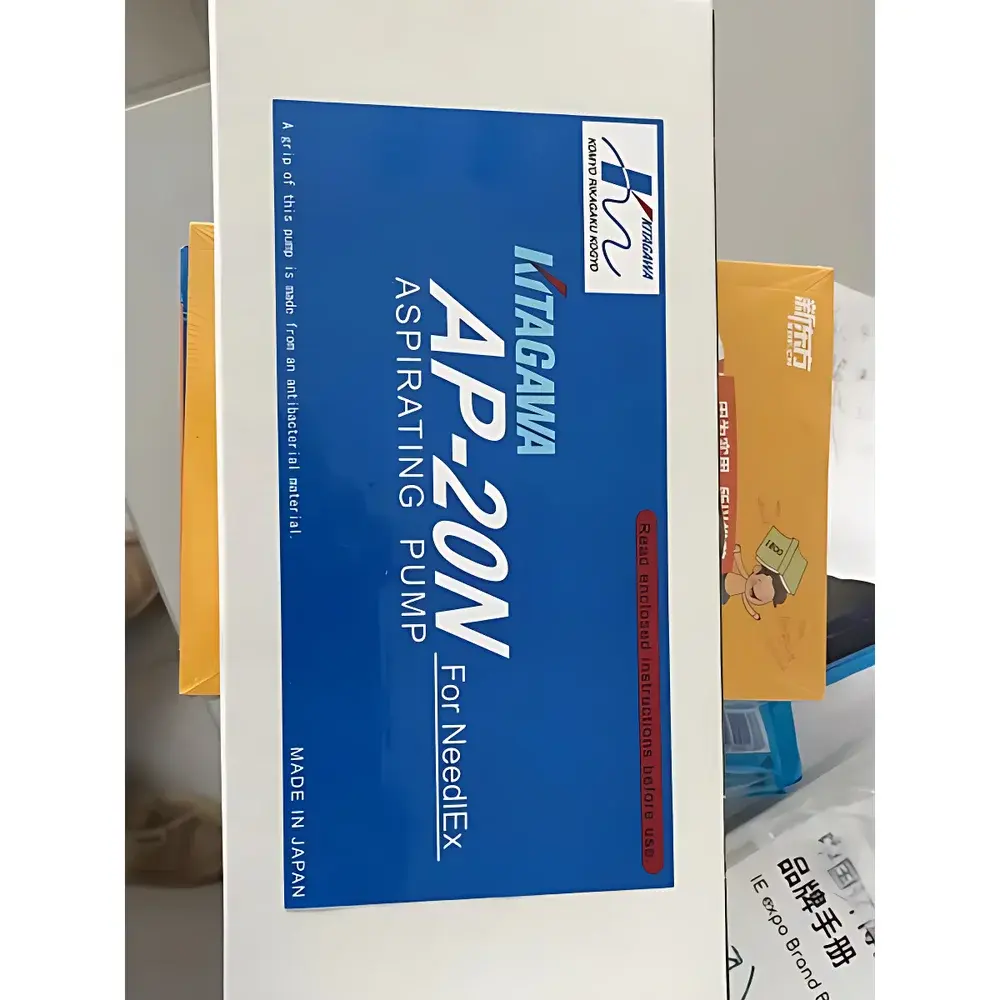
Kita-Kawa AP-20N Portable Single-Channel Gas Sampling Pump for GC Analysis
| Brand | Kōmyō Rikka (Komyo Rikka) |
|---|---|
| Origin | Japan |
| Model | AP-20N |
| Instrument Type | Handheld Air Sampling Pump |
| Configuration | Single-Channel Gas Sampler |
| Flow Rate Range | 2 L/min |
| Sample Volume Settings | 10 mL, 50 mL, 100 mL |
| Construction Material | Blue Antimicrobial Polymer Housing |
| Compatible With | GC Needle Extractors (e.g., Needle EX series) |
| Suitable For | Volatile Organic Compounds (VOCs) including gasoline vapors, kerosene fumes, fatty acids, floral volatiles, and organic solvents |
Overview
The Kita-Kawa AP-20N is a precision-engineered, handheld single-channel gas sampling pump designed explicitly for integration with gas chromatography (GC) sample introduction systems—particularly needle-type extractors such as the Needle EX series. Operating on a constant-flow principle, the AP-20N delivers a stable and calibrated volumetric flow rate of 2 L/min, enabling reproducible collection of gaseous analytes into fixed-volume sampling loops or sorbent tubes prior to thermal desorption or direct injection. Its compact, ergonomic design and antimicrobial polymer housing make it suitable for field-deployable environmental monitoring, laboratory-based method development, and routine quality control workflows where trace-level VOC quantification is required. Unlike general-purpose air pumps, the AP-20N is optimized for compatibility with micro-scale GC inlet configurations, minimizing dead volume and adsorptive losses during transfer.
Key Features
- Stable 2 L/min volumetric flow output with mechanical flow regulation—no external power supply or flow controller required.
- Three preset sample volume settings (10 mL, 50 mL, and 100 mL) actuated via tactile rotary selector, ensuring repeatable draw cycles without manual timing.
- Chemically resistant blue antimicrobial high-molecular-weight polymer housing—resistant to hydrocarbon vapors (e.g., gasoline, kerosene), carboxylic acid vapors, and polar organic solvents commonly encountered in environmental and fragrance analysis.
- Low dead-volume internal pathway (< 0.8 mL) and inert wetted path (fluoropolymer-sealed diaphragm and PTFE tubing interface) to preserve sample integrity and prevent carryover.
- Integrated pressure relief valve and backflow prevention mechanism to protect downstream GC injectors from overpressure or reverse contamination.
- Ergonomic grip and integrated belt clip for hands-free operation during extended field sampling campaigns.
Sample Compatibility & Compliance
The AP-20N is validated for sampling volatile and semi-volatile organic compounds (VOCs/SVOCs) across diverse matrices, including ambient air, headspace above liquid fuels, plant-emitted terpenes, and industrial solvent vapors. It meets functional requirements outlined in ASTM D5466 (Standard Test Method for Determination of VOCs in Ambient Air by GC), ISO 16000-6 (Indoor Air – Part 6: Determination of Volatile Organic Compounds), and EPA TO-17 (Determination of Volatile Organic Compounds in Ambient Air Using Active Sampling Onto Sorbent Tubes). While not a certified calibration standard itself, the AP-20N’s consistent flow performance supports GLP-compliant data generation when used with traceable flow calibrators (e.g., primary bubble meters or electronic calibrators per ISO 5725). Its construction materials comply with RoHS Directive 2011/65/EU and do not contain restricted phthalates or halogenated flame retardants.
Software & Data Management
The AP-20N operates as a standalone electromechanical device with no embedded firmware or digital interface. As such, it does not require software drivers, cloud connectivity, or proprietary configuration tools. All operational parameters are manually selected and mechanically locked. This analog architecture ensures long-term reliability, eliminates cybersecurity exposure, and simplifies audit readiness in regulated environments (e.g., ISO/IEC 17025-accredited labs). Users maintain full traceability through manual logbooks or LIMS-integrated sampling records that document date/time, location, volume setting, target analyte class, and associated GC method ID. For laboratories operating under FDA 21 CFR Part 11 requirements, the AP-20N may be included in instrument qualification protocols (IQ/OQ) as a “non-configurable ancillary device,” with verification focused on flow accuracy and volume repeatability per defined SOPs.
Applications
- Active sampling of gasoline and kerosene vapors for fuel composition profiling and evaporation loss studies.
- Headspace sampling of plant tissues or cut flowers to characterize volatile organic compound emissions (e.g., limonene, linalool, methyl salicylate) in ecological or horticultural research.
- Field collection of ambient VOCs near industrial sites, landfills, or transportation corridors for subsequent GC–MS analysis per EPA Method TO-15.
- Controlled dosing of standardized VOC mixtures into GC calibration systems using precise 10–100 mL draw volumes.
- Method validation support for ISO 16000-9 (determination of formaldehyde and other carbonyls) when paired with DNPH-coated sorbent cartridges.
FAQ
Is the AP-20N compatible with all GC needle extractors?
It is specifically engineered for use with the Needle EX series of GC-compatible extractors; compatibility with third-party needle systems requires verification of port diameter, sealing geometry, and maximum allowable backpressure.
Does the AP-20N require periodic recalibration?
Yes—while inherently stable, flow rate should be verified at least quarterly using a NIST-traceable primary calibrator, especially after extended field use or exposure to condensable vapors.
Can the AP-20N be used for sampling corrosive gases such as HCl or Cl₂?
No—the internal elastomers and housing polymers are not rated for strong acids or oxidizing gases; it is intended exclusively for organic vapors and neutral ambient air.
What maintenance is recommended for long-term reliability?
Replace the inlet filter every 50 hours of cumulative operation; inspect the diaphragm seal annually or after 2000 actuation cycles; store with desiccant in a low-humidity environment.
Is there an explosion-proof version available?
No—the AP-20N is not intrinsically safe and must not be operated in classified hazardous locations (e.g., Class I, Division 1); alternative ATEX-certified pumps are required for such applications.







