
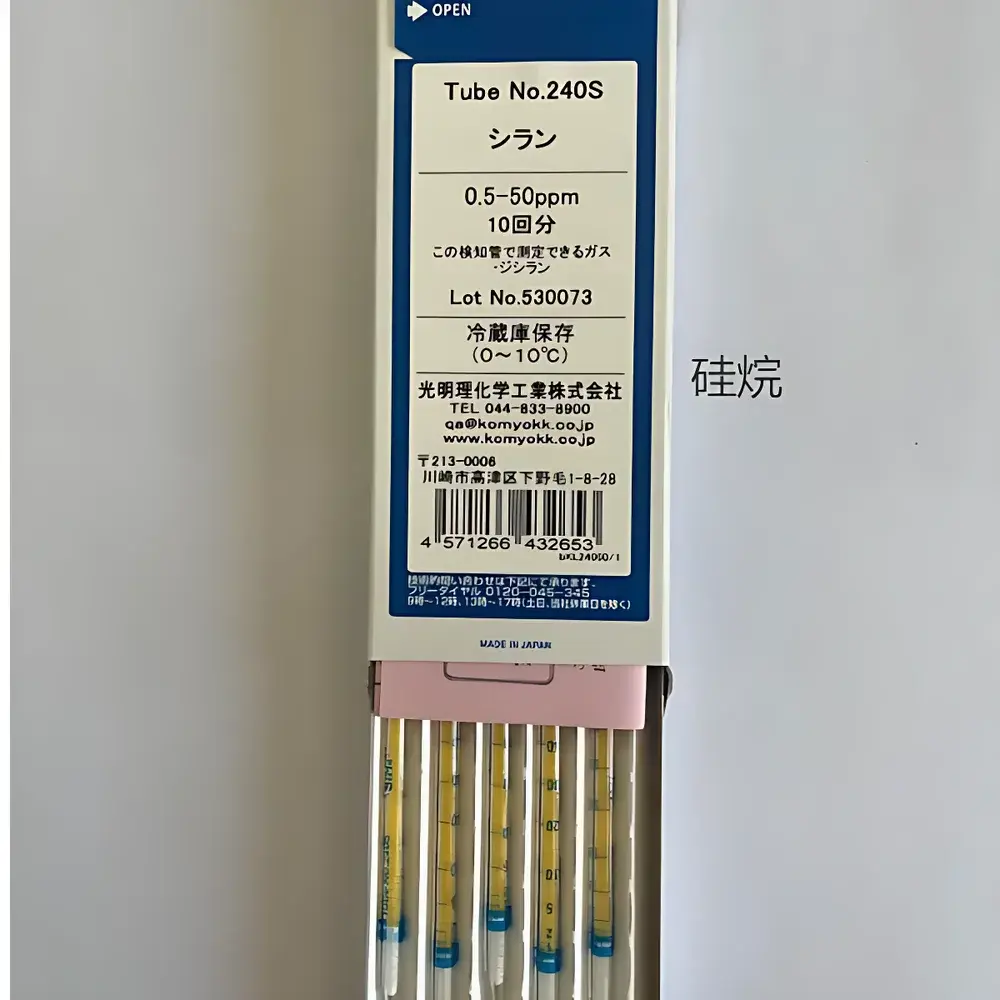
KOMYO RIKAGAKU North川-Type n-Butane Gas Length-Comparison Detection Tube (Model 221SA)
| Brand | KOMYO RIKAGAKU |
|---|---|
| Origin | Japan |
| Model | 221SA |
| Detection Range | 500–6,000 ppm n-Butane |
| Principle | Colorimetric Reaction with Graduated Scale |
| Compatible Pump | AP-20 Hand Pump |
| Portability | Handheld, No Power Required |
| Safety Rating | Intrinsically Safe for Flammable Atmospheres |
Overview
The KOMYO RIKAGAKU North川-Type n-Butane Gas Detection Tube (Model 221SA) is a single-use, colorimetric length-comparison tube engineered for rapid, on-site quantification of n-butane vapor in ambient air. Based on the classical North川 (Kitagawa) principle—developed by Dr. Shigeru Kitagawa in post-war Japan—the tube employs a precisely impregnated reagent layer inside calibrated glass tubing. When a fixed volume of sampled air (typically 100 mL, drawn manually using the AP-20 pump) passes through the tube, n-butane reacts stoichiometrically with the immobilized chemical reagent (typically palladium chloride or iodine-based oxidant systems), generating a discrete, sharp color front. The length of the stained zone, measured directly against the pre-etched scale on the tube wall, correlates linearly to the target gas concentration within the specified range of 500–6,000 ppm. This method requires no electrical power, calibration gases, or software—making it uniquely suited for emergency response, confined space entry verification, leak screening, and field-based industrial hygiene assessments where intrinsic safety and operational immediacy are critical.
Key Features
- Intrinsically safe operation: No spark sources, batteries, or heating elements—certified for use in Class I, Division 1 hazardous locations per JIS Z 8803 and IEC 60079-0 guidelines.
- Fixed-volume sampling: Designed exclusively for use with the KOMYO AP-20 double-stroke hand pump (100 mL stroke volume, ±3% volumetric accuracy), ensuring reproducible draw volume and minimizing operator-induced variability.
- Stable shelf life: Tubes retain performance specifications for ≥24 months when stored at 10–30°C in original sealed packaging; lot-specific expiration dates and calibration traceability provided on each box.
- High selectivity for n-butane: Minimal cross-sensitivity to isobutane, propane, or common hydrocarbon solvents—validated per ASTM D6262-20 for interference testing under controlled challenge gas mixtures.
- Robust mechanical design: Borosilicate glass construction (OD 6 mm, length 130 mm) with abrasion-resistant scale printing and hermetically sealed ends to prevent reagent degradation during transport or storage.
Sample Compatibility & Compliance
The 221SA tube is validated for use with ambient air samples collected at temperatures between −10°C and +40°C and relative humidity up to 95% RH (non-condensing). It complies with Japanese Industrial Standard JIS K 0201 (Gas Detection Tubes – General Rules) and aligns with ISO 8573-1:2010 Annex C for qualitative/semi-quantitative field screening methods. While not intended for regulatory compliance reporting under OSHA 29 CFR 1910.120 or EPA Method IP-1A, it serves as a Tier 1 screening tool consistent with NIOSH Manual of Analytical Methods (NMAM) Chapter 1000 guidance for preliminary hazard identification. Each production lot undergoes batch certification against reference n-butane standards traceable to NMIJ (National Metrology Institute of Japan).
Software & Data Management
This detection tube operates independently of digital infrastructure. No firmware, drivers, or proprietary software are required. Quantitative results are recorded manually in field logs or integrated into digital inspection platforms (e.g., EHS management systems) via standardized entry templates. For audit readiness, KOMYO provides Certificate of Analysis (CoA) per lot number, including batch-specific calibration curves, uncertainty budgets (<±12% at mid-range), and GLP-aligned manufacturing documentation. Optional barcode-labeled packaging supports traceability in GMP-aligned facilities performing routine leak checks per FDA 21 CFR Part 211.192.
Applications
- Emergency response: Rapid assessment of n-butane release from LPG infrastructure, tanker incidents, or refinery fugitive emissions.
- Industrial hygiene: Routine monitoring near butane-handling equipment (extraction units, solvent recovery systems, aerosol propellant lines).
- Maintenance verification: Pre-entry clearance testing in tanks, vessels, or piping prior to hot work or confined space entry.
- Environmental site assessment: Screening for subsurface hydrocarbon migration in soil gas or vapor intrusion investigations.
- Training and education: Hands-on demonstration of gas-phase reaction kinetics and stoichiometric detection principles in occupational safety curricula.
FAQ
What is the shelf life of Model 221SA tubes, and how should they be stored?
Unopened tubes maintain accuracy for 24 months from date of manufacture when stored between 10°C and 30°C in original packaging, away from direct sunlight and volatile organic vapors.
Can this tube be used with pumps other than the AP-20?
No. Only the KOMYO AP-20 pump delivers the precise 100 mL draw volume and flow profile required for valid length-comparison interpretation. Substitution invalidates stated accuracy and voids compliance with JIS K 0201.
Does humidity affect measurement accuracy?
Results remain within ±15% of nominal value up to 95% RH at 25°C; beyond 95% RH, condensation may impair reagent integrity and color front formation.
Is calibration required before each use?
No. The tube is factory-calibrated; users must verify pump functionality and observe strict adherence to the two-stroke draw protocol defined in the AP-20 operating manual.
How is measurement uncertainty determined for this tube?
Expanded uncertainty (k=2) is ±12% at 3,000 ppm, derived from inter-lot reproducibility, pump volume tolerance, endpoint reading variance, and reference standard uncertainty—documented in the CoA for each production batch.







