
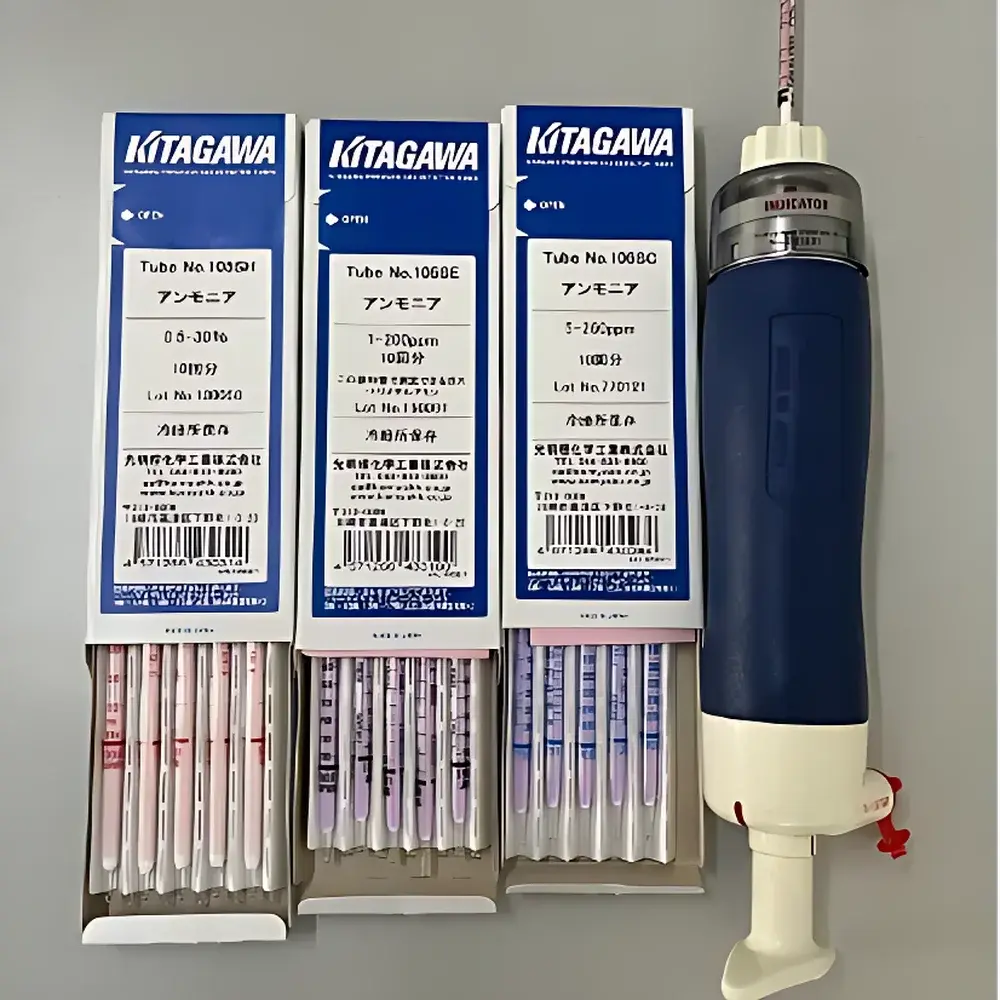
Kitaoka Vinyl Chloride Quick-Test Gas Detection Tubes (Model 132SB & 132SC)
| Brand | Meikou Rikagaku |
|---|---|
| Origin | Japan |
| Type | Imported |
| Models | 132SB, 132SC |
| Detection Range (132SB) | 5–500 ppm |
| Detection Range (132SC) | 0.1–12 ppm |
| Sample Volume | 100–400 mL |
| Response Time | ≤90 sec per 100 mL |
| LOD (132SC, 400 mL) | 0.05 ppm |
| Color Change (132SB) | White → Red-Orange |
| Color Change (132SC) | Straw-Yellow → Peach |
| Operating Temperature | 0–40 °C (temperature correction required) |
| Humidity Effect | None |
| Pressure Correction | Required (ppm × 1013 hPa ÷ actual pressure) |
| Reaction Chemistry | 132SB: CH₂=CHCl + PbO₂ → Cl₂ |
| 132SC | CH₂=CHCl + CrO₃ + H₂SO₄ → HCl |
Overview
The Kitaoka Vinyl Chloride Quick-Test Gas Detection Tubes (Models 132SB and 132SC) are single-use, colorimetric diffusion tubes engineered for rapid, on-site quantification of vinyl chloride (CH₂=CHCl) in ambient air, workplace atmospheres, and emergency response scenarios. Based on the standardized North American and Japanese “detector tube” methodology—widely accepted under ASTM D5402 and JIS K 0121—these tubes operate via fixed-bed chemical reaction principles: gaseous vinyl chloride diffuses through a calibrated glass tube packed with reagent-impregnated silica gel, inducing a stoichiometric color development proportional to concentration. The 132SB variant employs lead dioxide (PbO₂) oxidation, yielding a white-to-red-orange transition over 5–500 ppm; the 132SC variant utilizes chromium trioxide–sulfuric acid chemistry, producing a straw-yellow-to-peach change across an extended low-range scale (0.1–12 ppm), optimized for occupational exposure assessment near OSHA PEL (1 ppm TWA) and ACGIH TLV (1 ppm STEL). Both models comply with ISO 8518:2021 (gas detection tubes — performance requirements and test methods) and are validated for use in GLP-aligned field monitoring programs where trace-level VOC verification is required without laboratory instrumentation.
Key Features
- Two-tiered detection capability: 132SB for high-concentration screening (5–500 ppm); 132SC for regulatory-compliant low-level monitoring (0.1–12 ppm, LOD = 0.05 ppm at 400 mL draw)
- Integrated visual endpoint indicator: Built-in red pop-up marker on compatible hand pumps (e.g., Gastec ACCU-100 or Dräger Accuro) confirms precise 100 mL sampling volume—critical for reproducible calibration
- Temperature-corrected quantification: Supplied correction tables (0–40 °C, referenced to 20 °C) enable accurate conversion from observed ppm to true concentration per ISO 8518 Annex B
- Pressure compensation protocol: Enables field adjustment using local barometric pressure (ppm × 1013 hPa ÷ measured hPa), essential for high-altitude or variable-pressure environments
- Robust interference profiling: Documented cross-sensitivity matrix (e.g., HCl, Cl₂, halogenated hydrocarbons cause positive bias; ethylene and acetylene induce slight negative bias) supports method validation per EPA Method TO-17 guidance
- Stable shelf life: 24 months from manufacture when stored at 15–25 °C in original sealed packaging; no refrigeration required
Sample Compatibility & Compliance
These tubes are validated for vinyl chloride analysis in undiluted ambient air, indoor workplace air, and post-decontamination headspace. The 132SC configuration also supports multi-gas screening—including chlorotoluenes (o-, m-, p-), 1,1-dichloroethylene, allyl chloride, and 1,3-dichloropropane—with individual calibration factors provided (e.g., chlorotoluene = 5.27 mg/m³ per ppm). No pre-concentration, thermal desorption, or solvent extraction is needed. All tubes meet JIS K 0121 Class A accuracy requirements (±25% recovery at mid-range), satisfy OSHA 1910.120(q) emergency response instrumentation criteria, and are routinely deployed in EPA Region 4 Superfund site vapor intrusion assessments. They are not intended for continuous monitoring or use in explosive atmospheres (ATEX/IECEx certification not applicable).
Software & Data Management
As analog, manual-read devices, these detection tubes require no firmware, drivers, or proprietary software. Quantitative results are recorded manually in field logbooks or digital ELN systems (e.g., LabArchives, Benchling) compliant with 21 CFR Part 11 when paired with timestamped operator signatures and photo documentation of color bands. Calibration verification is performed quarterly using certified vinyl chloride gas standards (NIST-traceable, 10 ppm in nitrogen). Audit trails must include temperature/pressure correction inputs, pump calibration certificates, and lot-specific expiration tracking—fully aligned with ISO/IEC 17025 clause 7.7 (sampling) and AIHA LAP accreditation requirements for industrial hygiene labs.
Applications
- Occupational health monitoring during PVC resin handling, vinyl chloride monomer (VCM) transfer, and polymerization reactor maintenance
- Rapid leak detection in VCM storage tanks, railcar loading arms, and piping flanges per OSHA 1910.119 process safety management protocols
- Post-remediation verification at brownfield sites contaminated with chlorinated ethenes
- First-responder triage during transportation incidents involving VCM tankers (DOT Emergency Response Guidebook ERG #117)
- Field validation of fixed photoionization detector (PID) or FTIR sensor readings in confined-space entry programs
- Educational demonstrations of stoichiometric gas-phase redox reactions in analytical chemistry laboratories
FAQ
What is the shelf life and storage requirement?
24 months from date of manufacture when stored unopened at 15–25 °C in original foil pouch. Avoid direct sunlight and humidity >80% RH.
Can I use these tubes for personal sampling (e.g., badge-style)?
No. These are active-sampling devices requiring a calibrated hand pump; passive diffusion badges are not supported.
How do I correct for temperature and pressure?
Apply the supplied temperature correction factor table first, then multiply by (1013 hPa ÷ local barometric pressure) to obtain final ppm value.
Are there documented interferences I must report in my monitoring plan?
Yes. HCl, Cl₂, brominated compounds, and other halogenated VOCs produce positive bias. Ethylene (>400 ppm) and acetylene (>4% v/v) cause minor negative interference; document co-contaminant screening if suspected.
Is mg/m³ conversion mandatory for regulatory reporting?
Yes. OSHA and EU REACH require mass concentration units. Use the compound-specific conversion factor (vinyl chloride = 2.60 mg/m³ per ppm at 25 °C, 101.3 kPa).
Do these tubes meet GLP or GMP audit requirements?
They are routinely accepted in GLP studies when used within validated SOPs covering pump calibration, environmental correction, operator training, and raw data retention per OECD Principles of GLP §5.







