
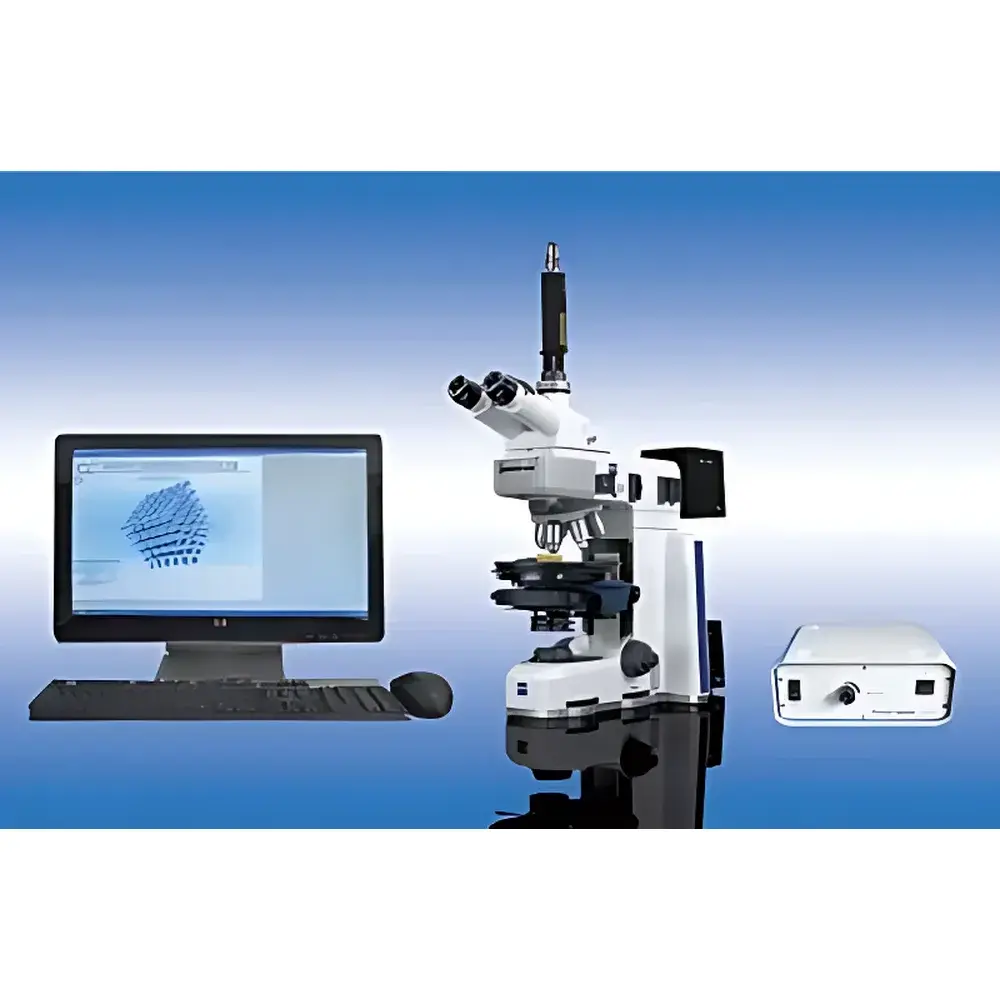
ZEISS MY5000 Research-Grade Digital Microscopic Coal Petrography Analysis System
| Brand | ZEISS |
|---|---|
| Origin | Germany |
| Model | MY5000 |
| Compliance | ASTM D2798, ISO 7404-5, GB/T 6948, USP <1058> (Instrument Qualification Framework) |
| Optical Platform | Polarizing Microscope with ICCS™ Optics |
| Photometer Core | PerkinElmer® High-Stability Photodiode Array (2003 Generation) |
| Measurement Aperture | 4 µm (centered & certified) |
| Data Acquisition Resolution | 1/65536 (16-bit ADC) |
| Auto-Focus | Motorized Objective Z-Drive with Real-Time Contrast Optimization |
| Stage Control | Precision Motorized XY Stage with Programmable Grid Navigation |
| Video Monitoring | Dual-Path HD Imaging Interface with Integrated Micrometer Scale |
| Temperature Compensation | Real-Time Reflectance Correction to 20 °C Reference |
| Reflectance Calibration | NIST-Traceable Certified Coal Standards (e.g., NIST SRM 29xx Series) |
| Software Compliance | 21 CFR Part 11–Ready Audit Trail, Electronic Signature, and Secure User Roles |
Overview
The ZEISS MY5000 Research-Grade Digital Microscopic Coal Petrography Analysis System is a fully integrated, ISO/IEC 17025-aligned instrumentation platform engineered for quantitative coal petrographic analysis in compliance with ASTM D2798 (Standard Test Method for Determination of Reflectance of Vitrinite), ISO 7404-5 (Coal and Coke — Methods of Petrographic Analysis — Part 5: Method of Determining the Reflectance of Vitrinite), and GB/T 6948 (Chinese National Standard for Coal Petrography). At its core, the system combines ZEISS’s industry-leading polarizing microscope architecture—featuring the patented ICCS™ (Improved Contrast and Color Stability) optical pathway—with a high-fidelity photometric detection subsystem based on a PerkinElmer® photodiode array optimized for low dark current (<0.1 pA), sub-millisecond thermal stabilization, and linearity deviation <±0.05% across the 0.2–3.0 %Ro reflectance range. The system operates on the fundamental principle of quantitative reflected-light microscopy: incident monochromatic illumination (546 nm ± 5 nm) is directed onto polished coal surfaces; vitrinite reflectance (%Ro) is determined via calibrated photometric integration of specularly reflected intensity, referenced against certified standards traceable to NIST SRM 29xx series. This physical measurement underpins coal rank classification, maceral group quantification, maturity assessment in petroleum source rock evaluation, and forensic identification of blended or adulterated coals.
Key Features
- ICCS™-optimized polarizing optics with flat-field, apochromatically corrected objectives (5× to 100×), wide-field binocular observation tubes, and motorized rotating compensator integrated with analyzer for precise retardation control.
- PerkinElmer® photometric detection module featuring a 4 µm-diameter, optically centered measurement aperture—validated per ASTM D2798 Annex A2—and thermally stabilized detector housing ensuring <0.005 %Ro/°C drift.
- 16-bit high-speed data acquisition system (1/65536 resolution) with hardware-level noise suppression, adaptive digital filtering (FIR + median), and electromagnetic shielding compliant with IEC 61326-1 for laboratory EMC environments.
- Motorized precision XY stage with programmable grid navigation, configurable point/line spacing (10–100 µm increments), and automatic sample area mapping for statistically representative sampling (≥10,000 measurement points per standard assay).
- Real-time auto-focus system employing contrast-gradient optimization at each measurement location—eliminating operator-dependent focus error and enabling reproducible reflectance values independent of surface topography.
- Integrated dual-path HD video interface with on-screen micrometer scale, permitting remote monitoring and positional verification without ocular use—critical for GLP-compliant audit trails and multi-user lab environments.
- Temperature-compensated reflectance algorithm converting raw measurements to standardized 20 °C reference state using embedded thermistor network and empirically derived correction coefficients per coal lithotype.
Sample Compatibility & Compliance
The MY5000 system is validated for polished coal and coke specimens prepared per ASTM D2797 and ISO 7404-2, including bituminous, sub-bituminous, lignitic, and anthracitic ranks; inertinite-rich cokes; and kerogen-bearing sedimentary rocks. It supports simultaneous acquisition of vitrinite reflectance (%Ro) and maceral composition (vitrinite, inertinite, liptinite) within a single automated scan sequence. All measurement protocols conform to regulatory frameworks governing energy resource characterization: full alignment with ASTM D2798 (repeatability ≤0.02 %Ro, reproducibility ≤0.05 %Ro), ISO 7404-5 (inter-laboratory CV <2.5%), and Chinese GB/T 6948-2018. Instrument qualification follows USP guidelines, with documented IQ/OQ/PQ protocols available. Data integrity meets FDA 21 CFR Part 11 requirements through role-based access control, immutable audit logs, electronic signatures, and secure database encryption.
Software & Data Management
The proprietary ZEISS CoalPetro™ software suite provides end-to-end workflow automation—from stage navigation and auto-focus calibration to statistical distribution modeling and regulatory reporting. Key modules include: Reflectance Distribution Analyzer (RDA) for bimodal/multimodal peak deconvolution (Gaussian-Lorentzian fitting); Maceral Classifier using supervised machine learning trained on >50,000 expert-annotated images; Blend Ratio Calculator applying both upper/lower limit bounding and curve stripping algorithms per ISO 11760 Annex B; and OTI (Optical Texture Index) Engine compliant with ISO 7404-3. All datasets are stored in an ACID-compliant relational database with hierarchical metadata tagging (sample ID, preparation lot, analyst, instrument log, environmental conditions). Export options include CSV, Excel (.xlsx), Word (.docx), and PDF reports with embedded spectral plots and histogram overlays. Raw reflectance spectra and focus validation logs are retained for full traceability—supporting internal QA audits and external accreditation reviews (e.g., CNAS, UKAS).
Applications
- Coal Rank & Type Classification: Automated assignment of coal rank (lignite → anthracite), coal type (e.g., vitrain, durain), and international coding (ASTM D388, ISO 11760) using reflectance distribution morphology (number of inflection points, skewness, kurtosis).
- Blend Authentication & Quantification: Discrimination of single vs. blended coals via reflectance distribution fingerprinting; calculation of blend ratios using statistically robust curve-stripping methods validated against known binary mixtures.
- Coke Quality Assessment: Automated porosity analysis (pore count ≥5 µm, wall thickness, pore size distribution) per ISO 11760 Annex D; optical texture index (OTI) derivation for blast furnace performance prediction.
- Petroleum Source Rock Evaluation: Vitrinite maximum reflectance (Rmax) determination via automated stage rotation and extinction search; kerogen maceral typing (Type I–IV) and TOC correlation modeling.
- Geological Correlation: Cross-section matching of coal seams using Ro isorank contours and maceral assemblage ratios—enabling paleogeographic reconstruction and thermal history modeling.
FAQ
What standards does the MY5000 comply with for vitrinite reflectance measurement?
The system conforms to ASTM D2798, ISO 7404-5, GB/T 6948, and ISO 11760 for methodology, calibration, and reporting—fully supporting interlaboratory comparability and regulatory submission.
How does the system handle temperature-induced reflectance drift?
An embedded thermistor network continuously monitors specimen temperature; reflectance values are dynamically corrected to the 20 °C reference state using coal-specific empirical coefficients derived from NIST-traceable calibration datasets.
Can the software distinguish between natural coal blends and adulterated samples?
Yes—the Reflectance Distribution Analyzer identifies multimodal distributions characteristic of mechanical blending; statistical outliers and non-Gaussian tailing indicate potential adulteration, triggering automated flagging per ISO 11760 Annex C.
Is the system qualified for GLP or GMP-regulated environments?
Yes—software includes 21 CFR Part 11-compliant audit trail, electronic signature, and user-role management; hardware undergoes annual PQ per USP , with documentation packages provided for inspection readiness.
What is the minimum detectable pore size for coke porosity analysis?
The system resolves pores ≥5 µm in diameter with sub-pixel centroid localization accuracy (±0.3 µm), generating histograms of pore size, wall thickness, and spatial clustering metrics per ISO 11760 Annex D.




